
Subscribe to the Women of Color Rise podcast
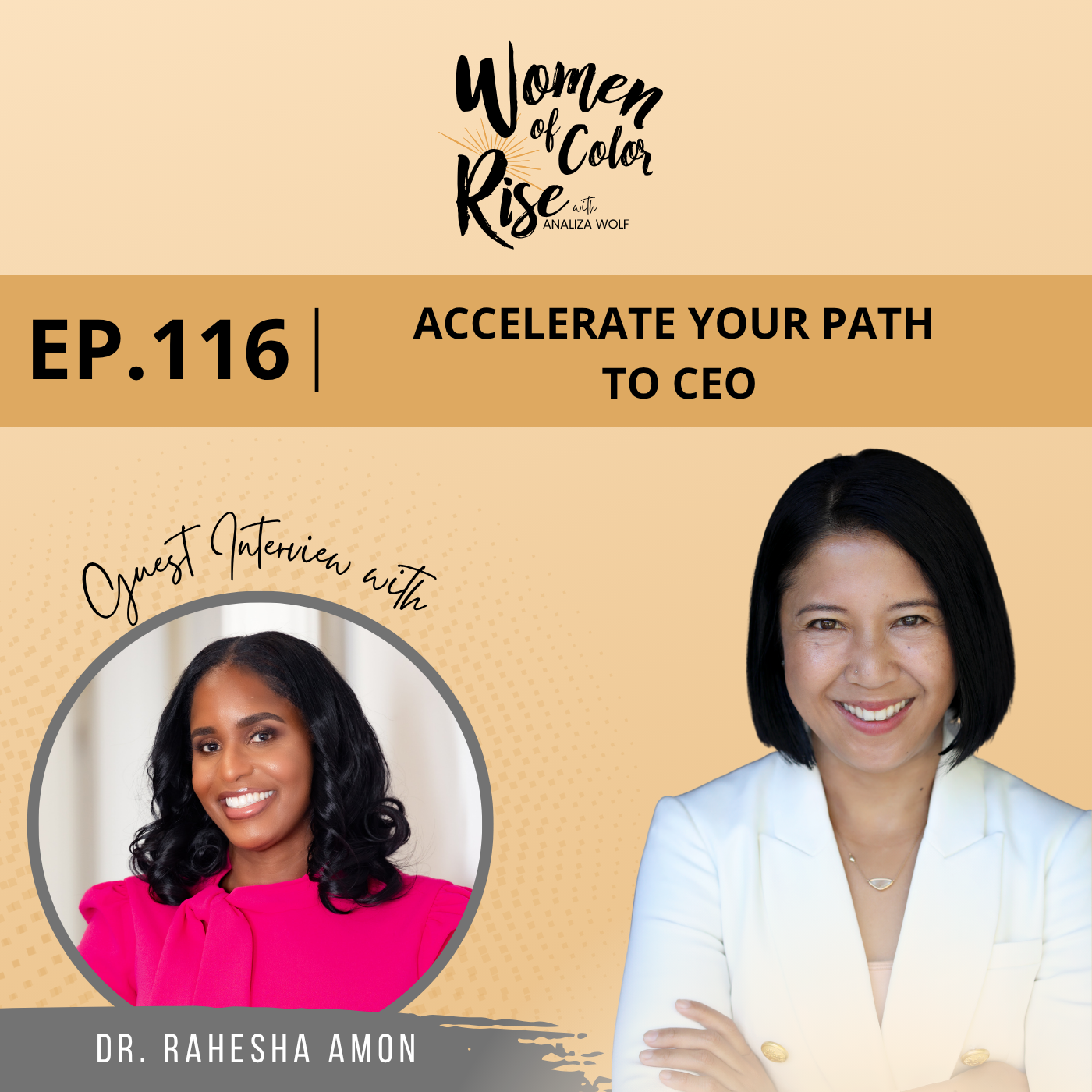
Episode 116 - Accelerate Your Path to CEO with Dr. Rahesha Amon, CEO of City Teaching Alliance
Women of Color Rise supports more diverse leaders at the table, especially women and people of color. We’ll be talking with CEOs and C-suite women leaders of color and learning about their leadership journeys.
How can you accelerate your path to CEO?
In this episode of Women of Color Rise, I speak with Dr. Rahesha Amon—award-winning career educator, Google GSV Fellowship alumna, and CEO of the national nonprofit City Teaching Alliance. With more than 25 years of leadership experience, Rahesha has served as teacher, coach, early childhood director, assistant principal, principal of Frederick Douglass Academy, and Senior Executive Director of School Support and Operations at the NYC Department of Education before stepping into her current role.
Growing up as a fourth-generation New Yorker and proud Black woman, Rahesha never envisioned herself as a CEO—she dreamed of being an actress and even entered college as a pre-med major. Yet her journey through education, her all-girls school experience, and her community’s encouragement helped her find her voice, build confidence, and ultimately lead at the highest levels.
She shares powerful lessons for anyone aspiring to lead and make an impact:
Stand in your identity. Own your full self—whether that’s as a woman, a person of color, a New Yorker, or all three. Authenticity builds strength.
Trust the process. Growth takes time. Both successes and failures are teachers, so don’t rush your journey.
Build your toolkit. Beyond degrees, seek fellowships, programs, and experiences that stretch your thinking and skills.
Create your personal board of directors. Cultivate mentors, thought partners, and advocates who believe in you and will speak your name in rooms of opportunity.
Believe in yourself. Know your worth, look to the light, and draw inspiration from those who came before you—whether that’s Harriet Tubman’s persistence, Assata Shakur’s strength, or Coretta Scott King’s grace.
Through her resilience, intentional growth, and unwavering belief in education as a civil right, Rahesha has become a transformational leader. Her story reminds us that with identity, faith, and community, we can accelerate our path to CEO and beyond.
Analiza and Rahesha discuss:
Background of Rahesha Amon
Rahesha shares her identity as a Black woman and a proud New Yorker, emphasizing the cultural diversity and experiences that have shaped her.
Rahesha discusses her initial career aspirations, including her desire to be an actress and her academic journey, which included a pre-med major at North Carolina Central University.
She reflects on the challenges and experiences that led her to her current role, including the impact of her all-girls school education and the support from her family.
Impact of All-Girls School Education
Rahesha explains the significance of her all-girls school education, which fostered her confidence and voice as a Black woman.
She describes the academic rigor and the supportive environment that helped her thrive despite being one of few Black girls in the predominantly white school.
Rahesha shares a memorable experience of being questioned by a teacher about her ability to learn French, which highlighted the racial and gender biases she faced.
She emphasizes the importance of the all-girls school in helping her find her voice and develop a strong sense of identity.
Leadership Journey and Overcoming Stereotypes
Rahesha discusses her early leadership roles, including being class president in elementary school, and how these experiences shaped her confidence.
She reflects on the challenges of being a Black woman in leadership roles and the stereotypes she faced, particularly in her early career.
Rahesha shares her strategies for overcoming these challenges, including focusing on her achievements and the support from her personal and professional networks.
She emphasizes the importance of standing firm in her identity and not allowing others' perceptions to affect her confidence and leadership.
Advice for Aspiring Leaders
Rahesha advises aspiring leaders to be themselves and not compare themselves to others, emphasizing the unique gifts and strengths each individual has.
She highlights the importance of intentional learning and seeking out opportunities for growth and development.
Rahesha stresses the value of building a personal and professional network of mentors, advocates, and thought partners.
She encourages aspiring leaders to trust the process, have faith, and be resilient in the face of challenges and failures.
Resources:
Book: Harlem Rhapsody by Victoria Christopher Murray
Connect with this Leader:
Want more balance, joy, and fulfillment in your life today? Get a FREE self-care guide to Juice Your Joy!
Download and enjoy Analiza's Free Gift: Juice Your Joy.
In this bonus: You’ll learn about the age-old Japanese practice of ikagai, get a reflection sheet to identify areas that can bring you joy and how this can be part of your daily practice, and be inspired by real Boss Mamas who have transformed their lives.
Connect with Analiza Quiroz Wolf and Boss Mamas:
Website: analizawolf.com
LinkedIn (Analiza): www.linkedin.com/in/analizawolf/
LinkedIn (Women of Color Rise): www.linkedin.com/company/bossmamas
Facebook (Women of Color Rise): www.facebook.com/womenofcolorrise
Facebook (Analiza): www.facebook.com/analizaqwolf/
Instagram: www.instagram.com/analizawolf/
Youtube: www.youtube.com/analizawolf/
Join our next Boss Mama program!
Be part of an intimate group of other Bad Ass women like you to live the life you deserve - rocking at work, family, and self-care. More information here.
Nominate a Podcast Guest
Nominate a Podcast Guest (we do not take nominations over email):
Join Our Newsletter
Stay up to date on other Boss Mamas and get tips that work to get the balance, joyous, and fulfilling life you deserve. Sign up here.
Transcript
Hi everyone. I am so excited to have Dr. Rahesha Amon here. She's an award-winning career educator, executive Google GSV Fellowship alumni with more than 25 years of leadership experience. 2024. She joins Citi Teaching Alliance as CEO from New York City's DOE, where she most recently served as senior Executive Director of school support and operations.
Rahesha has been a teacher. She's been an educational coach, assistant director of early childhood, assistant principal, principal of Frederick Douglas Academy. I mean, the list goes on so many awards. In addition to her degree, she's got a doctoral degree from NYUA, master's degree in Educational Leadership from University, a bachelor's in Arts from North Carolina Central University.
Rahesha, I am so excited to have you here. Thank you for joining us.
Rahesha: Oh, it's my pleasure, Analiza. Thank you for having me.
Analiza: So Rahesha, I would love to start with the identity shared with us. How do you identify and how has that shaped your past?
Rahesha: Absolutely. Well, I always start with just being a black woman and then I add being the quintessential New Yorker.
I am proud to have been born and raised here, fourth generation New Yorker, and it is so much a part of the fabric of. Who I am. I always say growing up in New York is like studying cultural anthropology. You know, you have this opportunity to just engage with so many different people, right. and have so many different experiences. You know, layered with being a black woman in America, you know, has really shaped so much of who I am and, and how I see myself at this young age of 53.
Analiza: I mean, Rahesha, you look fabulous. My gosh. I need to guess then. So Raha, did you know you wanted to be CEO? Was that part of like young S's, dream of Yep, that's what I wanna be.
Rahesha: Absolutely not, Young Rahesha’s Dream never thought of Biggie Smalls always saying, I never thought, you know, life would take me this far not quoting him exactly, but absolutely not. I actually wanted to be an actress for a long time, you know, I really appreciated the arts. I'm so grateful to my mother who made sure I got to see Broadway shows, live theater, and opera.I mean, just so many opportunities to engage with. You know, the, I always call it like this magic between an audience and your ability to kind of convey. So for me, I thought I'd be like on this stage someplace I had the opportunity to attend Harlem School of the Arts and you know, where I took a piano and danced. And, you know, other artistic forms. I was actually in my school plays all of the time, in particular in elementary school and then somehow this academic piece, right? Like, I went to an all girls school, six through 12, and I wasn't necessarily like a theater kid, so I didn't see myself in that space. And this academic push became, you know, more prevalent and I heard kind of like that voice from the people in my community versus like this pathway maybe in the arts.And so I. You know, while I loved the arts and remained, I started to think about like, what else could I do? And from there, actually I thought I was gonna be pre-med, right? I loved the sciences. And so, really doubled down there actually was entering North Carolina Century University as a pre-med major thought I would be someone's doc. And funny fact, I remember sitting in my first biology class there. A young man said to me, what are you doing here? Like, you know, I don't know why you're here. Remember I went to an all girls school, so like this brand of being a girl, this brand of being able to achieve things and have, I always say all the worlds right? The family, the career, the husband was. Front and center. So right to, to have someone say that to me was off-putting. But it also made me kind of rethink, you know, is this what I wanna do or not? And so I had an interesting path. I had many majors in college. I often don't know how, but I still graduated in four years. But never did I think I'd be a CEO. Have I always been a leader? Yes, I was class president even in elementary school, which blows my mind when I look back, but never thought I'd be, you know, leading an organization or even serving in many of the roles I served in here in New York City during my 30 years of service.
Analiza: Rahesha, I wanna talk about this all girls school. I find that. Surprising, but also it makes sense because whenever I talk with you, it's with this empowerment, like, why don't other women, why don't other people of color have my mindset? And you've talked about, you know, your, your, the love that you received from your family growing up and how that was obviously very important and to learn that you also had an all girls educational experience for six years of your life. Can you, can you go into that? Because I don't have that background. I don't know if many listeners do. Why is that so formative? What is it like? Why would you ask me that strange question? I don't even know what you're talking about there.There's not even a doubt. Like this male said it and there was no like, oh, maybe he, it's true. You, it just never dawned on you. Can you talk about that and why the, the all girls and how that all girls experience fed into that?
Rahesha: I always thank my mother because, you know, while some of these experiences could seem polarizing right there, these extremes, right?I went to all girls schools six through 12, then I went to an historically black college, right? To others it could be perceived as being polarizing. But you know, I think one of the things that my mother does. Stood and which was clear. Attending the Ursuline School in New Rochelle is really about promoting you, first and foremost as a strong entity, right? Like really understanding yourself beyond the traditional norms that can be associated with gender. And that's even so many years after like women's liberation and the women's movement. And so what does that experience feel like? One, it is like removing the stress of anything around. What happens when the male gender learns alongside women? Right? So you know about the classroom and there's the t and teachers often teach to the T in an all girl setting. Teachers are teaching to everyone, right? Understanding that not only is it about academics, it's also about helping us find our voice in a world that may not see us the same, we're still fighting for equal pay for women, right? Compound that with being a black woman, right? It. For me was a space that allowed me to thrive first and foremost in my gender, but juxtaposed to it wasn't. Because it is a predominantly white environment. During the time I was in high school in the eighties, early eighties, during a time when we weren't talking about diversity, equity, inclusion, there weren't parents of color groups, right? So there still were a. Moments when, yes, I was embraced, right? Because I was a part of this gender affirming community, but at the same time, I was different as one of few black girls in this environment, right? So. For me, it was this battle almost, right? Like, oh, I love being a girl, but what does it mean to be a black girl here? Right? 'cause that was very different. I did have my French teacher in middle school say to me, you know, I'm not sure you know how you'll pick up the French language. I had only one. I took Italian in elementary school, still a romance language. So foundational. Some of the things were the same. But she said, you know, because you know, I know in your home they may not speak proper English. And you know, that was such a shock to me, right? Because I'm like, my mother's paying a lot of money for me to be here. I'm sure she's not expecting this to be said. Quite the opposite, like in my home, English was spoken properly and actually it was the opposite, right? You know, it was, you know, constantly reinforced. So it took me a long time, right? It wasn't until adulthood that I really appreciated it. And I would say like in my late twenties. Having the all girl experience, I actually went back this past March as one of their women's history guest, women's History Month guest speakers and you know, I spoke a lot about the intentionality around the branding that, you know, this all girls environment really inspires and.Actually, I think champions, you know, and what I've recognized is in my adult light, I've sought circles out that are gender based, right? So my sorority, women's groups that I'm a part of in education, right? leadership opportunities. I'm in one now, the women's executive leadership through cho, right?
I'm still in this older age, seeking out opportunities where my lived experience based on my gender, rights, and some of the things that come with that are central and focused. So I look back now, yes, there were some experiences about going to that all girls school, and I think more that's based on race than gender that weren't PLE pleasant. But what I learned is I found my voice. Right. I knew to always stand tall. My identity was not going to be shaped by being in a relationship with a man. Instead, it would compliment who I was. So there were many affirming lessons, and most importantly, academics were not competitive. Based on gender and competing with someone that a teacher may see should do better in biology or in chemistry.Academics were excellent and they were rigorous. Right? And the expectations that it was, that we all could and should and would.
Analiza: Rahesha, I can see how much this has shaped just the near career acceleration to be CEO. It would make sense. I mean, why wouldn't you? If you declare it, it's a possibility then, let's make it happen. So I wanna talk about that. You are. At the helm of an organization and you're leading, and yet people don't know your background, right? People don't have, they don't know what's in your head, and so I'm, I'm, bring us in, right? People see you and you are standing in your power. Very clear. Yet there's, there's imagine tension. I face tension, so I'm just projecting on you. Imagine there's tension, what people stereotype, even as a person inside your organization, I'm not even talking about outside. Can you talk about how you are? And also help people with their own mindset, because sometimes this happens with women of color, right? You're just, what are you projecting on me? Your own work? And so I, I'll give you a very open field here, but what's coming to mind as with your security and seeing others insecurities or projections? How do you handle that?
Rahesha: Yeah , I'm really less concerned about that at this stage in my life. And so the handling is very different.I don't really see it as an obstacle, right? Or something that I have to deal with. I've recognized, I mean, I've now been leading adults in this kind of salaried position since 1999, right? When I took my first administrative role,as an early childhood director. Here in Manhattan.And so I would say in my earlier stages of leadership, I definitely felt or even perceived right, that people were receiving me one. Obviously I'm black and I'm a woman. Right. And there are many stereotypes that come with that. And so often I would try to make sure I was the opposite of that. Right.And you probably suffered a lot from perfectionism. Right. Whereas as I've evolved and taken the time to really understand who I am, you know, the work. And the love that my family and my village has really poured into me. Like even, you know, my name is Isha Shawan. Amman. I mean, it's very meaningful and powerful.Sun Goddess of Light, my last name being very connected to Egyptology. There's a power that comes within me. Just from my naming. It was just a matter of me stepping into that power. So now how do I handle it? I just stand very firm. And who I am and what I know, showing up very authentically. Right.And so what I found is as I've gotten more confident, and it's again, at 53 years old, it has taken me some time. You know, I still feel like I'm that awkward girl. Like, you know, often when I walk into a new room, you know, I’m more of an observer. I am an only child, so. Step back before I step in. But in this role of CEO, it didn't matter to me what the perceptions were going to be, right? Because one, now I have a track record of success and receipts that I'm really proud of.There's a level of confidence that comes with achievement. There's also a level of confidence that comes from failure, right? Because I've learned. I've learned some, some really valuable lessons on this leadership journey, so I don't receive any of that any longer, right? I'm not staying up at night wondering what they think of my curly hair versus if I've decided to have my hair straight versus if I decide to wear braids, right? Those things aren't the things that are keeping me up. What keeps me up now is like, what's the impact I'm having, you know, as this leader? Am I showing up right? In my full self right to do this job well, and I don't see myself any longer as having to shrink. Right. Or having to worry about what you think about me based on your lived experience. And I kind of end here, you know, this is a national company, a national organization, a national enterprise with employees that represent. Over 23 states across our country. So people are coming to this work based on their own, as we spoke of, lived perceptions based on the geography in which they've, you know, existed. And so I recognize that that may come with maybe they've never interacted, right? With a black woman. Maybe they've never been led by a woman, right? Even in this space, maybe they've never been led by a New Yorker, right? So, there are so many things that I could have brought here that I am grateful that at this stage in my life, I'm able to say, look, you are a New Yorker. You are black and you are a woman, right? And so those are the things that people may know and see, but you are. Highly competent. Highly skilled. You are definitely a leader who is tuned in and who is caring and concerned about people and impact. And to me, even what's become most important is this is my life's work, right?I believe in the power of education. I believe that education is a civil right, and I believe that every school community deserves it. Talent, whether it be at the teacher assistant level, the teacher level, the assistant principal, school leadership or district leadership that is well prepared, that believes that all children can and will succeed and comes to work every day in that way.And so this to me, is about this mission, right, which allows me to, I don't wanna say separate. But not be anchored or centered in what other people think about me when they see me, hear my name, hear me speak instead of, let me put this forward. And yes, this is who I am, but this is what's important here.We can talk about the other things and we will, and we have to, but this is what's important, and I'm not owning your stuff.
Analiza: I'm not owning your stuff. I mean, I love, it's so wonderful to hear your story and foundation and the. The evolving of earlier in my career, yes, it was a question, but I'm very clear that I'm not going to live in your lived experience, although I will acknowledge that it's different, and yet I am in my power. I wanna talk about this, this mindset in terms of your, you know, you are, you are a CEO. It's so inspirational to hear you talk about how you are. You can look in the mirror and say, here's my identity and I'm highly competent, highly skilled, and stop with the receipts. So I wanna talk about that because getting to your level, you know, if I were, you know, I wanna be that, I wanna have that sort of conviction. And I'm wondering, is it, if you were to give advice right, to others who are really wanting this, will it really be mission driven as you are? But they're not there yet. And I'm curious, what would you say, would you say, you know, other than this, or maybe even double down on this, is there another mindset, skillset, just an emphasis in your leadership that you think has CATA helped to catapult you besides being badass, but like in addition, what would you say to give advice to someone who wants to be someone like you with the impact level of leadership and confidence?What would you tell them?
Rahesha: Well, I'd start with, when everyone says, someone says, be someone like me, well first be yourself, right? Mm-hmm. Like, you know, really just be yourself, because we are all so unique and Right. There are so many magical gifts that we each have, and I think that allows us to not get caught up in this comparison. Because then you're chasing your dream, you're chasing your light versus someone else's, right? And, and I always say being an only child like I was my own competition and still remain that. And then, Dr. Lizette Neves always says, trust the process. It takes like when you're in your twenties, like you, my faith is, you know, definitely at a stronger, firmer space now.But you would've, when people told me, trust the process in my twenties, I'm like, no, the process just feels so hard. Why is it taking so long? But everything that is happening to you is really for your good, right. Obviously there's some intentionality that has to come into like your thinking around your training, right? So when I say that, like I was intentional around the programs that I sought, you know, sought, right? Even my doctoral program being a part of a cohort of cross sectoral leaders. The opportunities to be a part of fellowships. You mentioned A-S-U-G-S-V, the Google Fellowship, but I've been in others. You know, innovation for equity. I've been a part of the Women of Color Educator Collaborative. Right? So I have constantly sought out opportunities to learn and grow. To, to really understand what I'm doing at the moment, but to also think about expanding. Right? My own current thought, I had the opportunity to be a part of the Sterling Network, and that is a group of 40 New Yorkers from actually a lot of them nonprofit spaces.But this is when I was in government and I was fascinated by this because I wanted to learn. Then this was. Probably nine years ago about nonprofits and how they work and, you know, what are, what are some of the ways in which they think about, this being their focus, right? So I say be intentional around your own learning, right?Beyond the degrees. What are the things that you need to add to your toolkit, right? So believing in yourself, trusting the process. I equate that to having great faith. Making sure that you're constantly strengthening your toolbox. And then this board of directors, I cannot thank the people who I call them my personal board of directors who have believed in me. And I'd start like with my fifth grade teacher, Mr. Fried who writes over at public school, 71 in the Bronx, who you know. Isha, you just, I need you to do this. He put me in these leadership roles, right? And roles that I didn't think about. Right. And you know, that kind of started my trajectory on this class presidency. But from that moment on, I mean, early on I recognized the power of relationships and staying close to people who one believes. So deeply in you, right? I have this list. One of my mentors said this to me years ago. She said, Isha, as you meet people, keep a document. First it was in a notebook with their name.What drew you to them and their contact information. That list is now over 1500. Right. And I am able to join my team now when I'm like, wait, I know somebody, I'll go back to that list. Some of those people I don't keep in contact with. Many of them are my thought partners. They're my biggest cheerleaders. My advocates, they're saying my name's in rooms.So relationships matter, right? Relationships matter. We don't go into this work to make enemies, right? We go into this work to make friends, to build communities, right? Communities of powers, coalitions, right? Some people speak of, but first you need. That personal community, personal board of directors, then that greater coalition, right?So you have resources and you have access, and then I go to where I kind of started. You gotta believe in yourself. You gotta look towards the light. There are gonna be challenging times. Right now we're living through some challenging times and I'm constantly thinking about remembering to look through the light.Pictures in my, in my, my home office of Harriet Tugman. What Asada Shakur, Coretta Scott King, and and often people will hear me use three of them when I speak about how I show up in the room. And often I'm Harriet, right? Where I'm having to do things quietly in the dark that I can't tell people about, right? Because I know that there's a bigger thing in the end. That's something I'm trying to achieve, right? So I'm moving like Harriet, you know, often I'm out there, you know, fist to the air like a saada, right? You know, out front, you know, very vocal standing firm. And not that when I'm Harriet, I'm not standing firm.Right. But I can't be, it's not as outward. Right? And then there are moments when I'm Coretta, when I'm with my pearls on and my suit, and I'm. It may seem to others that, you know, through this gentler voice and you know, this smile like it may disarm, but I'm still as powerful. So that first, knowing yourself is so important and the strength, and you know, I call them my heroes, my muses behind be besides like the personal connections and family members that I admire, that I can look to, for leadership attributes that I admire that I can then apply, you know, so to my own day-to-day existence as a leader. So, you know, like I said, you gotta believe in yourself. You gotta look at the light. You gotta trust the process. Have faith. You gotta constantly think about, what am I missing in my toolkit?Not that you're not whole on arrival, but what else do I need? And then that board of directors, both personal and also for you to build that coalition around whatever it is your passion and mission is.
Analiza: Rahesha, I love that. The advice and that is, we can source from within and also from our community that we're not. Right. We gotta be tough and brave by ourselves. It's this network, but it starts with a real relationship. Real relationship, absolutely.
Rahesha: Real relationship, absolutely. And I forgot to add and Yeah, It's okay to fail. It's okay. I have learned some of my greatest lessons from failures.Mm-hmm. I'm not saying we wanna fail all the time, obviously not. 'cause there's this thing that people say, but you learn if you take the time. And this is that self-awareness to recognize that, you know what? I tried it but maybe it didn't work in the way that I thought and you're able to learn from it. And, and. Maybe apply different moves that you need to make, or leadership strategies, right. You will become better for it. So, you know, allow yourself to just, again, trust that process.
Analiza: Mm-hmm. Mm-hmm. So good. Because it's learning, right? And if we're sitting just like, oh, if I ride a bike, I'm gonna fall. I'm a failure.
Rahesha:No. It's part of the process. Trust them, that's right. You're gonna fall, but you'll get back up. It'll be okay. That's right. But it's painful, so let's just name it. I can't be like, oh, it's gonna be fun to fall. No, it's not. And you'll get back up. You'll get there. Listen, I cried every day as an assistant principal my first year, by the way.I cried e. I cried every day as an assistant principal my first year. Right? It was, it was tough. It was challenging, but I mean, years later, those tears, right? Built a muscle where I could lead adults, right? And, you know, where I could, you know, be able to act on a mission and be in my, you know, sweet spot and, and be passionate and lead. But the tears had to come and they had to fall.
Analiza: That definitely cheered me, my tears and our waterfall as well. Okay. Rahesha, this has been so good. Are you ready for lightning round?
Rahesha: Yes.
Analiza: Chocolate or vanilla?
Rahesha: Both. Why do I have to choose?
Analiza: Cooking or takeout?
Rahesha: Cooking. I love to cook. It is like a language for me. It's a love language. It reminds me of my grandmother actually. I feel like she's with me when I'm cooking. So cooking, yes, I love to cook. I love the smiles on people's faces. 'cause I actually can cook.
Analiza: Climb a mountain or jump from a plane?
Rahesha: So as badass as I am, I am scary and I am not athletic at all. So I don't wanna do either actually. Like I'm not trying to jump out of a plane. Why be on a plane? Sure. Climb a mountain. Absolutely not. 'cause I'm already thinking I'm going to fall. Tell me, have you ever worn socks with sandals? Actually, now that I do Pilates quite a bit because you have to wear your grip socks to class.Right? So sometimes I'm like, so I don't forget my grip socks. But as a fashion statement, absolutely not. But to Pilates, yes.
Analiza: How would you rate your karaoke skills on a scale of one to 10? 10 being Mariah Carey?
Rahesha: Well, I think because I'm full of life and very theatrical, but I can't sing at all.But I can move the crowd, right? Like the crowd will be like, keep going. Go Isha. Go Isha. But no, I cannot sing. What's a recent book you read or what's a good book that you Oh, I am finishing up Harlem Rhapsody by Victoria Christopher Murray. It is so yummy. I don't wanna give any teasers, but it's a little bit of WED Du Bois, a lot of like Harlem history. I am enjoying it, and my book club meeting is on Sunday. Can't wait to discuss it.
Analiza: What's your favorite way to practice self-care?
Rahesha: I would say two things for me. One of them is sleep. I did not grow up in a family where you're supposed to sleep. Actually, my uncle stopped by my house and he said to me, I don't understand.You're always sleeping. I'm like, really? 'cause then when do I work? When do I cook? Like stop. Right. But now it's the gift of rest really. And when my body is tired, but you know, if I'm thinking about it. Self-care in the way that people think it is, the way I am caring for myself by exercising what I'm eating. didn't always have the luxury of figuring that out, especially when my daughter was. In house and younger. there were spaces in my life where I can gain a considerable amount of weight. Jobs are very stressful. But now being able to go for a walk, I am a Pilates disciple. I also love bars like those things, movement.Are so important for me, but really simply, every day I make sure I walk at least 30 minutes and it is my time. I am quiet. I used to walk and talk to people on the phone. No, I'm just walking. I'm looking around, I'm breathing and I love it. I really enjoy that gift to myself. And it's free.
Analiza: Yeah. Oh, so good.What's a good professional development you've done?
Rahesha: I would say it's funny, I've been thinking a lot about that. Most recently, I just joined the inaugural group of the women executive leadership through Coro and we just had our two retreat days. Phenomenal. Really phenomenal. I can't thank them enough for their intentionality of how they, you know, just program the days. I think that's so important. But the content, we did a lot of personality inventory and how that shows up in your leadership and, you know, being able to flex really powerful. And that was just three weeks ago.
Analiza: Nice. What is your definition of a boss mama?
Rahesha: Oman in the flesh. I mean, you know, and then the 2.0 version, my daughter Savannah, I mean, look no further, right? I mean, I could look backwards to my mom, Doris, to my grandmother, Sadie. I mean, these are women who you know are unapologetic, right? Who stand firm, who believe in things that matter.But most importantly, who anchor everything in loved joy and have great faith. Beautiful.
Analiza: What advice would you give your younger self girl?
Rahesha: Trust the process and you were, and are full on arrival.
Analiza: Hmm hmm. What, where can we find you? Like LinkedIn, anywhere else?
Rahesha: Yes, I'm on LinkedIn, Instagram, I always call it the old book, Facebook.I'm on TikTok. I don't post, but I do love TikTok. I'm here, I'm around. I'm in New York and all over the country. We're in Baltimore, Washington, dc, Philadelphia, and Dallas. So if you're looking for me in person, which I love most, those are the places I often am. Last question,
Analiza: Last question, final ask, recommendation party thoughts to share?
Rahesha: Yeah, I mean, I'm gonna go back to, you know, you are enough. You are, you were whole on arrival and trust the process. Life is good. It's a, it's a beautiful rollercoaster ride on this side of town, on this side of 50. I can truly trust the process. It really is all rigged in your favor.
Analiza: Wow. Amen. That's right. Thank you so much. Thank you. Oh no, thank you. I am so full of light. I appreciate you and our friendship so much.
Rahesha: Me too. Thank you, Analiza. You've been a blessing to me, really. And thank you for this opportunity. Thank you
Analiza: Thank you so much for carving out time to hear today's podcast. 3 things before you go. First, if you found it helpful, please leave a five star review. Second, you can get a free chapter of my book, The Myth of Success: A Woman of Color's Guide to Leadership at analizawolf.com/freechapter. And lastly, if you're interested in executive coaching, please reach out to me at analiza@analizawolf.com. Thank you so very much