
Subscribe to the Women of Color Rise podcast
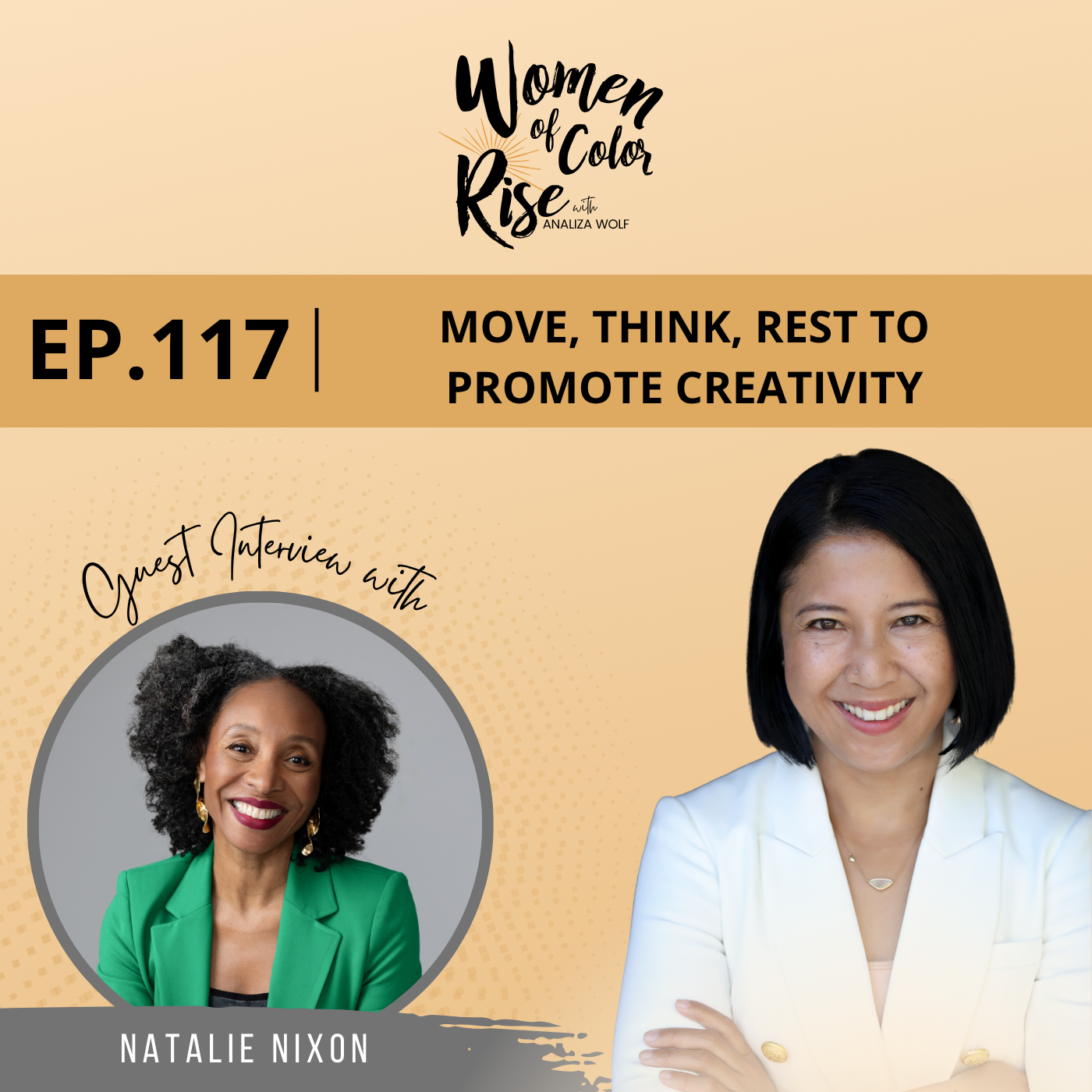
Episode 117 - Move, Think, Rest to Promote Creativity with Natalie Nixon, CEO of Figure 8 Thinking
In this episode of Women of Color Rise, I speak with Dr. Natalie Nixon—creativity strategist, author of The Creativity Leap and Move, Think, Rest, and CEO of Figure 8 Thinking. Recognized on the Thinkers50 Radar and named one of the Top 50 keynote speakers by Real Leaders, Natalie helps executives and organizations harness creativity as a strategic advantage.
A proud African American woman and Gen Xer, Natalie grew up on the East Coast in a family that modeled discipline, faith, imagination, and rest. From her father’s example of Sabbath practice to her mother’s encouragement of daydreaming, Natalie learned early that curiosity and movement fuel innovation and resilience.
She shares lessons for leaders:
Embrace creativity everywhere. It’s not just for artists—engineers, CFOs, and educators all thrive when they pair wonder with rigor.
Build curiosity into culture. Ask better “what if” questions to unlock new possibilities.
Honor natural rhythms. Movement and rest sharpen thinking and prevent burnout.
Connect ROI to creativity. Collaboration and curiosity drive productivity, efficiency, and innovation.
Trust intuition. Imagination and foresight are as powerful as logic in leadership.
Natalie’s story shows that by moving, thinking, and resting with intention, leaders can reimagine what’s possible and create lasting impact.
Order Natalie’s book Move Think Rest here.
Analiza and Natalie discuss:
Introduction & Background
Natalie Nixon, creativity strategist and CEO of Figure Eight Thinking.
Keynote speaker and author; ranked in 2024 Thinkers 50 radar.
Education: BA from Vassar, PhD from University of Westminster.
Author of Move, Think, Rest, focusing on creativity, rest, and innovation.
Identity & Upbringing
African American woman from the U.S. East Coast; identity shaped by ethnicity and gender.
Credits family and community role models for big dreams and strong work ethic.
Early experiences emphasized movement, planning, and rest as essential life practices.
Move, Think, Rest Framework
Movement: essential for blood flow and oxygen to the brain, not just exercise.
Thought: combines back casting (reflection) and forecasting (curiosity & imagination).
Rest: intermittent breaks, micro retreats, and sabbaticals to prevent burnout.
Business ROI of Creativity
Creativity: toggling between wonder and rigor to solve problems and deliver value.
Collaboration: diverse inputs drive innovative business outcomes.
Examples: fostering curiosity in teams can reframe markets, e.g., Airbnb.
Building a Culture of Creativity
Start with meetings: encourage question storming rather than immediately solving.
Model curiosity and reward it to embed it in organizational culture.
Foster collaboration and inquiry through structured, creative practices.
Personal Practices
Micro retreats and noticing retreats activate different neural pathways.
Schedule rest and daydreaming to engage the brain’s default mode network.
Run experiments to track the impact on problem-solving and productivity.
Stakes of Not Practicing Creativity
Creativity is critical for well-being, avoiding burnout, and sustaining energy.
Supports employee retention and productivity when encouraged in organizations.
Integration into daily life requires attention, strategy, and self-awareness.
Balancing Business & Soul
Soul: the child self, aware of what excites and inspires.
Soul work ensures alignment with personal needs and authenticity.
Examples: leaders like Yvonne Chouinard support employees’ interests and passions.
Resources:
Training: Chris Voss Negotiation Training
Connect with this Leader:
Want more balance, joy, and fulfillment in your life today? Get a FREE self-care guide to Juice Your Joy!
Download and enjoy Analiza's Free Gift: Juice Your Joy.
In this bonus: You’ll learn about the age-old Japanese practice of ikagai, get a reflection sheet to identify areas that can bring you joy and how this can be part of your daily practice, and be inspired by real Boss Mamas who have transformed their lives.
Connect with Analiza Quiroz Wolf and Boss Mamas:
Website: analizawolf.com
LinkedIn (Analiza): www.linkedin.com/in/analizawolf/
LinkedIn (Women of Color Rise): www.linkedin.com/company/bossmamas
Facebook (Women of Color Rise): www.facebook.com/womenofcolorrise
Facebook (Analiza): www.facebook.com/analizaqwolf/
Instagram: www.instagram.com/analizawolf/
Youtube: www.youtube.com/analizawolf/
Join our next Boss Mama program!
Be part of an intimate group of other Bad Ass women like you to live the life you deserve - rocking at work, family, and self-care. More information here.
Nominate a Podcast Guest
Nominate a Podcast Guest (we do not take nominations over email):
Join Our Newsletter
Stay up to date on other Boss Mamas and get tips that work to get the balance, joyous, and fulfilling life you deserve. Sign up here.
Transcript
Hi everyone. I am so excited about having Natalie Nixon with us today. It is Dr. Natalie Nixon. She is known as a creativity whisperer to the C-suite. She's the creative strategist and CEO of figure eight thinking, helping companies catalyze creativity. Looking at the. Return on investment for inspired business results. She's also the author of Move, Think, Rest. I have my copy here as the Creative Creativity Leap, and she's ranked in the 2024 Thinkers 50 Radar and Real Leaders named Natalie, one of the top 50 keynote speakers globally. Also featured in Forbes, Inc. And Fast Company. She got her BA from Vassar, PhD from the University of Westminster. I am so excited to dive into you and your life, Natalie, as connected to the book. But thank you so much for being here.
Natalie: Thank you Analiza for having me. It's good to be here.
Analiza: So Natalie, let's dive in first to identity, because as women of color, we're just talking about how important it's to support each other.How do you identify and how has that shaped this path of yours?
Natalie: I identify as an African American woman, gen Xer from the East coast of the United States. And I have always been firmly rooted in my ethnic identity and my gender. I have had a lot of incredible role models in my family, in my community, and just what I know of African American history that has really both rooted me and.
Lifted me up to be a really big dreamer and to make sure I do the reps, do the work that I need to do to inch closer to my dreams. My identity is something that fuels me and where, from where I, I get a lot of encouragement.
Analiza: Natalie, your book, move, think rest. it's not for me.When I think about how I was brought up in my culture, those were not things except for the thing that was really emphasized, right? Yes, we do sports, but it's really focused on planning, making sure you're moving forward, getting your goals accomplished, certainly not resting. So I wanna blend this.Identity that you have for yourself, perhaps you had a different upbringing of, we all did. But was that part of your fabric of being, or was there a shift for you that said, actually, I want to operate on a different blueprint?
Natalie: In many ways the motor framework or move, think rest has absolutely been a fundamental part of my upbringing and my orientation.I never formalized it as such because I certainly have had my burnout moments, my moments when I've hit a wall where I've had to regroup and revisit. What I know to be true, and when I talk about movement, thought and rest, what I just wanna clarify is from a 30,000 foot level view what this framework is really about. It essentially offers people a set of tools, a very set of very actionable tools to help them build creativity. As a strategic competency. And the reason that matters is because all of us, whether we are solopreneurs, employees stay at home parents for a lot of us, innovation is the mo.
Innovation is the goal. And the only way we can consistently and sustainably win. Is to tap into creativity as a strategic capacity and competency. The challenge has been that a lot of people don't think about creativity. They don't self-identify as being creative. First of all, they think that creativity is something the only artists are great at.So when I wrote, move, think, rest it, it is one more set of tools in my portfolio of work for people to have an on-ramp, to build creativity as a capacity. So movement is not just about exercise. Oops. Movement is not just about exercise. As humans, we were actually designed to move. The spinal cord is an extension of the medulla oblongata at the base of the brain, and in this knowledge economy where a lot of us are very sedentary.If we sit for extended periods of time, and I mean for more than an hour hunched over the computer, we are constricting blood flow from the spine up to the brain. And therefore we're, we are restricting oxygen, which means we actually are not gonna be doing our best thinking. So in terms of movement, I talk about movement hygiene in terms of thought.I really am an advocate of dimensions of thought that we typically don't think about when we're thinking of. Rapid clear cognition and rational thought. You actually will not have your best rational thought if you do not spend time on doing what I call back casting and forecasting. So back cast is the role of memory.The role of reflection forecasting is about curiosity. Dreaming is imagination and also intuition. And so it turns out that when we engage in these other dimensions of thought, our rational cog, cognitive thought is sharper. It's far more interesting, and it actually ends up being more innovative.And then finally, the rest. What I'm not saying in the book is that corporations should add a nap room to their buildings. That's not what I'm talking about. I'm talking about intermittent rest and we can think about intermittent rest in terms of building in breaks throughout the day, but also scaling that in terms of sabbatical.And the sabbatical for you might be. One weekend, a quarter a sabbatical might be organizationally and policy-wise condoned, so that as in a lot of tech companies, every five years you can opt in to a sabbatical. But the reason why rust is important, intermittent rest, whether it's micro breaks throughout the day or extended breaks, is that we as humans are these natural organisms that.Often fail to mimic the rhythms of natural systems around us. So whether we're talking about in nature or in the human body, what we see is an ebb and flow of contract release. Contract release. And what we tend to do in our Always on productivity, theater addiction to busyness culture is contract.Which means we were headed to. A surefire burnout. And in my own upbringing, I share in the book that I was actually raised Jewish and my father was a devoted observer of the Sabbath day. He was the hardest working man I knew. He, at one time, had. Three different jobs who put my sister and me through private school.And he got up and left the house way before we, we got up sleepy eyed to go to school and when he got home he had to finish sales reports, but he was devoted. To the Sabbath day as he called it, getting his rest. And we are African American. Just to clarify, 'cause a lot of people don't know the diversity of the Judaic faith I'm not a practicing Jewish person anymore, but that model of carving out time for rest was important.The other thing my father modeled for us was we were lower middle class, but he always wanted to expose us to leisure. To beautiful environments to take a vacation, that for a lot of us growing up, vacation was visiting a family member, right? And so we did visit family sometimes during summer vacation, but he also would take us to places like Hilton Hit Island in the 1970s where it was just, we would be stared and gawked at as an African American family going to a place like Hilton Hit Island.So that was modeled for me. The type of thinking that I'm talking about, the dreaming, the daydreaming was definitely supported by my mom who was an artist, is an artist, and who really advocated for that type of thinking. And then the movement part, I'm a very kinesthetic learner. I tinker and move around to figure things out and that, that was supported. So that's what I mean by move, think, rest, and those are the ways that it was modeled for me growing up.
Analiza: So Natalie, the case for creativity. We can say we want as an organization to produce results. Of course we need innovation. And so it's one of these banner-like taglines, right? Of course we wanna innovate. Of course. What are your ideas? Of course we want to hear from everyone, and yet it tends to be right. I like to put your head down, let's get this done. Oh, it was, should have been done yesterday. We're already falling behind. It doesn't really promote all these beautiful practices that you mentioned with creativity. So let's go there. I know that you're a doctor and you've studied this also as a professor. I wanna talk about the case for creativity. And these practices that actually say, here are the bottom line results, that when you practice these, and I know that they're not the normal standard MBA type of do these things and you'll get results.But can we show, as you mentioned, like the ROI return on investment to say, Hey, look. These, it's not just my kinesthetic learning style and my father who practiced the Sabbath. These actually translate to business results.
Natalie: Yeah, there is a business, ROI, to creativity. I'll give you a few examples.So when we are more creative, and let me also just level set. I'm wise by explaining how I define creativity. So I, I spent the. The majority of my last book, the Creativity Leap to define creativity is our ability to toggle between wonder and rigor, to solve problems and deliver novel value. And if you begin to think about creativity as this toggling between wonder and rigor, you quickly realize that it's not only artists who are creative, but the best engineers, scientists, CFOs, attorneys. Executive assistants, teachers, farmers, plumbers, and artists are super creative. So it's this backward between wonder and rigor.And so one example of the business, ROI of creativity is that creativity is at its peak when we collaborate. For example, most people, if they're really honest or they have a sidebar conversation with you, will confess that they hate collaborating. 'cause they think it slows everything down. Why do we have to explain these things to these new people?They don't understand how we do things around here. And the truth of the matter is that when we, if we don't collaborate, what's at risk is that we keep asking the same sorts of questions. And questions are inputs into a system. But the more diverse the inputs, the more innovative the output and not, I'm not only talking about ethnic diversity, I'm talking about experiential diversity, skill, diversity, age diversity, all those sorts of things.
When we collaborate productivity. Longer term, not maybe in the short term 'cause there's some speed bumps in the initial stages of collaboration, but longer term productivity goes up. When productivity goes up, efficiencies go up, and when efficiencies go up, costs go down. That is a business result, deeply rooted in any creative endeavor.Another example of the business, ROI. Creativity in addition to costs going down is that when you commit to building your capacity for creativity, you must also commit to building a culture of curiosity. You must commit to more self-inquiry and build that muscle to ask new and different sorts of questions.That leads often in organizations that I've worked with to identify. New opportunities in the marketplace reframing the problem. So, I'll take the example of Airbnb. When Airbnb first started. The question they were asking was not how can we disrupt the hotel industry?They were asking if we've got these conferences that are coming into town. Is there some, there's some opportunity we can do with people who are stuck without a hotel. We've got this, we've got this other supply of people's private homes. Is there an, is there a possibility that we could bridge the gap between the need to have a place to stay and people who might have extra space in their home?And through a process of inquiry, they actually realized the business that they are in is a trust building business, right? They had to build trust for homeowners to say. Yeah, okay. You vetted this stranger and I could make a few extra a hundred bucks. Sure they can stay on this floor of my home.And they actually also had to build trust from me, the visitor new to this town, to this city. To say that I'd be, I think I'm having a much more enriched experience staying in a home than in this hotel. So they reframed the question. When we engage in curiosity, which is the fundamental dimension of the wonder rigor paradigm, then we actually unlock new market opportunities and we build business value.So that's another business result and an example of the business ROI of creativity.
Analiza: So Natalie I wanna dive deeper into this culture because it is a culture you can't come in, it's more difficult as a one person to look at. Then the organization says, okay, I'm not the CEO, but I'd really like to infuse this into my team and my organization. But we're not there yet. And so I'm curious, as you step into an organization that has more curiosity, more openness to, yeah, collaboration is slower, but it will yield results if we bring people along. How does one step into this without going, being reasonable not going whole hog
Natalie: One of the places I suggest people start is the age old OG of all.Artifacts of organizational culture, which is the meeting, you can tell a lot about an organization's culture by the way they meet, how often they meet, who gets to lead the meeting, the content of the meeting, the process, et cetera. And if you are a person who is not a leader in the organization, but you have.Some relationship with the boss, with the manager to ask if there's opportunity to run meetings differently. It doesn't mean that you wanna lead it, for example, but maybe even the first five minutes of the meeting could start with building the case for inquiry by doing something called.Question storming so we can tell a lot more about each other by the types of questions we ask often more than the answers that we give. Let's say the agenda for the meeting is a new marketing strategy for Q1 in 2026. Or maybe the agenda is the holiday party. I, what it doesn't really matter, right?
Instead of spending the fire, instead of the whole meeting being about solutions and answers, and we need it yesterday, what if the manager was open to just spending the first five minutes of this meeting that you might suggest as a team member of just generating questions? Because as my colleague and Powell Warren Berger likes to say he wrote a more beautiful question. Asking questions is a way of thinking. And the reason why we don't see more cultures of curiosity in more organizations is because it's not modeled. It's not modeled by leaders. It's not incentivized, it's not always rewarded. So in question storming if the topic is. New marketing strategy for Q1 2026.Instead of trying to start out meeting gangbusters or just figure out what's the answer, what should we do? You would prompt everyone to just take 90 seconds quietly to themselves and ideate. Five. What if questions around the Q1 2026 marketing strategy? Not answers, no solutions, just a big blue sky. What if questions 90 seconds.And you encourage her to try to even populate even more than five questions, but let's just say five. The next step two is to pair off, and because this can be done on Zoom or teams, it can be done in person, pair off with one other person. Take three minutes to just share what you came up with.A lot of the time people find that there's overlap, there's inspiration, there's an engaging conversation. You learn something new about your colleague, in terms of the way their sort of beautiful brain thinks about things. And then you come out of that pairing, asking people just to share their favorite what if question from that conversation.So maybe the last, I don't know, final two minutes. I know I've gone over a bit of five minutes, maybe seven minutes now. You now have this incredible democratization of new questions that can spark new sorts of thinking about this Q1 2026 marketing strategy based on this big expansive.What if question, it didn't just come from the leader that, that kind of percolated up emergent in an emergent sort of way from the group assemble assembled. And you could gamify, you could vote on it, you could carry the question over to the next meeting. You could say, these are from this, let's vote on our top two favorite questions that we want to help steer us in this building of this market show.That's just an example, right? So it doesn't, so it means that you're coming to your boss, your manager, with not just a complaint. But an active I idea. And it's, you're actually beginning the process of building this capacity for creativity that doesn't take over the entire meeting, but takes over a portion of it and is still relevant to the topic.
Analiza: Natalie, it's so nice to hear you say, it can be that gentle, right? Sometimes we're like, oh, there's gotta be a creativity guru. There's gotta be a whole change to our values. There's gotta be new new things on the wall. And it's nice to say, actually, it can be as gentle as let's start the meeting with a 90 seconds pair and then share.Come up with two questions that we wanna actually answer, and it can be light. I wanna talk about Natalie bringing this to the personal because you embody this. We talked about your birthday and how you even celebrate your birthday with beautiful practices that cultivate both like celebration of you and also so much of this creativity.And I wanna talk about that because as women of color, as some of our, as our mothers, we're also leaders. It's a lot. And yeah, this sounds great, Natalie. I wanna put this into practice, but it just feels like one more thing. So how would you advise you know what, I hear that, and actually it doesn't have to be so heavy.Here are some suggestions of what the daily practices could look like. So it's, it feels okay. Integrated.
Natalie: Yeah, so first of all, I wanna remind all your listeners that it is part of our birthright as humans to be creative. And we, if we accept that as a truth, we then have to really ask ourselves what is at stake if I don't commit to building?My own version of creativity and a creative capacity in myself. What is at stake if I don't do that? And one of the ways to do this, and this is again, this is related to my latest book, Move, Think, Rest, is to build in micro retreats into your year. Now this does not have to be cost prohibitive.It doesn't have to be time prohibitive. One of the sorts of micro retreats I give as examples in the book, move, think rest is a noticing retreat going to a different neighborhood in your community, in your city. I live in Philadelphia, so we are a city of neighborhoods. It's all, and they're very distinctive and being a tourist.For an hour, just taking a walk, having a cup of coffee in a new cafe, not having an agenda, but letting yourself in that role when you are able to take a vacation and be an observer. And how you are delighted by what's new, how you are one of the favorite things I love to do if I have to take a train from Philly to New York City. One of the things I love about train rides is you can be an eavesdropper.And it, and just the daydreaming that can take place for me, just like the rhythm of the train, the staring out into space. It's so important for the brain. So putting yourself in a new environment, even if it's just for a morning. And if you commit to one morning a month, can you afford one hour a month?That's not on a Saturday or Sunday where you have an embargo, you slot your day slightly a little later. Where you're just going to hit, enable yourself to have that refresh. It does wonders for your mind, and here's why. When we tap out of the world, so to speak, after a good rest, a daydream, a nice walk, a fun, engaging conversation with a loved one or a dear friend, laughing our heart out with a joke.We are activating different neural synapses in the brain. We are allowing the default mode network of the brain to take over. And the default moat network is really important to activate. It is activated when we are less rationally, cognitively active in that frontal neocortex of the brain. That's where the juicy bits of thinking and juxtaposition of ideas come together and where the real, in my view, productivity is actually happening so that when you return to the work.At hand all of a sudden that problem that had you stymied something has shifted. You start to see it in a new light. Something you overheard, you realize is a great metaphor for the way you could be approaching X, Y, Z. There's a lightness, inner energetically in how you show your work. So it's very important to schedule these moments. And again, it doesn't have to be a trip to Bermuda that costs thousands of dollars in time that you don't have. It can be strategically and intentionally carving out that time for yourself, for yourself. That does not have to be expensive, and that does not have to be all time consuming.And what I would recommend to your listeners is to just run a couple of experiments if you don't believe me. Just say before Thanksgiving. I don't know when this is gonna be airing, but within the next two months, you're gonna commit to doing a version of this and just to track it in terms of how it makes you feel, how you're able to problem solve differently and pay attention to that, those insights.That's data.
Analiza: I love that it can be that simple and it doesn't have to be Bermuda because it feels more accessible. And no matter where you live, whether it's New York City or Philly, you can do this in your neighborhood. Even. I wanna talk about this birthright because I love that you answered this question in terms of it's your birthright and stop.Then you went to what is at stake. I would love to go there, Natalie, because as women of color were just like I'll do it later. I'll do it in 2026. That'll be something I looked forward to. I get the access, but right now I'm just trying to get through life. I'm Life in how? What is at stake?
Natalie: What's at stake is like in the most penultimate way, is your soul.The other thing that is at stake is your health, right? I've experienced my own burnout. I was a professor for 16 years and I loved it until I didn't anymore. 'cause I've just, I was just stretched and extended to the bone. I was doing my passion. Project. I was the founding director of a strategic design MBA program.I just needed more support to scale it in ways that were necessary. And when we have those reckoning moments for me, I heard myself say out loud through grit teeth. It was about five 15 on a Wednesday. I'm walking back from the photocopy machine to my office with a pile of 11 more papers to grade.Three more recruiting calls to make. Had to text John, my husband once again said, I'm gonna be late for dinner. And I heard someone say out loud, they're good at teeth. I don't want to do this. I couldn't even, I couldn't even contain it anymore. I couldn't res, I couldn't restrain and police myself anymore.And when I heard myself say that. I felt the tension. I walked into my office, I shut the door, and I plopped on my seat and I exhaled, and I said, because I'm a person who has always followed my heart. I've always reckoned with that, that hitting a wall, gotta regroup. I don't just push through and there's a way that we can go about it.But here's the, my, my main message is that you must. Be attuned to yourself. You must listen. Now when you hit those walls and you realize something's gonna change, most of us don't have the luxury to just leave. You've got to strategically figure out how can, how, what am I feeling? What are versions of this that I wanna leave behind, and what are the dimensions of this? Currency that I wanna bring forward. And then how can I start to prototype this future version of myself? Where could I volunteer? Where could I do a low stakes version of this idea that is actually my true creative self, that doesn't feel like work?That makes me feel alive. That's super easy for me to do. And people like, how do you do that? And for you, it's just easy, right? So we have to reckon with it because what's at stake is a lot of times I'm serious, our soul. What's also at stake is our health and also you are actually not being fair to your colleagues. The organization, they're not actually. Ultimately getting your best self, and this doesn't mean that for everybody, that you should leave where you are. In fact, a lot of the work that I do is to help organizations identify ways to, for their employees, to build out their creative capacity so that they will stay so that they will retain that talent because it's really expensive for organizations to lose incredible talent because the person is unable. To build that wonder and that rigor in ways that, that, that make sense for them and for the organization.
Analiza: Natalie, you spoke so directly with me in your opening about soul, it, it just, often we don't right. Business and soul. How do those both coexist? And I wanna dive into that because. As a woman of color, that really resonates and yes, we're talking about ROI and also soul work, so can you just dive into that?What do you mean? When you talk about soul, and I know we're talking about intuition, li listening to ourselves, but we're here for this short time that we have. In these bodies and Yeah. Speak to that part please.
Natalie: It's I'm sorry, I don't know the correct name for the Russian dolls that are matric. Yes. What is it called? Dolls. Turka Dolls. Excuse me. Yes. So the soul is that little girl's self, right? I'm talking to women now or that little boy self if there, if their men listening in as well, but it's that child self that is so clear on what they want, what they're into, what excites them, what inspires them, and that's who people wanna be around.That version of you, that's the version of you that is. Magnetic. And so what's happened though in the process of growing up? We cover it up, covered up with education, with more race, especially when we're women of color. We get excellent in making other people comfortable with us and figuring out how to code switch and figuring out multiple languages to speak and all the, I'm talking about languages in terms of all sorts of metaphors.Behaviors that we adopt and take on and that soul work is to be really tapped into. Is this meeting my needs? I'll tell you there, there's a, I, my husband and I really got into watching that TV show succession. Which was an HBO series for several seasons. Show. And there's a moment.There's a character named Jerry, who's the attorney for this multi-billion dollar family owned company. And one of the children who's a bit of a bully to hers is looming over her and demanding something of her. And she looks up at him and she says. But how does that serve my interests? That doesn't serve my interests.And I love that moment because there was such clarity coming from a woman with this young man looming over her deme, these demands, but she had this moment of clarity. And calm and surety to speak up for herself, right? And we have to ask ourselves periodically, is this serving my interests? And again, sometimes we can do something about it in the short term. Other times we have to be systematic and figure out using our words, and ask for what we need. And hopefully we have managers. And leaders in the organization who realize that organizations are organisms, and because organizations are org, they're organisms because they're made up of humans and because organizations are organisms, they're imperfect, they're inconsistent.And they're not predictive. God bless the managers and leaders who are curious about who we are as people, what makes us tick, because they realize that we actually will get our best work from us. I'll give you an example of a leader who was very, really good at that. Yvonne Shanar, the founder, Patagonia, wrote an incredible memoir called Let My People Go Surfing.I read that book. Almost 20 years ago now, and I was just so impressed and excited by a manager who knew that if he had an employee who was into surfing and she knew that the surf was gonna be up between two and five, he was like, you go do that. And he trusted that she would get an earlier or say later to get the work done.That is a macro management model of leadership, which is what move, think, rest. Pacs versus a micromanagement model of leadership that feels very counterintuitive initially. Let people do whatever they want and trust that they're gonna get the work done. Yeah, because they will feel seen, they will feel heard, they will feel trusted.And that's another part of the soul work that you alluded to. Soul work has to be inside out. It also has to be part of what we hire for in management and leaders, in my opinion.
Analiza: Oh, Natalie, that is speaking to my soul, my, my inner child. I so appreciate 'cause imagine if we could. Show up, up and say, let me show up as best as I can in my full self.Truly, you would have an amazing organization.
Natalie: Oh my gosh. Retention would be off the chain. Yeah. You're the business cost of quiet quitting. Quiet firing of resentment of how collaboration would just be much easier to oil that machine. Because of trust
Analiza: Truly, we can be in sync. To enhance one is to enhance the other. Natalie, what a wonderful discussion. Let's go to lightning round. Are you ready?
Natalie: Ready.
Analiza: Chocolate or vanilla?
Natalie: Chocolate, dark chocolate.
Analiza: Cooking or takeout?
Natalie: Takeout.
Analiza: Climb a mountain or jump from a plane. Natalie: Definitely climb a mountain.
Analiza: Have you ever worn socks with sandals?
Natalie: Yes.
Analiza: I have. How would you rate your karaoke skills on a scale of one to 10? 10 being Mariah Carey.
Natalie: Definitely not a 10, but I'll put me up there like a five or six. I love karaoke. It's so cathartic.
Analiza: What's a recent book you read? I know we've got Move, think, rest and Creative Creativity Leap Talk about any other books.It can be a great book or a recent book.
Natalie: I am committed to reading fiction because fiction is one way to activate the default mode network. It's part of that, that, that rest piece and that thought piece. So I have been reading Abraham Verghese's work, so he's an incredible polymath. He's a very accomplished surgeon and he also got into the Iowa School of Writing, and right now I'm almost finished with his 700 page novel called The Covenant of Water. Highly recommended.
Analiza: Thank you for that. Natalie, what is a favorite way to practice self-care?
Natalie: Oh, Korean Day spas, massages love those that, yeah.
Analiza: What's a good professional development you've done?
Natalie:Gosh, let's see. Every year I commit to one professional development experience and one personal development experience. And what I'm finding since I've become an entrepreneur is that often they merge. A couple years ago I signed up for a negotiation workshop with Chris Foss, the FBI negotiator but I'm also new to open water swimming.
And while I had put that in the bucket of. Personal development. It actually does wonders for my professional development. It helps me to become braver, more courageous, more curious. It's just the swim, open water swim is just the give that keeps giving of that.
Analiza: What's your definition of a boss mama?
Natalie: A woman who has clarity, curiosity, and confidence.
Analiza: And then what advice would you give your younger self?
Natalie: You are all good. No worries. You are doing great. And continue to follow your heart.
Analiza: Where can we find you? LinkedIn, anywhere else?
Natalie: Yeah, definitely follow me on LinkedIn. I offer a lot of value through my LinkedIn posts articles.But absolutely go to figure eight thinking.com. That's F-I-G-U-R-E, the number eight, thinking and signing up for the Wonder Rigor Newsletter for lots of great valuable content.
Analiza: Wonderful. And then last question, final ask, recommendation, parting thoughts. We'd love to share. Hear you share.
Natalie: I just thank you.
I'm Elisa for sharing your platform, inviting me in on this conversation, and I would love it if people purchased moves, think,rest, and then share feedback with me. My email's at figure eight thinking.com.
Analiza: Wonderful. Natalie, what a wonderful story. So many practical tips that people can take today are accessible. So thank you for this. Congrats on your book. Excited for other readers to read too.
Natalie: You're very welcome. Thank you for having me.
Analiza: Thank you so much for carving out time to hear today's podcast. 3 things before you go. First, if you found it helpful, please leave a five star review. Second, you can get a free chapter of my book, The Myth of Success: A Woman of Color's Guide to Leadership at analizawolf.com/freechapter. And lastly, if you're interested in executive coaching, please reach out to me at analiza@analizawolf.com. Thank you so very much