
Subscribe to the Women of Color Rise podcast
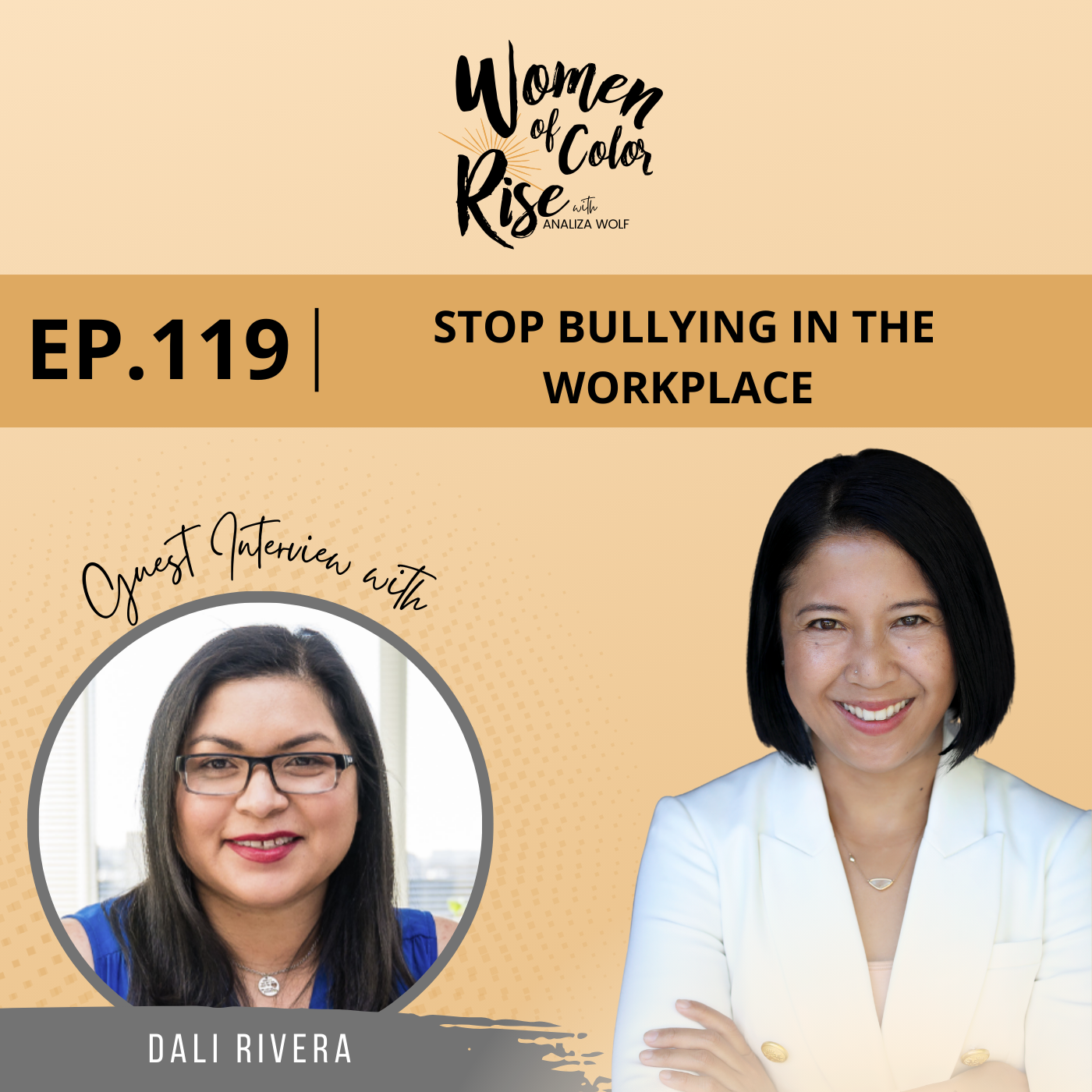
Episode 119 - Stop Bullying at School and in the Workplace with Dali Rivera, Founder of the Diversity and Anti-Bullying Academy (DABA)
Women of Color Rise supports more diverse leaders at the table, especially women and people of color. We’ll be talking with CEOs and C-suite women leaders of color and learning about their leadership journeys.
Facing a bully at work?
In this episode of Women of Color Rise, I speak with Dali Rivera—parenting coach, U.S. Army veteran, author, and founder of the Diversity and Anti-Bullying Academy (DABA). Dali transformed her pain over both her and her daughter’s bullying into a powerful purpose, creating tools for confident advocacy in schools and in the workplace.
Dali shares advice for leaders to confidently address a workplace bully or a hostile situation:
Listen and Believe: When your child tells you they're being bullied, your first job is to believe them and affirm their experience.
Know the Policy: Educate yourself on your school and work official anti-bullying policy and definition; vague reports are easily dismissed.
Document Everything: In both school and workplace situations, collect dates, times, and specific details to create an actionable paper trail.
HR is for the Company: Understand that Human Resources' primary loyalty is to the organization, not the employee, and be prepared to seek external counsel.
Trust Your Child's Competence: Encourage your children to participate in the conflict resolution—it builds vital life skills for the future.
Dali’s story is a powerful reminder that our pain can become our greatest purpose, giving us the strength to advocate not only for our children but for ourselves in the workplace. Do not be afraid of the power of your voice.
Analiza and Dali discuss:
Identity, Purpose, and Path
Dali shares her experience moving from Nicaragua at age seven, struggling with bullying and a lack of self-confidence that affected her grades.
She credits joining the U.S. Army as the best thing that could have happened, forcing her to speak up and giving her the courage to advocate for others.
Her passion for anti-bullying began when her five-year-old daughter was bullied, which occurred while Dali was pursuing her Master's in Women and Gender Studies with a concentration in Social Policy and Leadership. This synchronicity led her to focus on flawed organizational policies.
Advocacy for Children
Parent-Child Steps: Listen, believe, and affirm the child's experience. Collect data (dates, details) patiently. Encourage the child to propose their own conflict resolution solution before intervening.
School Steps: Stay calm. Read the school's bullying prevention policy and its definition of bullying (often requiring repetitive behavior or a power imbalance). File a formal, written complaint—not just a verbal one—to legally hold the school accountable.
Bullying in the Workplace for Leaders
Context: Workplace bullying is often perpetrated by people of power or who think they have power, often using hard-to-prove microaggressive behaviors. Dali cites that 80% of people leave jobs due to co-worker/manager behavior, not the job itself.
Protection: Documentation is key: Dates, times, witnesses, and how the behavior impacted your work/safety.
Reality of HR: HR's job is to protect the company, and information you give them can be used against you. Dali advises seeking external help (attorney, HR coach) to ensure you have a valid argument and are protected.
Dali’s Experience: She shares a personal example of feeling harassed by a director who monitored her office visits and how HR dismissed her concerns, confirming the need for an attorney to build a provable case.
Resources:
Book: Confident, Bully-Proof Kids by Dali Rivera
Workbook: Bullying Prevention 101 (Available at Dalitalks.com)
Book: Don’t Let School Get in the Way of Your Education by Anane Olatunji
Connect with this Leader:
Website: DaliTalks.com
Podcast: Dali Talks
Facebook: @DaliTalks
Instagram: @DaliTalks
Youtube: @DaliTalks
LinkedIn: Dali Rivera
Want more balance, joy, and fulfillment in your life today? Get a FREE self-care guide to Juice Your Joy!
Download and enjoy Analiza's Free Gift: Juice Your Joy.
In this bonus: You’ll learn about the age-old Japanese practice of ikagai, get a reflection sheet to identify areas that can bring you joy and how this can be part of your daily practice, and be inspired by real Boss Mamas who have transformed their lives.
Connect with Analiza Quiroz Wolf and Boss Mamas:
Website: analizawolf.com
LinkedIn (Analiza): www.linkedin.com/in/analizawolf/
LinkedIn (Women of Color Rise): www.linkedin.com/company/bossmamas
Facebook (Women of Color Rise): www.facebook.com/womenofcolorrise
Facebook (Analiza): www.facebook.com/analizaqwolf/
Instagram: www.instagram.com/analizawolf/
Youtube: www.youtube.com/analizawolf/
Join our next Boss Mama program!
Be part of an intimate group of other Bad Ass women like you to live the life you deserve - rocking at work, family, and self-care. More information here.
Nominate a Podcast Guest
Nominate a Podcast Guest (we do not take nominations over email):
Join Our Newsletter
Stay up to date on other Boss Mamas and get tips that work to get the balance, joyous, and fulfilling life you deserve. Sign up here.
Transcript
Hi everyone. I am thrilled to be with Dali Rivera today. She's a respected parenting coach, speaker, author, and the founder of the Diversity and Anti-Bullying Academy. She's all about supporting parents and educators to raise confident, inclusive, and bully proof children to practical tools and meaningful conversations.
She's also a proud US Army veteran. Thank you for your service, Dali and a mom of two, and she has her own experiences as a mom trying to help her five-year-old who is being bullied. Dolly, let's get into it. Thank you so, so much for being here. Thank you. I'm very happy to have this discussion with you.
So, Dali, we know that you have experience in the Army and I wanna talk about this path. Did you plan as young golly, to, did you think you would be, you know, having your own podcast and also dealing with. This Bully Academy, that would be your passion and a career
Dali: Not in a million years. And Analiza, the little Dali that moved from Nicaragua at age seven was severely bullied and had no self-confidence by the time she got to high school. And there were a lot of things going on at home that contributed to my confidence. and then suddenly as a way to run away from feeling like a loser because when you're little, growing up, you don't know how much things affect you. So my grades slipped. I felt like I was not good enough for college, and I joined the military and it was like the best thing that could have happened to me. Although it was extremely hard mentally. And I faced a lot of adversity. So it actually just shoved me into that place of, okay, what are you gonna do? Are you gonna speak up for yourself or are you just gonna let this happen? And then that gave me the power, the courage to also. Speak up for other people.And so by that time, my then 5-year-old, she's 19 now. By the time she was bullied, I was just like,, no, this is not happening. This is not gonna happen. I was in my master's program. I majored in women and gender studies, and the concentration was social policy and leadership, which it was ironic that that happened at the same time because, one of the things that the school kept telling me about why they were not helping my daughter was the policy, the policy, the policy. So I'm like, let me look at this darn policy. And I went and looked at it, analyzed it and I was like, this is what's wrong with it. This is what's going on. like with why these kids are not being helped. Just like the policies in the military that did not help me, just like the policies in my school when things were going on and there was just no help. So that's how I actually ended up in this space of creating diversity in an anti-Bullying Academy. And the other element that I, I threw in the diversity in there because one thing I noticed is that. People bully kids, even adults, because they don't know about other people.They don't know enough about their culture. They don't know enough about that accent. They have misconceptions. They believe stereotypes, they conform to social norms that are toxic or harmful. And we, I felt like I needed to educate kids, but I can't get into those conversations without the parents.Initially I thought I was going to work only with kids, and as I started this through schools, I realized parents were the ones I need to educate and the teachers. So that's who I mostly work with now. And what I love is that I've created, some, workbooks for parents and educators, but I throw in their activities that are very comprehensive, very simple, very achievable, realistic. Very doable so that the adults are having these conversations with children and they form not just a trust between the adult and the child because kids are gonna come to you when they know mom knows her stuff, they're gonna come and immediately tell you what's going on, but. The other thing too is that I want to create a bridge of communication between the parent and that school administrator because I also saw how much lack of information there is, for the parent when I was going through my thing with my baby.I just couldn't understand all these protocols, these policies, what the steps were, who's in charge. I found an array of things. I was like, oh, there's an investigation process. Oh, there's an appeal process. And I'm like, oh, there's a legal definition or a definition of that. If this didn't happen and it doesn't match the definition, then they're not going to help me because they don't have to.So anyway, I'll stop there because I can really dive deep, deep, deep into this whole topic.
Analiza: Okay, Dali, there's so much you said, and I wanted to have a through line here. One is that your own personal experience, were you born in Nicaragua? I sure was, yes. Okay. So you were you. You were born in Nicaragua.You come to this place as a person who I was born in, in the States, but had this whole assimilation and trying to fit in, and also lack confidence. So see connections with you and me there. But if I look through your own like young Dolly and then. Your experiences trying to fit in, not feeling confident joining the military.And as much as the military was an amazing experience, I think for both of us. Also very challenging. and then seeing your own daughter bullied in school. So I want to get this through the line because sadly, me too, right? As a child, and then in these different workplaces and then now, seeing my own daughter.So I connect with you so much. Personally, I wanna talk about supporting our kids because mine wasn't, she was eight when she was bullied and she was bullied three times at the same school. Mm-hmm. At the time. I just trust I've been in the school world for a long time too, and I really appreciate when parents trust that the school will handle it, because we did and we did investigations, but I found it surprising and shocking actually. I'm ill-equipped. I was about how do I trust the school but also protect my daughter. Especially when it continued to happen with different bullies. So can you just map it through, I mean, for those, for a crash course in parents, when your child is bullied, here are the three steps, five steps you need to take to make sure you protect your child.
Dali: Right. Okay. So I'm going to give you two different perspectives. One for you and your child, the other one with the school first, with your child, the first thing you wanna do is listen to your child and not question what happened regardless of their age, because their experience is their experience. It's very real to them.
So while it may not seem like a big deal to you, it is a huge deal to them and they're scared and they just want to come to you for comfort, for love, and for help. So you tell them. You ask them what happened. When they tell you you believe them and you ask questions and you tell them, you reaffirm, and that this should not have happened to you.You do not deserve it. Because unfortunately, when children never hear that and it continues to happen, they start believing that there's something wrong with them and they're attracting these horrible people who are doing this and it tears down their humanity. It can get very ugly. And you are going to ask questions, you're gonna get different versions of the story because when something traumatic happens, we remember stuff.But then little by little that the next day you're like, oh yeah, and this happened too. Oh, oh, and so and so was there too. So you just be patient, keep having the conversation. Don't push, just let it flow naturally. But if they're not speaking enough. Do subtle, you know, comments or questions to get them to speak, because what you're trying to collect here is data, data that the school needs.Because they do not do anything. If you do not have a pattern to show them dates and specific details. If you go to them and everything's vague, they're just gonna dismiss it. The other thing you're going to do is you're going to stay calm. I know that your baby's hurt. You are angry. It shouldn't have happened.But what you're gonna do is you're gonna stay calm. You're gonna go and read your school's bullying prevention policy, and you're going to look at that definition. Normally these schools offer not just a definition, but examples of what constitutes bullying to them, and you're going to see, does this situation fit that definition? If it does. Proceed in that same form, there should be instructions on how to file a formal complaint when parents just go to the teacher or the principal and they verbally, you know, communicate about what happened. You do not legally hold that school accountable for the safety of your child, but once it goes in writing, and I mean literally in writing or now through their websites, which is the norm.Now there's paper trail. Now there is evidence that you sought out the school for protection of your child. If they do not comply, then you can proceed at a higher level or with legal action. And it's sad that we have to get pretty litigious, but that's the world that we live here, live in here in the United States.And it's not to say that it's going to get litigious, it's just that you want to cover your bases because your child is the most priceless person in the world and you don't have time to mess around. And you also want to be taken seriously because you wanna cut it off as soon as it happens. You need to educate yourself with the, so the policy. You need to make a plan and collect the data from your child.Once you have all of that information, then you're going to craft a letter, or you're gonna submit it through their website. They're going to ask you many different questions. In my book, confident Bully Proof Kids, I talk a little bit about that. But I also have another book on my website on dalitalks.com. It's called Bullying Prevention 1 0 1. And I have a template there that I highly suggest parents take a look at, because it can help you remember, what should I be asking, what should I be collecting? And so once you have all that information, you submit your complaint. And I want you to, I'm going to tell you, the definition is unwanted, aggressive behaviors that are usually repetitive in this part, usually repetitive.Not everybody follows that. Some organizations will say it has it, it has it, I can't speak today. It has had or you should have had at least three incidents. Some require just once. A lot of 'em. Don't consider one incident a bullying incident. So that's why it's very important for you to read that definition.
The other part of the definition of bullying is that it is usually, so repetitive or has the potential of becoming repetitive and also a power imbalance exists. And what does that mean? That means maybe the child that bullied your child is older, or maybe they're the school principal's child. Or the teacher's child. There's some kind of power, superiority there and. Why do, why is that important? Well, because if my child is being bullied by the teacher's child, then my child might think, well, the teacher's just gonna take their side, so they're most likely not to say anything. So I'm just giving you a little recap or a summary of what it can look like and if you choose not to report, which most of us don't, because usually we want to allow our child to handle the situation on their own. and I encourage that if it's something that you think it's very manageable, your children. Usually know the solution because they're the ones that know the bully. They know that child very well. They know what could or could not work. So when you speak with your child, ask them, how would you like to handle this? They might say, well, I want you to go talk to them, okay, but how would you handle it? So give them the opportunity and encouragement to handle this with conflict resolution, you're teaching them a skill. You don't wanna enable them by always being the first one to go over there and break it up and give a solution that's not gonna help them later in life. Especially in the workflow place because oh my gosh, it happens so much in the workplace hear them out, hear their solution out. If you think it's going to work, then back them and say, I'll be right there with you. Don't do it for them, but just let 'em know, I'm with you. I support this. If you think it's lacking something, then suggest it's like, you know what? I really like your plan, but what about if you add this to it?What if we do this? What do you think? It'll work right there. You are giving this child gold. You are telling them, I see you as a competent human being, regardless of your age. I support you. You're not alone. You're going to be fine because you have me backing you up, and you also helping their critical thinking skills. You are helping them with conflict resolution skills. You are helping them with communication skills. There's so much and we really need to trust our children. And then when you talk to stay calm, stay collected. When, and this is something that many school principals, male and female have told me, and they say when a parent comes in here, really upset, really mad.About something happening to their child and they wanna complain. They want me to come and create the solution, and boom, he's like, I can't help but think, well, I don't know if the parent is like this. How is a child?
Analiza: Dali, I wanna talk about this as a way forward. and this is a, you can be honest here.
Dali: Yes.
Analiza: Do you feel like generally speaking, schools are equipped after we flag it for them and I, Hey, this is happening. I'm not gonna file a co complaint.
Dali:Mm-hmm.
Analiza: I trust that you're going to. Do what you need to do so this doesn't happen again. I'm just curious. Yeah. Not just like it's silly and stupid or No. Yeah. Just tell me like what is that a path forward at all?
Dali: So some schools do a really great job educating, but not actually practicing. Okay. 'cause they don't know. And I think there's a lot of fear of being sued, they're actually very afraid of parents. And I always tell parents, you are so powerful.The power of your voice is so incredible. It's more powerful than the teachers. A teacher can suggest the same solution that you suggest. Like they can be, they, a teacher will have had the suggestions all of last year, but the moment a parent comes and gives that solu,you know, that request, especially when it's a group of three or more parents, they'll listen to the parents over their own teachers and these schools educate the children and they educate the teachers. Some do better than others, but when it comes to implementation, sometimes they don't have the right person implementing. The procedures. Mm-hmm. And so it's up to you to ask like, who is, you know, doing the investigation, what does the investigation look like? How long should it go for?
Analiza: Will they always investigate Dolly if you, if it's just one, one incident and it doesn't quite meet the definition, they should. Okay. they should still do an investigation.
Dali: Yes. Even if it's a small little investigation.
Analiza: Okay. Yes. So I wanna shift Dali to talking about bullying in the workplace because that is real. And I didn't realize even in these places where we're, it's a mission oriented organization. And talk to me about what trends you were seeing for bullying in the workplace. Where does it happen? To whom, I know we're being very general, I'm just looking at who, how, what's the context in general?
Dali: Usually people of power or people who think that they have power. They will use a lot of microaggressive behaviors, a lot of undertones. It's really hard to prove. and that's what it's like,I read 80% of people who leave their jobs, they leave it because of the behavior issues.Because of the people they work for, not because of the job itself. Mm-hmm. And. So documentation is very important because when you go to HR, you have to prove, and just like with children, dates, times, what was said, who was there, how it made you feel, and here's some key things for children and for adults.If it makes you feel unsafe, that's a big red flag and that is something that HR should. Definitely be informed about if there is a threat, if there is an impact on the quality of your work. You know, you're not able to focus because you're scared that this person's gonna come and do or say something. So documentation is key.Also, keep in mind that HR is not going to be backing you. HR is going to be backing the company. Mm-hmm. While a lot of HR professionals do really, truly care for the employees that they're looking after, their loyalty is to the company. And what does that
Analiza: And what does that mean? Why can they even help us?
Dali: So they can be certain, they're human. I would say like the humanity in them, will do their best to bring something fair. But they also have to follow that company's procedures. And if they have to, look at things from an angle of where it could look like you are.
Blowing things outta proportion or you are creating the problem or, You are lying or anything like that, then that's their job. Their job is to see it from the company's angle of how you are trying to get something out of the company. Got it. And this is not something they do, very consciously. It's just how the work is. Taught, this is how, and I know a lot of HR professionals are probably gonna hate me right now, but there are a lot of HR professionals that have to deal with that, and they quarrel with that, you know, because it goes against their own personal values. or what they would do if they were them.But a lot of 'em have told me like, we work for the company and not for the employee, and we will try to be fair. They definitely try to, but you have to keep in mind that that information you give 'em can also be used against you. Okay. Talk about that. Yeah. So when that happens, I always tell people. Try to seek out external help, whether it is an attorney, whether it is an HR coach that coaches people, and how you can work with institutions so that you can protect yourself or at least make a valid argument so that they understand.How this is impacting you and the solution that you need. And that's the other thing too. Whether it's speaking up for your child or for yourself at work, you need to. Suggest solutions, realistic solutions
Analiza: Let's talk about that. So what are two realistic solutions?
Dali: Okay. So let me give you an example of something that I went through. one of my jobs, the supervisor was actually, he was the director of the entire. Building. He would come by my office and look at who was in my office and for how long. And, you try to build relationships. So sometimes you might ask, oh, how's your daughter doing? Because I heard, okay, well how can I help you? So that little, Hey, how was your daughter was considered according to him as socializing too much. And so I had to give an example, you know, and then he would like, It pays back and forth, by my office door just to see how long and who was in my office. And so I had to,remember I called her. I said, Hey, I feel like I'm being harassed and it feels intimidating and it's stressful. So now I'm trying to rush people out of my office because now I can't really dedicate the time that I really, truly need to because he's got me on a timer. And they, the HR told me, we represent.
Analiza: The organization, not you. And are you sure that this is happening to you? Are you sure you're not overanalyzing? I was like, okay, I need to go to somebody else. I did call an attorney. I got a free half hour and they said, okay, so you might not have a case here. And that was very disheartening because I was like, this has been happening for months why didn't you have a case?
Dali: Because everything is verbal. and if it were more obvious, even though I had witnesses and even people who would come to my office would say, Hey, have you noticed that he passes by every time I'm in your office, I actually don't even wanna come to your office anymore. Can we meet outside?And maybe during break I can talk to you. And I was like, wow, this is not good. I shouldn't have to use my break to help this employee. That's my job. I should do it during my active work hours. So unfortunately, the sad truth is sometimes you do have to pay an attorney. Wow. Because this HR person that I kept calling and I called her dozens of times because they got really intense and she was like, we're here for the company.
Yeah. We're, and eo, but we can't do much.
Analiza: Dali listening to you about protecting both our kids and ourselves, there is, we've gotta be smart about it. That's what I'm taking home from it. Mm-hmm. And yes, there's documentation and yes, we can get other people to support us, but we do have to be smart and understand what, how the game is rigged, and yeah, protect ourselves.Dolly, I wanna move to lightning round. Are you ready?
Dali: I'm ready.
Analiza:Chocolate or vanilla?
Dali:Vanilla.
Analiza: Cooking or takeout?
Dali: Takeout.
Analiza: Climb a mountain or jump from a plane.
Dali: Oh, I'm definitely climbing that mountain. I'm so afraid of heights.
Analiza:Have you ever worn socks with sandals?
Dali: Yes.
Analiza: Too many times. My kids will tell you all about it. How would you rate your karaoke skills on a scale of one to 10, 10 being Maria Carey?
Dali: Oh my gosh. That's a zero in my mind. I still like Mariah Carey, but no, I could probably make people go deaf.
Analiza: Dali, what's a recent book you read?
Dali: Ooh, Don’t Let School Get in the Way of Your Education by Anane Olatunji.
Analiza: What's a favorite way to practice self-care?
Dali: That's a good question. I think just being, sitting on the couch and just being with yourself. Don't listen to anything but just what's a good professional development you've done. Oh, wow. Professional development that I've done. I took a conflict resolutions class.It was very empowering. Yeah.
Analiza: And what's your definition of a boss mama?
Dali: A woman. That's it. Just a woman.
Analiza: What advice would you give your younger self?
Dali: I would say stop caring about what people feel about what you do, and just do it. Mm-hmm. And then where can we find you? Tell us about your podcast, your book, your website. Yes. You can find me on my website@dalitalks.com. All of my social media handles are Dali Talks and the Dali Talks podcast, where I share not just information about bullying and diversity, but also really valuable information to help moms parents be more than a mom, but their own self.
Analiza: And then last question, final ask, recommendation, parting thoughts to share.
Dali: Yes. Do not be afraid of the power of your voice because in the end, like you are the one who's going to either, feel those ramifications for not doing so or reap the rewards.
Analiza: Amazing. Dali, thank you so much for your expertise and your stories. We really appreciate it. Thank you, Analiza. Have a great day. Thank you.
Thank you so much for carving out time to hear today's podcast. 3 things before you go. First, if you found it helpful, please leave a five star review. Second, you can get a free chapter of my book, The Myth of Success: A Woman of Color's Guide to Leadership at analizawolf.com/freechapter. And lastly, if you're interested in executive coaching, please reach out to me at analiza@analizawolf.com. Thank you so very much