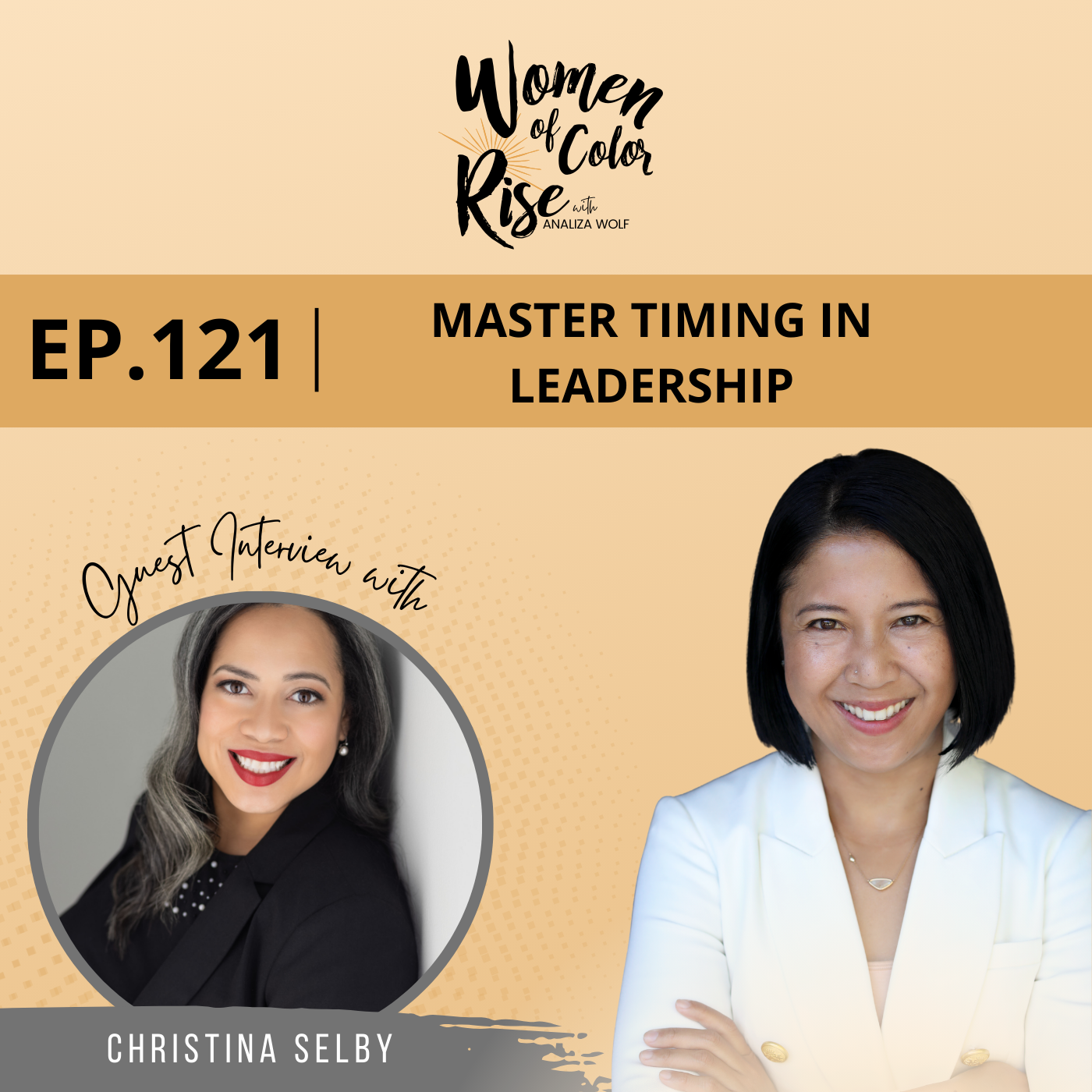
Analiza:: Welcome to the Women of Color Rise podcast. I'm Analiza Quiroz Wolf, proud Filipino-American executive leadership coach and former CEO of a nonprofit and Captain in the U.S. Air Force. I'm also the author of The Myth of Success: A Woman of Color's Guide to Leadership. It's based on the lessons learned by many women of color leaders, including those on this podcast. We talk with successful CEOs and C-suite women leaders of color and learn about their leadership journeys. I'm on a mission to support having more diverse leaders at the table. If you're a woman or a woman of color who wants to sit at that table, you're in the right place. Now let's get into today's show.
I am so excited to be with Christina Selby today. She's the Vice President of production and touring at Lander Producing Company of America. She does so many things, including staff oversight, booking tours. We're just talking about how the weather is definitely having an impact on Christina's worlds and all of the rebook you might have to do.
In addition, Christina is on several committees. For example, the Broadway League. She's on the board of Governors executive committee, and she is an adjunct professor for Columbia's Theater Management and producing MFA program among many other things. Christina, thank you so much for being here.
Christina : It's a pleasure to join you today.
Analiza:: So, Christina, let's start with identity. I'd love to ask you, how do you identify and how has that shaped your career?
Analiza:: So I identify, specifically as a Haitian American. And then when I have to kind of put that in a broader sense, I'll say, uh, I'm, um, black and Hispanic, but born and raised here in the US but I am first generation American.
Both of my parents were born in other countries. My mother and Honduras and my father in Haiti. And, that colors obviously every aspect of my being, because of the languages and the foods growing up. Because of the immigrant thought process and the focus that my parents have put on education and how one should comport themselves in the world, especially as a person of color in the United States.
So it has basically been integral to every aspect of how I have perceived and taken on education work, my interpersonal relationships with other people. And it's very much. A big part of my persona,
Analiza:: Christina. So when you were young, Christina, did you sit with your parents and say, I'm gonna be in theater?
Analiza:: Not at all. So I, from a very young age, I decided I was going to be a doctor, specifically a pediatrician. And I had this dream, this goal, this planned forever. If you look back in my high school yearbook or in the, you know, what are you going to be when you grow up? It was consistent, I'm gonna be a pediatrician.
And then I got to college and was taking all of my free med classes and decided, no, I'm not going to be a doctor. And I basically ran away and joined the circus, but now I work in theater. But it's been a wonderful journey and basically I made that change, when I was. Sophomore year of college, when I realized that the science classes weren't giving me as much joy as I thought they would, and I had to sit down and kind of do a hard look at myself and say, what brings me joy?
And I realized that I loved going to the theater. I loved it, and I was a dancer. Uh, and I had been every time it was my birthday or if it, I grew up on Long Island, so lifelong New Yorker. anytime it was my birthday or some special occasion, we came to Broadway. We came to the theater, and then I was a dancer, so I was always performing.
And so I love seeing and performing in shows and being part of the arts world, and that's what I always spend all of my side time doing. I like to be in charge of things because I'm bossy. And then it kind of hit me that someone has to be in charge of arts in some way. Like it had never crossed my mind until my sophomore year of college.
and I sort of searched and realized that if an entire field, which I don't know how, that kind of flipped by me for so many years of my life. and that's kind of where my journey began. I've made a career working in theater specifically on Broadway.Basically since my first week out of college, I have worked on Broadway, so here I am.
Analiza:: It's an inspiring arc because often for especially immigrant families, I too wanted to be a doctor. Christina and I said that as people were like, what do you wanna be when you grow up? And I see the smile on their faces when I would say, doctor. So I get that. Also, when I got to college, I realized that was not bringing me joy, so I wanna go there because your choice of I'm going to go to Joy.
I didn't actually go to Joy, I went to more practicality. What felt like a strength of mine, but you deliberately leaned toward joy and you saw this arc in your career and in your personal life of loving Broadway, loving dance, loving theater. So tell me about this process of joy, choosing joy. Was that something you had just done in college?
Was it something that you had practiced your life? Like how did that come about?
Analiza:: I think that I didn't realize that I practiced it my whole life until. Pretty recently, but it is something that I have always taken as a, a big part of my persona is what makes me happy. And always carving time out for that.
And growing up it was as simple as, I love puzzles. Puzzles are kind of the, the place that I can sit down and turn my brain off while keeping my brain on, and if anything was stressful or if I was overwhelmed with how many activities and classes and so on and so forth, growing up. I was always happy reading books and doing puzzles.
It's always just been something that brings me joy and in its meaning. I return back over and over and over again in my life, and I realize I've always kind of carved out those little, little pieces for myself. It's never been conscious, it's never been, something that I'm saying, I'm going to do this because it burns me door.
Now I do that. Now that I can recognize that I do that, but at the time it was just something that I, I guess I just. It became part of my being, part of my, my, my way of operating in the world, that I just didn't realize would be so profound. I got older and my responsibility grew and you know, now I have my own family and, and I still find the ways to carve out my joy and I do it intentionally now as an adult.
Analiza:: So you're in theater and I remember that when I was first. I'm also, I love theater as well. I love that we have so many connections. There's the idea of having people of color on stage, until Hamilton just wasn't a thing. And so I'm curious if you can comment on, your own, as you developed, as you were leaning into your joy, that, did you notice, like, how did that, the representation, the arc of that, unfold as you leaned more and more into theater and leadership?
Analiza:: Well, I think that it's just so telling that I came into this industry at this very specific moment in time. To me just shows how much has changed over the years. So growing up, I would just go see shows and it was kind of like, I just like going to the shows for Ray. But the day that I realized that I was going to get my very first job in the industry, I was a senior in college, I would come down to do a second round of review here in the city for the Broadway League, which is the trade association that represents.
Theater owners, producers, presenters, general managers, so on and so forth, on Broadway. And as I sat in that interview, I heard from the president of the organization because it was the interview with her. She said, oh, you know, you basically have the job. I'm just doing that. I just wanted to get to know you, but they've already kind of chosen you, which I got to know at that time.
So I'll say, oh my goodness, I'm about to get my first job out of college. How exciting. And it was in April of 2008. I still remember it so clearly. It was like. Week of April. and my mom had come into the city that day with me, so she said, okay, whenever I'm done with this interview, we'll go stand on the T kts line and we're gonna go get some tickets and we're gonna go see a show.
And my dad would join us. He'd come in after work and we'd all go to a show and go out to dinner and it would be great. And we stood in line and got tickets for it that day within the height. And I got to that theater and I sat in that auditorium and I watched the show and I said. Oh my God. This is the first time I've seen my family on stage, that is like, that the mom, that might be Amar, like that is her, like, there, there was just, it was just this profound moment of I'm joining this industry.
I just found out I got to join this industry on the day, still to this day, my absolute favorite show, but it's the first time I saw my family on stage. And so it's, I feel like I just came in, in this moment where everything leads. Not to say that there weren't shows previous to that obviously, that you know, had multicultural different people on and so forth.
But for me, it hit me so personally and for that to be my journey in. And I just feel like the doors keep on opening for me in so many different ways and. Now that I progress in my career, I'm trying to do the same for the generation behind me. But it was, it was a profound moment, that's for sure.
Analiza::That's such a great story. I also love, love, love that musical. Christina, I wanna talk about choosing joy being sunshine in the world today. Because you are infectious. Your energy is infectious. I could be running around and wanting to see Broadway plays having so much hope, and yet we're in the world we are today.
And so I wanna talk about how, one, you stay with your sunshine self, and two, how do you, and you mentioned mentoring others and trying to uplift others, especially the next generation. How do you provide that to people who really have it? real stories of hardship and trauma and the news and what even to the, what's happening to their families.
And so how do you do both? One, bring sunshine to yourself, but also in a real way, share sunshine with others.
Analiza:: I think it's all about perspective. There's always going to be a challenge. Some people are challenged far more than others in their lifetime, but every single person on this planet faces challenges at some point.
And the only thing that is in your control in those moments of challenge is how you decide to react to it. And I have always taken the stance or the approach that I will approach everything that comes my way with as much and. Finding silver linings as possible. So no matter what, you know, like there, there's a phrase in Spanish that my grandmother always used to say in the translation is basically whenever a door closes, a window opens, and that from my grandmother, you know, coming down, that's just kind of the philosophy of my whole family.
No matter what is going on, no matter how dark a day may be, there's always some kind of something you can find that is a silver lining or you know, a piece of hope. And so, for example, you'll. Everything that's happening in the world currently. And it's dark and bleak and dire and there are people who are suffering so horribly.
And the silver lining, or the piece of hope or joy that I try to find in that is watching my fellow humans basically who stand up for other people. And just knowing that, you know. No one's walking alone. There are all people who are seeing, who are witnessing, and who are trying to stand up for the right thing.
And so I focus on that piece of it rather than the suffering piece. I focus on the fact that there is someone out there who's focused on trying to help someone else. And if it's in my own life, you know, if everything looks terrible, I try to find the one thing that's so positive. It's an active choice you have to make because it's so easy and a lot of people, you know, suffer if they, something goes wrong and then they just go down to the dark spiral of, oh, everything is terrible and, and they can't find any silver lining.
And for me it's just always looking for that one tiny bit of light or that one tiny bit of hope, clinging to that. And then keep on expanding on that. And that's what kind of keeps me in my, in my positive attitude that I approach everything. And it, again, came down to my grandmother this way. Both of my parents operate this way.
So it's not something that I ever consciously learned. It just was part of how I was raised. It was part of the household I was in. It was just something that we practiced as a family without actively saying we're practicing it. And so it's so ingrained into my being and in my nature. I don't realize that I'm doing it until someone else points it out.
Well, how are you positive during this horrible thing that is going on or this bad situation that is happening? But I guess we need the people like me to balance out the people who go on the little death. So.
ANALIZA: I mean, one of the reasons that I was really attracted to you in our conversation was because you had radiated this optimism and not a Pollyanna.
Like it's not happening. And you know, we don't have to la la la I can't hear it all. But actually with eyes wide open to say, yeah, it is really tough. And there are still silver linings. I find it you as let, let's go here. Being people of color, being women of color. One of the silver linings of facing, you know, discrimination is that I find there's empathy that I would not have had, had I not had these tough situations to say, wow, I know what it feels like to be left out and therefore I can see that I want to avoid that.
Or I see someone left out or potentially could be left out. And that's a gift because now I'm gonna set this up so that. That won't happen or that will happen less. So I, I'm curious, as you reflect on challenges in your life and you think about particular ones that at the time was a little harder to find some sunshine, but you see now have been maybe learned lessons or gifts, any come to mind for you as you reflect?
Analiza:: I mean the biggest one for us, back when I was, I was a junior in college. My brother was a junior in college and he was in a horrendous fire and passed away. He had 20 degree burns, sorry, third degree burns on 20% of his body. He was in the hospital for three months. Basically, it was one of the darkest chapters in my family's whole history.
But we cloned on that very first Saturday, so it happened that early on a Saturday morning. It was right after his birthday, it was his birthday party actually. Power went out, people lit candles and they went to sleep and something caught fire and it was horrendous. And, uh, a week later we were at the hospital up in Boston and 50 people, family members from all over the northeast drove up.
friends. A family friend, his friend, 50 people showed up to that hospital that first Saturday because we used to keep a little luck if we wanna, send, you know, thank you or something down the line after everything was over and. It was just this outpouring of support at our darkest moment. They were in the waiting room,standing room only in the waiting room of this hospital.
And so it, it's those, it's those moments. Like I focus on the fact that, you know, everybody showed up for us. I don't focus on the fact that my brother was in this horrible fire. And so I think that's kind of the way that I view it, it's finding whatever you can that is good, in the worst of situations.
Analiza:: We need that, Christina. We need that, especially in these tough times. So thank you for that infusion. Christina, before we go round, I talk with you about. In your leadership career have you, as you've accelerated, and there are many challenges besides choosing sunshine and choosing hope and choosing joy, have there been any Christina sly moves that you have tended to.
Maybe you already have since you were a child or maybe you developed over time that have helped you to be successful in an industry that's quite tough, competitive, not just to get in, but also to thrive. So any other Christina Selby moves leadership, um, advice or lessons that you could share with us?
Analiza:: Yeah, my biggest tactics, I realized over time, and now I actually speak about it, I do a lot of professional development work now with younger folks.
And what I realized that I did with, I wasn't, again, wasn't actively doing it, just like I learned how to do this over time and now just teach people how to do it. It's really meeting people where they are.
Analiza:: I give this example in the little kind of speech that I give in my professional development session of, at the time my son was two, he's now four and a half.
and there's another kid now, you know, family grew, but at the time, my son was two years old and I said, you know what? My 2-year-old came up to me and said, mommy, can I have an attack? I'm in the middle of, you know, doing something. I have a knife in my hand and I'm chopping onions or something.
The answer of course, is going to be no, but it becomes up to me when we're in the middle of no, just kind of sitting there on the couch, having a night time playing together and like, mommy, can I have a snack? We go, of course you have a snack. No problem. And it's, you know, it's kind of finding your moments and finding the right timing.
Timing is such an important piece of advancing in your career. People don't take that into account enough. I mean, if you're trying to land a client or you're trying to get a promotion or whatever it is you're trying to do in your journey, tiny, it's so important. And it's not necessarily about the right place, right time, although that is part of it sometimes, but it's understanding the person that you are trying to be.
Speak to or make a deal with or have some kind of conversation with, and knowing where they are in space at that given moment. And maybe you might just need to wait a little bit longer, a little bit patient to get to whatever that next conversation is going to be. Because if they are not in the right head space, if they're standing there chopping onions with their knife, they're not going to give you a.
And so that goes, I mean, it is, that's part of managing up, it's part of managing laterally. It's also part of managing down. If this is just one of those things that you just need to be very adept at, read the room, figure out what's happening in space, understand what the bigger context is, and choose your timing appropriately.
It's the most important part of advancing your cup with, I think, anything else.
Analiza::Christina, I have not heard that advice and yet it's so wise. 'cause often it's, here's how you structure your bullet points. Here's how you make sure you negotiate effectively. Here's them, you make sure you have executive presence, but all of those things won't matter.
If you have a knife in your hand and you're just chopping like mad, it's probably not going to yield a snack. Yeah, a promotion and opportunity. So. That's so wise. That's so wise because now we're also choosing, we're choosing our perspective, our choosing our joy, and now we're choosing timing.
This might not be the right time and that's brilliant. Ah, I'm so happy I asked you that question. Thank you so much.
Analiza::You're welcome.
Analiza::All right. You're ready for lightning round?
Analiza:: Sure. Okay.
Analiza:: Chocolate or vanilla?
Analiza:: Oh god, this is so hard. Okay, If you would ask me for the first 30 years of my life, it would've been chocolate, but now I'm gonna go with vanilla
Analiza:: Cooking or takeout
Analiza:: Cooking.
Analiza:: Climb a mountain or jump from a plane,
Analiza:: Climb a mountain.
Analiza::Have you ever worn socks with sandals?
Analiza:: Absolutely not.
Analiza:: How would you rate your karaoke skills scale of one to 10, 10 being Mariah Carey?
Analiza:: So karaoke is my favorite activity. That's one of the things I do to bring joy. Um, I am not that great. I would say I'm six and a half.
Yeah.
Analiza:: What's a recent book you read or a favorite book?
Analiza:: Oh, that's such a hard one as well. I read a ton, but lately, again, on the bringing joy front, it's been just a bunch of fantasy novels. I like to take my brain off entirely. so I just read this series with the Wizards Butler and the Wizard Cat.
They're, you know, just silly little beach reads, that I do on the train to, to bring my, just, yeah, it turned my brain off for a little while. Nothing profound, which is fun.
Analiza:: And then what is your favorite way to practice self-care?
Analiza:: Massages. Definitely.
Analiza:: What's a good professional development you've done?
Analiza:: Well, just this morning I, uh, was giving some career advice to one of the interns. I run our internship program and I feel like I, it was a very simple piece of advice that I gave him that blew his mind and that felt pretty good that he, it's something very simple. I'm like, if you wanna be a Broadway, you know, a Broadway producer down the line, here's step one for you.
And he was just like, I've never thought of it that way. And so
Analiza:: What was step one, Christina?
Analiza:: Basically, I said, just get in a room with your, with your peers, with your, because he's in grad school. I said, go find a director from the ING program. Go find a play from a playwriting program. Go find some actors in the actor actor program.
Book a room and do a reading there. You produced a show. Like, it's like he never really thought it could be that simple because people think of producing like a Broadway show. It's $20 million. You're 22. So simple. and yeah,
Christina: Sometimes simplicity is key.
Analiza:: What's your definition of boss? Mama?
Analiza:: Ooh, understanding that you can't do it all. And understanding your limitations, even though you're gonna try to do it all, we all try to do it all. It's hard. as a boss and, and a mama, it is impossible to do every single thing. Do as many as you can to the best of your ability and just let the rest slide.
It's fine. You're gonna be okay.
Analiza:: And what advice would you give your younger self
Analiza:: Learn to say no earlier? I always credit, I have like informal mentors and one of them is one of my former bosses from my prior job. And I always credit her with teaching me how to say no. Because there's a way to say no with grace.
There's a way to say no and not burn bridges, but it's okay to say no sometimes. And it took me until I was, far too old to realize I was allowed to think everything
Analiza:: That's so wise. And then where can we find you like LinkedIn? I
Analiza:: That's about it.
Analiza:: Great. And then the last question, a final ask, recommendation or parting thoughts to share.
Analiza:: Figure out what brings you joy. It's shocking how many people you ask that question to, and they have to think for far too long to search for an answer. So that 's all of your homework. Figure out what brings you joy, and then schedule it into your day because you know that you're not going to do it if it's not scheduled there.
We're all too busy, so schedule your joy and you got it.
Analiza:: Love it. Christina, thank you so much for our conversation.
Analiza:: So welcome. It's been fun.
Analiza::Thank you so much for carving out time to hear today's podcast. 3 things before you go. First, if you found it helpful, please leave a five star review. Second, you can get a free chapter of my book, The Myth of Success: A Woman of Color's Guide to Leadership at analizawolf.com/freechapter. And lastly, if you're interested in executive coaching, please reach out to me at analiza@analizawolf.com. Thank you so very much