Subscribe to the Women of Color Rise podcast
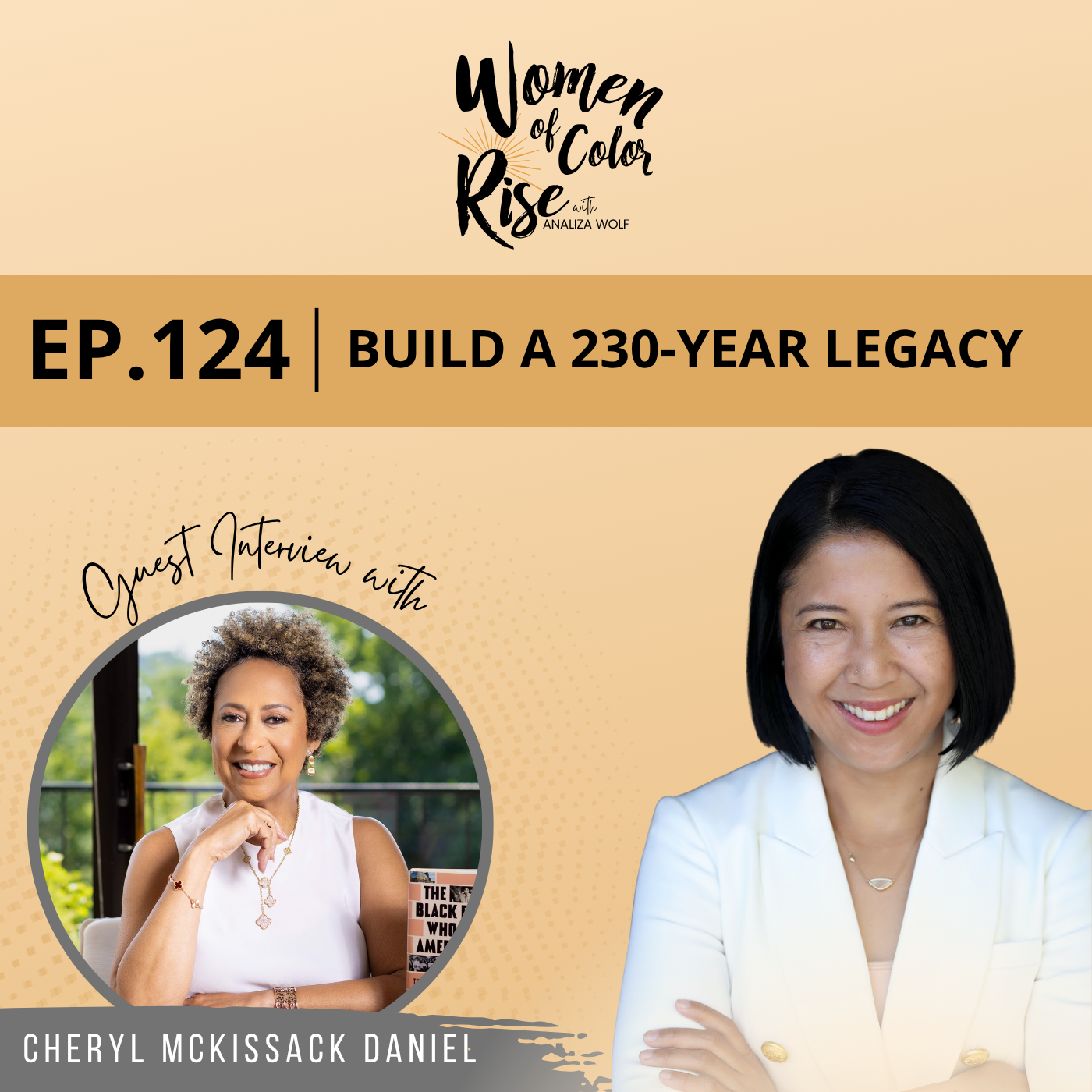
Episode 124 - Build a 230-Year Legacy with Cheryl McKissack Daniel
Women of Color Rise supports more diverse leaders at the table, especially women and people of color. We’ll be talking with CEOs and C-suite women leaders of color and learning about their leadership journeys.
How can you build a legacy that lasts for centuries?
In this episode, I speak with Cheryl McKissack Daniel, a fifth-generation builder and the Chair of the Board of McKissack & McKissack. Under her leadership, the firm has tackled monumental projects like the expansion of JFK International Airport and LaGuardia, and the construction of the National Museum of African American History and Culture.
Growing up in Nashville, Cheryl was drawn to the energy of New York but didn't initially see herself as the CEO of her family firm. It was only after entering the corporate world and seeing the lack of diversity at the top that she realized the power of her own heritage. Today, she carries the responsibility of a legacy that began with Moses McKissack, an enslaved man who learned the trade of brickmaking in the 1700s.
Analiza and Cheryl discuss:
The Weight and Pride of Legacy Cheryl reflects on the responsibility of being "excellent by necessity." She discusses how knowing her family built America gives her the confidence to walk into any boardroom and cut billion-dollar deals without feeling like an outsider.
The "5 Ps" of Success Cheryl breaks down her framework for endurance: Persistence, Preparedness, Perseverance, Productivity, and Prayer. She shares how these principles allowed her family to survive the Jim Crow era and thrive in industries that were never built for them.
Navigating Identity in White-Dominated Spaces With over 35 years in construction, Cheryl discusses being the "only one" in the room and how she transitioned from feeling on edge to viewing her unique identity as a data point of strength and progress.
The Power of Prayer and Meditation Cheryl shares a personal look at how she manages stress (especially after major health scares) through centering herself. She explains why her office has a meditation room and why "peace is her empire."
Advice for the Next Generation Cheryl encourages listeners to start their own legacy by researching their family tree. "It really does matter where you came from," she says, emphasizing that everyone has the capacity to build something that lasts.
Resources:
Book: The Black Family Who Builds America by Cheryl McKissack Daniel
Book: The Warmth of Other Suns by Isabel Wilkerson
Training: Brian Tracy Professional Development
Instagram: @McKissackOfficial
Instagram: @cheryl.mckissack
Facebook: @cheryl.mckissack.daniel
Website: https://mckissack.com/
Want more balance, joy, and fulfillment in your life today? Get a FREE self-care guide to Juice Your Joy!
Download and enjoy Analiza's Free Gift: Juice Your Joy.
In this bonus: You’ll learn about the age-old Japanese practice of ikagai, get a reflection sheet to identify areas that can bring you joy and how this can be part of your daily practice, and be inspired by real Boss Mamas who have transformed their lives.
Connect with Analiza Quiroz Wolf and Boss Mamas:
Website: analizawolf.com
LinkedIn (Analiza): www.linkedin.com/in/analizawolf/
LinkedIn (Women of Color Rise): www.linkedin.com/company/bossmamas
Facebook (Women of Color Rise): www.facebook.com/womenofcolorrise
Facebook (Analiza): www.facebook.com/analizaqwolf/
Instagram: www.instagram.com/analizawolf/
Youtube: www.youtube.com/analizawolf/
Join our next Boss Mama program!
Be part of an intimate group of other Bad Ass women like you to live the life you deserve - rocking at work, family, and self-care. More information here.
Nominate a Podcast Guest
Nominate a Podcast Guest (we do not take nominations over email):
Join Our Newsletter
Stay up to date on other Boss Mamas and get tips that work to get the balance, joyous, and fulfilling life you deserve. Sign up here.
Transcript
I am very happy to have Cheryl McKissick Daniel with us. She's the chair of the Board of McKissick and McKissick. It's the oldest minority and woman owned design and construction firm in the country. She previously served as president and CEO from 2000 to 2025. She's a fifth generation builder and author of the Black Family who builds America, and she carries forward her family's 230 year legacy while shaping the future of infrastructure, equity and generational wealth.
Cheryl, I'm so excited for you to be here. Thanks for coming.
Cheryl:: Thank you Analiza. So nice to see you.
Analiza:: Cheryl. I wanna talk about your, I mean, this legacy, it's fifth generation. You have had women, people, ancestors who come before you. And I'm curious, as a young girl, Cheryl, did you aspire to be the CEO to carry on the torch?
Was this part of your dreams that you'd envisioned for yourself?
Cheryl:: Not really. Unfortunately not. growing up in Nashville, Tennessee, my parents would. Take us to New York, uh, over the summers for a week or so to see plays. So I was extremely attracted to New York at a very early age. So I knew I wanted to be in New York in business, but not necessarily.
Running my family firm. It's very interesting when you have something as powerful as that, but because you're so close to it, you don't recognize that power, you don't recognize that you can charge your own destiny. you really want to go out into the world and experience something totally different.
And so, early on I didn't even think I would be an architect or engineer. I thought I would be. I wanted to, I really wanted to be an airline stewardess and travel the world. That was my dream. And you know, I was recently at a book tour and someone raised their hand and they said, now that you've accomplished everything you could do that.
it wasn't until I entered into the corporate world and began to understand, building a career and what that looked like and understanding that. The best route for me was to go back to my family firm, embrace that, lean in, build it, and be totally different than trying to climb the corporate ladder, which if you think about in the nineties.
It was very difficult. You looked at the higher echelons of the firms, at least the ones I worked in, but I think many people did not look like me. And so it was clear that a path for me was slim to none. You know, I could work really hard at it and probably could achieve a relatively good level of success, but not what I could, uh, by running my own company and charting my own path.
and so when I realized that I had this tremendous legacy, when I realized that I actually had the ingenuity inside of me to do it, I used to be a very shy person. So I learned not to be shy and to speak up about my family firm through my mother. and I saw her stand up in front of numerous crowds and just command their attention.
I never thought I could do that, but eventually she would say, well, sure, you know, you have that in you. I'm like, no, I don't. No, I don't. but. Eventually it does come out, and now I'm definitely my mother's child.
Analiza:: Cheryl, I wanna talk about you in terms of how you think about your identity, your race.
First, how do you identify and then second, how has that shaped this path of yours?
Cheryl:: I definitely identify as a Black American. There is no question I have two, African American or Black American parents. But of course we're mixed. We have quite a bit in us, but definitely identify as a Black woman.
It is hard to get away from that. In America, it'll remind you every day of who you are. It has shaped my opinions. It shaped me as a person. And, I am definitely happy about where I've landed. Many times I have walked in a room and I'm the only woman, definitely the only black woman, but I don't get as on edge anymore. Before I felt like I had to outperform, I felt out of place. I felt that people were talking around me, and now I just take it as a data point. Because I'm so used to it. I mean, I have been in this business for, what, over 30 years, 35 years. And so I'm just used to it now.
Most of the people that I work with and that I move and shake with don't look like me. And so I've made that all right. But I've also been able to say, Look how far we have come in 35 years and so that's pretty much how I look at it today when I found myself in that setting.
Analiza:: One thing you said earlier, Cheryl, is that running your own company, I mean, you would've done great on your own and gone to the standard McKinsey's and Goldman Sachs or wherever you decide to go. And yet you decided that running your own company and continuing your family legacy could amplify your success, your impact.
I mean, the types of work you've done. JFK International Airport, LaGuardia, Columbia University's expansion, Coney Island. I mean, the list is huge. Huge.
Yes.
Analiza:: And monumental. And, you know, the greatest city, let me call it, New York is in the world and that mm-hmm. That's you and your family's legacy.
Talk to me more about the idea of running, 'cause not everyone, most, every, the rest of us, right? don't have this legacy and yet you, declaratively said, running your own company for you was the pathway to impact and amplification. Can you talk about that idea? And for the rest of us mm-hmm. How does that concept apply?
Cheryl:: The legacy, it has a weight, and a pride and I know that I inherited at an unimaginable cost. So what I do with it really does matter. And where it really shows up is as a responsibility to be excellent because my ancestors were not protected. Mm-hmm. They did not own anything. They were operating day by day on faith.
They didn't know that they were building a generational company. but what they did do is. Do extraordinary things with what they had at the time. They were uneducated. and what that has taught me is excellence. I stand on the shoulders of four other generations that have sacrificed for me, so I cannot cut corners, I have to show up with my very best and the pride of it.
Now when I walk into boardrooms and cut a billion dollar deals, I think to myself, well, damn, my parents built America. My family built America. I'm supposed to be here. I don't feel like I don't belong anymore. I know I'm supposed to be there. And so I carry both the weight and the pride of this legacy forward knowing that the mission is to open more doors so we can break down more barriers.
So when women and people. Black and brown people show up at the table, they're welcomed. They don't have to be the only one in the room like we talked about earlier. Mm-hmm. They don't have to feel like they don't belong because my ancestors created this space a hundred years ago.
Analiza:: Mm-hmm.
Cheryl:: 200 and 30 years after Moses McKissack laid his first brick, the McKissack family is still standing as a pillar of resiliency and ingenuity, in America that is still dealing with grappling with. equity diversity and includes almost comical, where we are today. But these men received their license in 1922, over a hundred years ago in a profession that was really for the elite.
It was for European white men. Architecture was not for black people, but these two men. Decided they were going to get up on their drafting stools and draft anyway. And that was long before inclusion became a buzzword and diversity, a corporate matter. And they created spaces, not just physical spaces, but spaces for other black professionals to be able to shine and dream beyond the limits that this society had set on them.
I ultimately believe America wants to be fair. I really do. I think most Americans want to open up the mainstream for diversity because of. The effect diversity has, we clearly know that it brings more innovation and creates more profit for companies and diverse companies are sought after companies for young people to work at.
I am a big proponent of DEI. I am not afraid to talk about the elephant in the room. I can go deep into DEI, but I don't have to. McKenzie does it. McKenzie talks about the power of DEI. and so you know, people who want to, say this is for lowering standards. They're wrong. DEI is to make a system that was never neutral. More, more fair.
Analiza:: Amen. Amen. And I love that. I'm just like, preach, Cheryl, that was so, so, so spot on. I wanna talk about this thing. You mentioned earlier that your ancestors back in the early 19 hundreds had, your grandfather, Moses Mc, he founded the family business in 1905. And then. It was carried F forward 1968 it kept on going and going and so I wanna talk about legacy.
And even though at the time he might not have dreamed that this is what would be happening, these airports and universities and huge city projects would be happening. I wanna talk about legacy. Because imagine, imagine for those of us who don't yet have this incredible model that you've demonstrated for us, how might you inspire, advise, support?
Us with thinking through. Yes, we do want you to do well in life. Yes, we want you to provide for your children if you want children. And also there's a possibility of creating something even bigger and your family has modeled that for us. And, almost 150 years. Right. Of, they say seven generations.
We're almost, we're fifth generation now.
Cheryl:: Right.
Analiza:: How might you help us dream, Cheryl? How might you help us envision what impact could look like seven generations from now, like leveraging your and your family's example for us?
Cheryl:: Yeah, I think everyone can build a legacy.
Analiza:: Hmm.
Cheryl:: But you just have to do it with intention today. And it's a lot more about principles and the principles you put in place at an early stage. When we wrote this book, Nick and I, about. McKissick, we studied the McKissick, like, how on earth did these black men. Last, all these generations, I mean, I don't know if you know the numbers, but for a company to make it to the second generation is 40%, to the third generation is 18% and to the fourth generation is 3%.
And we're not even talking about black families. Okay. No. And here we are, the fifth generation. So we came up with the four Ps, and that was, persistence, productivity, perseverance, preparedness, and then I added the fifth p, and that is prayer. Mm-hmm. Because I believe God had to direct and make way for a lot of the steps.
I mean, when you think of Moses McKissick ii. Incorporated the McKissick first business in 1968, right after emancipation in a small town called Pulaski, Tennessee. Where the Ku Klux Klan started. Okay. And so the Klu Klux Klan, incorporated in, formed in 1968 as well, with the sole purpose of getting rid of any black people who showed any independence, any economic growth.
And here we have Moses McKissick ii, right there. Designing, designing the city square for Pulaski, Tennessee. So he is my next subject. Okay. I wanna know who his godfathers were. What people were working with him. but when we go back to the peas, okay. When I think about the persistence, that reminds me to stay in rooms that people don't really necessarily want me to be in.
Okay? But I persist anyway because. The act of just persisting and showing up is resistance all by itself. Hmm. Without saying anything, right? Mm-hmm. and then the preparedness we've talked about, and, you know, we've talked about excellence, how, you know, excellence does not have a gender. It does not have a race.
It erases doubt before it has a chance to enter the room. So. Chandra, my publicist will tell you, I am always prepared. Even if I don't get a chance to go, I am prepared. and perseverance really helps me when I think about the McKissick and their perseverance. It helps me when progress is slow and setbacks really feel personal.
It reminds me that my legacy was not built with one win. It was built by staying the course. My course, not anybody else's course. My course over a long period of time, you know, it doesn't happen overnight. This has been 35 years. Then when we get to productivity, that's like my favorite because that deals with results early on.
I would always say let the McKissick results speak for themselves. don't. Worry about what people have to say about Cheryl McKissick. Let people say that what the McKissick produced was beautiful, excellent, sustainable. It was the best and of the highest standards, because I think that again, creates a legacy.
and then the prayer, of course, That gives me clarity, clarity to deal with difficult problems. It also gives me the idea, lets me know that I am a part of something bigger than myself. And so all of that together gives me the conviction and compassion to lead this company every day, in the purpose of all the McKenzies that have gone before me.
You know, our purpose definitely has been a cultural and a historic one. and it's all around, preserving what we have built over the years. I mean, my mom used to say, we've documented. The black, history through our buildings over the last, you know, 200 years or however long. we've also preserved a way of doing business and those are the principles that, that I would, anyone who is looking to build a legacy,
Analiza:: Cheryl, these principles are incredible.
helpful no matter what station. And no matter whether you've started with privilege or you haven't, I love that they can last the test of time. I wanna go to this idea of prayer, Cheryl, because often in business books, product placement, right, they'll, they'll have all of these pieces, but it's often not the prayer that is lifted.
So you mentioned that prayer offers clarity and part of something bigger. I wanna ask you about clarity, Cheryl. When you mean clarity, can you share with us what, what do you mean? If you have an example, if you have even a process. Sometimes people say, here's, here's how I know I'm more clear or less clear and, and now I have conviction.
If you can bring us deeper into what you mean by that.
Cheryl:: Yeah. So business always has its ups and downs. you are bombarded today with more information than you've ever had in your life. I remember the calm days where people had to call you on the telephone. Mm-hmm. And if you were at a meeting, they couldn't track you down.
They couldn't stop you. They couldn't interfere with your train of thought. I find that a lot of this information just clouds the brain. All this bombardment just clouds the brain. And, you know, we have difficult decisions to make. And so when I say prayer, prayer means, first of all, I believe in a higher being that does orchestrate, who's all knowing, who's all powerful.
But I also believe that I need to center myself in that being. And the way I do that is to calm the mind. Calm the mind. You have to bring the mind into the present. I just truly believe in meditation and exhaling, and I do it on a regular basis, you know? But I've been through a lot. I've had a stroke. I've had open heart surgery, so I have let the stress get to me, but no more because I know the power of prayer, the power of meditation.
So when I say clarity, when you allow yourself to think about nothing but breathing that you are and you exist with a higher build being. Then when you come out of that, I have had situations when I come out of that where. I go into it very confused, not knowing what I want to do, but I understand that peace is my empire, and so when I come out of that, I can come out of that with a clear understanding of what direction to take, whether that's to pick up the phone, call somebody if it's to send an email.
If it's what relationships I need to, build whatever it is. if it's just the words to say the right words to someone, that's what I get when I go into this space. And let me tell you, I try to do this every day in our office. We have a meditation room. And when things get tough, usually in the afternoon, right?
Usually around three o'clock, you're kicking in for the second half of the day. Because after leaving the office, there's usually a reception, a dinner or something where you are now going into a space with. A lot of people, a lot of different energy. and you need to prepare yourself for that energy.
That is when I can definitely meditate and I only need 10 minutes and I'm fine. But I definitely suggest that, and understanding that, whatever problem you have. Whatever is bothering you, you created it through your decisions.
Analiza:: Mm mm-hmm.
Cheryl:: And so if you created it, you can certainly get yourself out of it.
Analiza:: Great. Okay, Cheryl. Oh my gosh. What an amazing conversation. Are you ready for our lightning round questions?
Cheryl:: Absolutely. Let's go.
Analiza:: Chocolate or vanilla?
Cheryl:: Chocolate.
Analiza:: Cooking or takeout?
Cheryl:: Takeout.
Analiza:: Climb a mountain or jump from a plane.
Cheryl:: Climb a mountain.
Analiza:: Have you ever worn socks with sandals?
Cheryl:: Nope. That is a faux pa.
Analiza:: How would you rate your karaoke skills on a scale of one to 10, 10 being Maria Carey?
Cheryl:: Oh, two.
Analiza:: I was gonna say
Cheryl:: Five.
Analiza:: What's a good book that you've read besides your own? What's a good book you've read or a recent book?
Cheryl:: Warmth Other Under Other Sons by Isabel Wilkerson.
Analiza:: What is your favorite way to practice self-care
Cheryl:: Meditation.
Analiza:: What's a good professional development you've done?
Cheryl:: Brian, Tracy,
Analiza:: What is your definition of a boss Mama?
Cheryl:: What?
Okay. I might be too old for that one.
Analiza:: What advice would you give your younger self?
Cheryl:: Girl, you're gonna be okay.
Analiza:: Aw. And then where can we find you? LinkedIn. Where else?
Cheryl:: LinkedIn, Instagram, Facebook, Cheryl McKissick, Cheryl McKissick, and also, at McKissick Official, which is my company handle.
Analiza:: Great. Last question, final ask, recommendation or any parting thoughts to share?
Cheryl:: Any parting thoughts? Yes, you can build a legacy, but start with a family tree. Anyone can do that, especially if you know who your parents are. and that's two generations right there. go on ancestry.com, look up who are your relatives.
It really does matter where you came from.
Analiza:: Beautiful. Cheryl, thank you so much for this conversation.
Cheryl:: This was great. Anyways.
Analiza:: Thank you so much for carving out time to hear today's podcast. 3 things before you go. First, if you found it helpful, please leave a five star review. Second, you can get a free chapter of my book, The Myth of Success: A Woman of Color's Guide to Leadership at analizawolf.com/freechapter. And lastly, if you're interested in executive coaching, please reach out to me at analiza@analizawolf.com. Thank you so very much