Analiza:: Welcome to the Women of Color Rise podcast. I'm Analiza Quiroz Wolf, proud Filipino-American executive leadership coach and former CEO of a nonprofit and Captain in the U.S. Air Force. I'm also the author of The Myth of Success: A Woman of Color's Guide to Leadership. It's based on the lessons learned by many women of color leaders, including those on this podcast. We talk with successful CEOs and C-suite women leaders of color and learn about their leadership journeys. I'm on a mission to support having more diverse leaders at the table. If you're a woman or a woman of color who wants to sit at that table, you're in the right place. Now let's get into today's show.
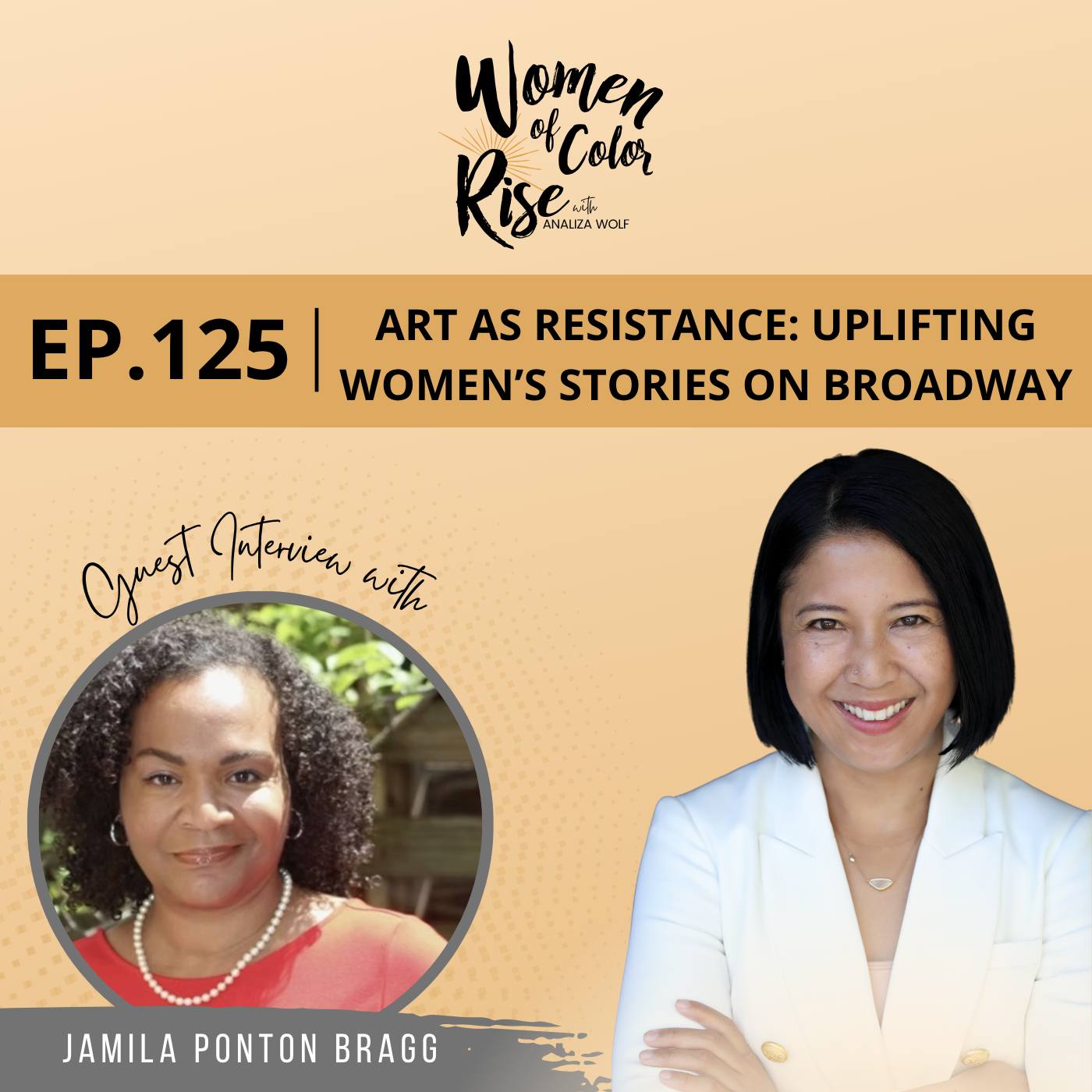
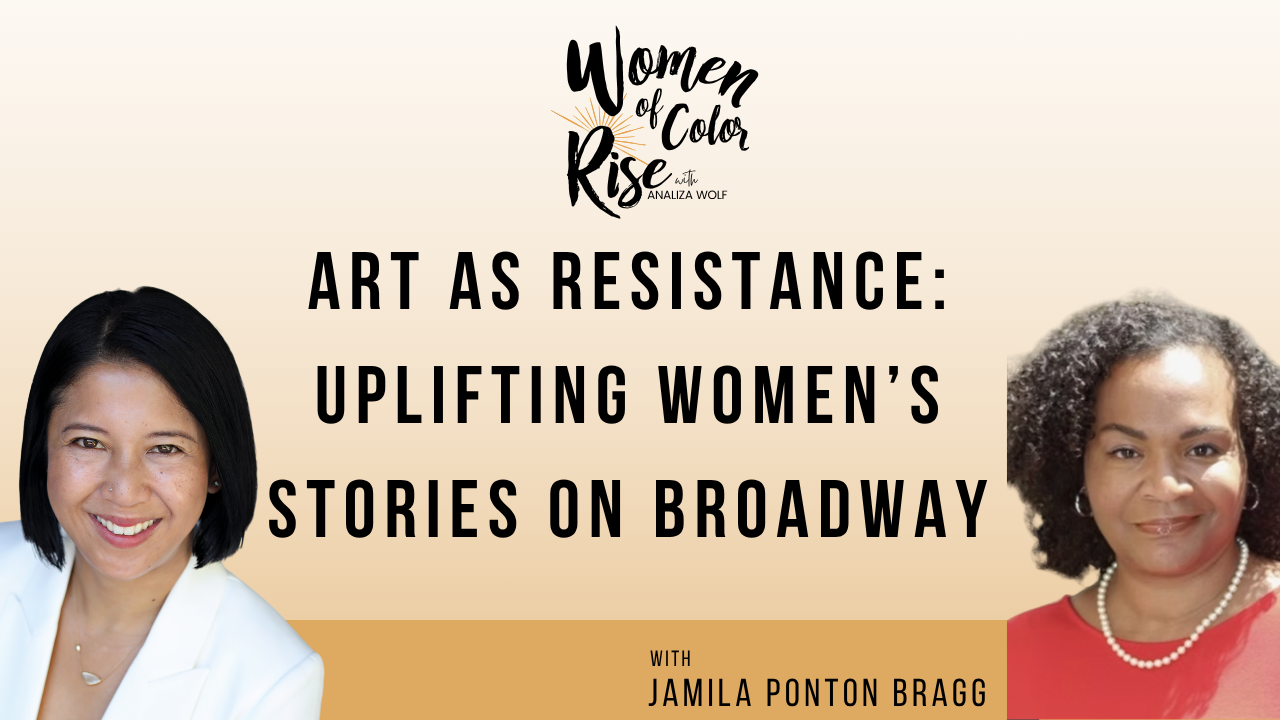
Hi everyone. I am so excited to be with Jamila Ponton Bragg. She's the founder of Jam Rock Productions, a theater production company committed to the works for women, about women, and by women after nearly 20 years in the nonprofit industry. Jamila transitioned into theater production. She's got so many amazing projects from the Blackburn Prize winning, and she's also done incredible works like Death of a Salesman, the play Fat Ham, which was a Tony nominated best play, the Wiz, and Soul Train.
Jamila also has a background having been named Broadway Women's Funds Woman to watch on Broadway. She graduated from Duke, a BS in Psychology, a master's from the Harvard Graduate School of Education. She's originally from Pittsburgh and resides in Harlem. Jamila, thank you so much for being here. Very excited about this conversation.
Jamila:: Thank you for having me.
Analiza:: So let's start with this question. How do you identify and how has that shaped your career?
Jamila:: I am an African American woman. I am a Black woman and I can't put one above the other. Me being black influences how I show up as a woman and how being a woman is influenced by how, by being black.
And they can't be separated. It is a, I’m very cynical about it right now, I believe, which is terrible. I know. But I believe that the world hates women and I really believe that the world hates black women. And yes, there's some lingering from the elections, election and elections. But it's also just the constant war on women in the constant way that we have to constantly prove ourselves again and again.
And how it influences why I want you to find ways to amplify women because our stories aren't told in the right way or we are. Put in a box or we are represented in their tropes or stereotypes. And so any story that I support, I, it is important to me, even if a woman isn't the main character, that women have depth, that they have depth to them, to them, they have depth to their character.
and that's, that's important to me. And I'm grateful that I can be in this space to be able to find ways to lift up women and stories about women.
Analiza:: Jamila, this passion of yours, it started. Much earlier. It wasn't like this in the last couple years with the politics going on, you've been committed for decades now,
Jamila:: Women and girls in championing women and girls has always been important to me, even in my nonprofit years. One of the companies that I worked for was Girls Incorporated, and Girls Inc. It is dedicated to making all girls strong, smart, and bold and so, so yeah, it has been something that, it's been the fabric of any of the work that I've done and not surprised that I've been able to continue that even in the switch of a career.
Analiza:: Jamila, what are your thoughts on this? The pendulum swings because it's an honorable cause when I am also, I feel like you're a sister in that. That's one of the reasons I wanted to connect with you is that there's a kinship in the work and often, I mean, we're like goddesses that seem to have forgotten.
the world has seemed forgotten sometimes. We also have forgotten. Our mothers are, you know, incredible ours, and then our daughters in the future generations and. There's this lineage of power that we've forgotten. And so I connect with you on that. And particularly Jamila, that you have the, I mean literally the stage for it.
Mine is the podcast and books and, and meeting people and then, people like you were so inspiring, but you literally have the stage.
Jamila:: Mm-hmm.
Analiza:: I want to talk about that because that. Is a gateway as someone who's a spectator and someone who claps and says like, wow, the Wiz, like groundbreaking.
Can you talk about what it's meant for you in theater, being able to have that cause? How has that influenced the way in which you? Cast your productions that you, um, cast the storyline that you, um, that you convey this message. Can you talk about that as someone who, who is behind you, is behind the scenes?
You were the vision completely
Jamila:: behind the scenes. And I, one of the things I've learned about being a producer is it's about the people that you surround yourself with.
Analiza:: Mm-hmm.
Jamila:: And anytime that I work on a project or what I'm doing, the people that I choose to work with. Also have to share those ideals in some way, in the way that they show up with the casting directors.
What I just said about the casting director, the casting directors that I choose, the directors I choose to work with the writers that I choose. That really starts with the writers. It's about the people that I choose, that they also, that these are their values and the stories they want to tell and be involved in are also the lifting up of women are also important to them as well.
I tend to think about and it is just little things and you just tell. I mean, as you said, we've been able to connect and get a vibe from just spending time with each other. If you figure that out when you're talking to people, when you're getting to know people, when you're asking them questions about something, you, you figure out pretty quickly whether or not your values are going to align pretty quickly that or when it's not going to work and what's something that puts you off.
And I've learned to trust that instinct. I've learned to trust. When things don't align or when we're off. And so I am a little more wary of that when I'm, when I'm working with somebody or choose not to work with them. is really, it is really that, but it is, you know, if our tastes align at the same kind of stories that we're choosing a line, you can tell a lot about that.
I've also been in situations where I figured out this is what's interesting about a project, the, the. The play that you mentioned before. A way to the writer, AK Payne. Brilliant young writer, that I'm proud to support and pour into. I was asked to be a part of another project. That is by a different writer, Abigail, if I pronounced that correctly.
and I was getting to know Abigail and found out that she and AK are best friends, and I was like, of course we would be drawn to each other. I'm drawn to the same thing in both of you that connects the two of you. And so it's little things like that. It's really the people and the vibe.
Vibe. I don't mean to. To feel like vibes are something that's not, make it a bigger, oh, that there's no, it is not professional in any way, but it really is. We have our tastes align our interests align the way that they want, the right writing that they have aligns the choices that they make as a casting director, the choice to make as director.
All of that aligns.
Analiza:: I hear you say the importance of finding your people, finding community. Especially when the message is maybe not mainstream and there is power in seeing ourselves in each other and being able to lift up. I'm going to say it is a tough time.
It's a tough time to be women, a woman of color, a black woman, and filing solidarity. Finding ways of saying, I see you is critical. I want to talk about Jamila, your way of standing strong during these waves of opposition because you have continued for decades fighting the fight, like lifting up. as sometimes people falter.
How do you in these waves stay strong? And if you have examples of, in theater, a challenge that we face is this sign of challenge and here's how you have been able to weather the storm.
Jamila:: It's a great question. This time I wanted to make sure I'm, forgive me for being distracted. It's an, I want to get her last name right.
Abigail An mm-hmm. is the playwright. You know, I think making art is an act of resistance right now. Having the opportunity. I'm so grateful that I have the opportunity to make art, to pour into these artists, to support these projects. That is what's keeping me going right now.
Truly the fact that I can continue to lift them up. I think about what my grandmother says, all used to say all the time, this too shall pass. I do trust that we will get on the other side of this. But what's going to be on the other side of this is, of course.
and I think that by focusing on the art and making art will make whatever is on the other side of it, of this. A little brighter and knowing that it was, I was committed to making the art and lifting up these voices and working with these playwrights, and working with these artists, that's what I'm doing is the commitment to the art.
Analiza:: Art as a forum, as an act of resistance.
Jamila:: This is, that's what I can do right now.
Analiza:: Jamila talking about that. it's a time where it's hard to take, have courage, especially now what makes art, I think, incredibly special is that you share it. It's not like I'm going to do my art, my little room here and, and it's end of art is beautiful no matter what.
But the power that you're sharing is that you want to. Make sure that others can see it, that they, you can amplify, that you can lift others. And so I want to talk about that because it's even in our conversation, right? Like, oh, we're talking about resistance, we're talking about the other side, who's going to listen?
And I, I think that's the point is that you keep on keeping on, but there's also risk and there's fear. And with work that you do, I want to talk about that, that, that. That piece of having courage in yourself, having inspiring courage in others, what does that look like?
Jamila::I don't know until someone says how much they appreciate me pouring into them or how much they appreciate the things that they do.
And so I've just learned to. the little things that you can do, it's the follow-up email. It's the check-in. It's, how's this project going? It's the, how are you doing in this? is this okay? That's what is showing up. Mm-hmm. And that's what people are, remember it, the phrase people don't remember.
That people don't remember what you do. People don't remember what you say. People remember how they, how you treat them, and that that's the most important thing. And so showing up, if I can show up, I will. And so it, it's showing up. If I can go see a play, if I can go see a performance, a reading, I will, I'll do my best to do that.
The little things are, is the way that, that, that I can do that and the PE people will tell me they appreciate those things and so that's all we can do for each other right now. I appreciate when people show up for me and I and that, and so all I like to do is try to reciprocate that.
It's really the little things right now
Analiza:: as someone who also has heard from others how. The work that I do has impacted them even the smallest way. That means a lot. So I, I have to just say like, yes, exactly. It doesn't have to be, although it would be helpful, right, to say, let me do some work with you, or here's a, you know, an opportunity.
It could just be we, I see you and I thank you and I appreciate you. That's true. Jamila. I want to talk about you, with the many productions you've done, you've done so many, I mean, groundbreaking people are talking, and I didn't even realize it was you, and I'm like, oh my gosh, I'm talking to you.
I would actually say draw, open up the curtains of it into your own experience. Tell, tell us about one that was particularly moving for you. It could be. Working with a specific person or the play itself, but bring us behind the scenes. For you personally, what was one that really took you back?
Jamila:: Yeah. I appreciate you highlighting the work. different. I have different roles. I take different roles in different productions. So the co-producing that I've done is mostly that I've been able to raise money for a show. and, but I only join a production if I am drawn to it in some way.
There's, I tell people, there's always a reason why I do a production. So for Passover, it was about the writer Antoinette Nwandu, who I think is a brilliant writer. It was about being able to support her and support that work. Death of a Salesman was about the fact that it was the first, black Loman family that Wendell Pierce was starting at. I adore the play, Death of a Salesman. I saw Brian Dennehy do it years ago. It's one of my favorite plays. I do believe it's one of the Great American plays. And so the opportunity to see that, to be a part of that in a small way was great. Fat Ham I did because the writer, James Ijames and the directors are very talented theater makers, and I was just excited for the opportunity to be a small part of that.
The Wiz was, of course, it's The Wiz, right? but more importantly it was directed by Schele Williams, a Black director. And so the opportunity to support her and support her work was great. But yeah, it's the Wiz too. and my connection to the Wiz, my mother played that. That was our cleaning music when I heard that music come on. And we knew it was Saturday morning in time. If you weren't up cleaning, you were going to be in trouble. So that was the connection to that.
Gypsy was not only about, of course, the Audra of it all and being able to support a project that Audra McDonald was in. But one of the lead producers, Mara Isaacs, is someone who is very inspiring to me. The way that she manages a project, the way that she shows up, the opportunity to be a part of that and to learn from her, was great. and also, Camille a Brown, who was the choreographer on that, I followed Camille's career for many, many years, and so proud of her. The opportunity to show up for her was great as well.
But the projects that mean the most to me are the ones that I am developing. And it's specific to, as I mentioned, we mentioned a way to, earlier, the Blacks, which is a play that was originally written in 1957. It's a French play. The first US production was done in 1961. The Blacks is about a black man on trial for killing a white woman. But it's an exploration of race, of class, of whiteness, and blackness. It's a lot of layers to the play. The original US cast was Cicely Tyson. James Earl Jones, Maya Angelou, Roscoe Lee Brown, Lou Gossett Jr., Helen Martin when they were babies, in the sixties. And again, pouring into up and coming writers and directors. Miranda Hamann, who's a young, brilliant, young director, this was her idea. Miranda brought this to me and said that she wanted to bring the blacks back, and so I've been really excited to give Miranda her opportunity to have a Broadway debut and to pour into her and put everything around her to be able to make that happen.
So that's exciting supporting AK and supporting AKs work. Not just a way to, but also any future projects. I believe that AK is one of the bright lights of the 21st, going to be one of our bright lights in the 21st century. And so the opportunity to kind of support. Her beginning of her trajectory is really, really exciting.
I also have the option, one of my projects, Betsy Brown. Betsy Brown is one of Zaki Shaw Gay's, lesser known works. she's mostly known for, for colored girls who commit, who considered suicide when the rainbow is isn't enough. But Betsy Brown is one of her books that was. Some are semi autobiographical. It's about her family's time when she was 13, when they were living in St. Louis. And it's really about, it happens around the brown v board of that court case. And so it's this family living integration and it's this family of what happens to this, this black middle class family that was living.
Very wonderful, rich life with all of these other black middle class families. What happens to them when they're, when they have to do an integration? So working with Erica Dickerson Despenza and figuring out what this works. So I enjoy developing the projects and finding ways to support these young artists and give them the opportunity to thrive truly.
Analiza:: I mean, so many things you've shared there, legacies. These are like Broadway. These, I mean, this is where we change. How we view Broadway. It's incredible. So incredible. Congratulations, Jamila. Thank you. I want to ask you about this fundraising piece. I mean, not only are you going after art. No matter how challenging the circumstance and with people who often don't get our voices heard, we're not really seen.
I mean, wow. And then you're going to fundraise, like, wow. You, I mean, you're just like, choose challenging, or challenging your challenge. Yeah.
Jamila:: I do everything at a B plus level, like everything could be better. Oh so the issue, the fundraising is very, very hard, particularly in this climate. But I've been very grateful to find people who want to, who have the resources and want to use their resources for good. And it's finding those people and it's finding when. When you find those people, the fundraising is easy. And so it, it's back to your point about staying true, staying true to what you believe in.
Staying true and staying on kind of message on, on, on brand and being committed to work. being committed to work by women and talking about that. I've been lucky to find people who are interested in supporting that.
Analiza::Yeah, it's hard.
Jamila:: I'm not, it doesn't happen overnight when it does happen, I'm always like, okay, yes, this is why I'm doing this.
Analiza:: And what's great is that you just continue to have the same message. You're so dependable. and to know that you stay the course, no matter. The situation. I mean, that must be a huge trust that you have for the people that they have for you, for the people who you know, fund. That's true. Put your money where your mouth is.
Congratulations.
Jamila:: Thank you.
Analiza:: Okay, so I have a question as a mother of a daughter who's interested in art and for all those others who would like to follow in your footsteps to say, wow, one day maybe I can have an impact like Jamila Ponton Bragg. And so what kind of advice would you give?
People who come after, which also includes, I wish I had known. Right? It's not just like all the inspiring things, but also like, be ready. Be ready. Right. So any, any wise words to share because people want to be you.
Jamila:: Well, I don't know about all that, but I appreciate that it's very sweet. I have been very lucky to have really good mentors, and I tell people all the time, find a mentor, find people who are doing what it is that you want to do, whether you are just switching careers or thinking about switching careers, or if you're just getting started to young writers and young playwrights and young directors find people who are doing what you're doing.
I think you'll be pleasantly surprised. Like for when we were. First starting, you could do email. You had to call people and you had to schedule time to call and you had to hope that they'd take your call and that kind of thing. You can send an email and everybody's checking their email constantly.
If they don't answer you, they don't answer you, but you did it and, but more than likely, they actually will answer you and they will take the time to talk to you. So mentorship and building a network is, I think , one of the most important things that you can do. I always do. Tell people and I'm, I try to do it myself that when you're having conversations with somebody, you end it with.
Is there anyone else you think that I should talk to? Do you have anyone else who you think might be interested in hearing what I'm saying and just the one or two PE people that they name, that you never know what can come from that? but mentor, I've had just the mentorship, I've learned more.
I have one woman, Nugent, who is the producer she's been producing for years and years on, on Broadway and film. When, during the pandemic, when I first started doing this work, one of the things that I was. I'm a part of the Women in Producing Network and we were on Zoom during the pandemic, and we would meet every other week and we would just mostly lament, the status of what was happening and all that.
But Nell was there and honestly, you could learn more in 20 minutes from Nell just talking and listening to her experiences than for any kind of other things that you're doing. But, so it's really about connecting, and keeping checking in and finding the people who inspire you.
Analiza:: It's interesting how you come back to that very first point that you made in this conversation, which is.
Find people who are values aligned.
Jamila:: Yeah.
Analiza:: And that includes what the people you pour into, but also people who can pour into you that it's, you know, it is a fountain. And we can give, there's no like, oh shoot, Jimmy just took for me now I'm hungry or thirsty. Actually, that's not true. If you pour, others will pour into you.
So I love that so much. With that, Jamila, are you ready for lightning round questions?
Jamila:: Let's go. Let's go.
Analiza:: All right. First question. Chocolate or vanilla?
Jamila:: Chocolate
Analiza:: Cooking or takeout?
Jamila:: I like to cook.
Analiza:: Climb a mountain or jump from a plane.
Jamila:: I guess. Jump from a plane because you gotta come back down the mountain.
Analiza:: Have you ever worn socks with sandals?
Jamila:: No.
Analiza:: How would you rate your karaoke skills on a scale of one to 10? 10 being Mariah Carey.
Jamila:: Oh, you mean my voice or my skills to know the words to something? That's two different things. Your
voice.
Jamila:: My voice is, oh, my voice is like a four. I'm not a good singer. But I know the words. I can give you all the words.
Analiza:: Nice. That's a book you read, a good book or a recent book.
Jamila:: I'm on a memoir kick right now. I just finished Jeanette McCurdy's. I wish my, I'm not, I'm glad my mom had died, whatever.
I forget the name of the title, but it was Jeanette McCurdy's memoir.
Analiza:: What's your favorite way to practice self-care?
Jamila:: My shows, my binge watching of my shows.
Analiza:: What's the show?
Jamila:: My daughter and I are about to start season two of the Pit tonight. I think if she finished season one last night, she was supposed to stay up and watch season one so that we could start season two together.
Analiza:: What's a good professional development you've done?
Jamila:: Probably, the fellowship that I did at Columbia of the Prince Fellowship and joining that community and the work, the taking the classes and the, the mentorship that was part of that I think is in terms of kind of my trajectory and pouring into myself and in professional development, probably that.
Analiza:: What's your definition of a Boss Mama?
Jamila:: A Boss Mama. Someone who just gets shit done.
Analiza:: What advice would you give your younger self?
Jamila::Don't be afraid to go for your dreams. Had I known that I should have just. I went to LA and became someone's assistant to be a TV writer. I wish I would've known that and I would've done it because I, when, for years, when I was working in a nonprofit, even now, my dreams, people would ask, what's your dream job?
And it would be to be a TV writer, to, to be a TV writer for a show. But I didn't know what I, this, we didn't have that pipeline. To the entertainment side. So I didn't know that I just needed to just be someone's assistant, and that was work that I needed to do to be able to get into a writer's room, to get, being a show runner.
Like I now know that path, but I didn't know that. So I wish I had known that I could have found a way to get to my dream, I totally would've been an assistant. I would've left school and picked up and gone to LA.
Analiza:: Jamila. I just have to ask that question. How would you have known that?
Jamila:: Right. That's what I want to do, it's no different than the pathway to being a doctor or being a lawyer. A lawyer, right. You know that you gotta go to law school.
It's just the pathway. But I wasn't exposed to the pathway. The school that I went to isn't known for it. It works in that area where other schools are, other schools do have that pipeline. And so it just was one of those things, I just didn't know that it was an option. It's talking to people again, back to talking to people who are doing what you want to do, even if it's like, even if you are in finance right now and you're in finance and you're on that pathway, but you have a passion for art and being an art, working in an art gallery, go talk to someone.
Go talk to someone who's running that gallery. You might not be there yet, but you might get there at some point. So it's constantly talking to people who are doing that.
Analiza:: That's great.
Jamila:: Doing what you want to do.
Analiza:: Where can we find you? Like LinkedIn, anywhere else?
Jamila:: You can just Google Jamila Ponton Bragg.
I will show up, on all, all the things. I'm actually terrible at LinkedIn. I really need to be better about updating that. I'm horrible at it. and, but yeah, you google me, I'll show up.
Analiza:: And then can you share a final thought recommendations with us?
Jamila:: Thank you for this opportunity to talk. That's my parting words. I'm so grateful. Excuse me. I'm so grateful that we had the chance to spend time together. I'm grateful for, you know, like being in community with someone who. Also believes the importance of lifting up other women. So thank you so much for the work that you are doing by doing these podcasts like this has been great, and I wish for other people to find, find chances to do something like this.
Find ways to, to talk about your, your passions. Find the people who want to listen to you.
Analiza:: Jamila, thank you so very much.
Jamila:: Thank you.
Analiza:: Thank you so much for carving out time to hear today's podcast. 3 things before you go. First, if you found it helpful, please leave a five star review. Second, you can get a free chapter of my book, The Myth of Success: A Woman of Color's Guide to Leadership at analizawolf.com/freechapter. And lastly, if you're interested in executive coaching, please reach out to me at analiza@analizawolf.com. Thank you so very much