Analiza:: Welcome to the Women of Color Rise podcast. I'm Analiza Quiroz Wolf, proud Filipino-American executive leadership coach and former CEO of a nonprofit and Captain in the U.S. Air Force. I'm also the author of The Myth of Success: A Woman of Color's Guide to Leadership. It's based on the lessons learned by many women of color leaders, including those on this podcast. We talk with successful CEOs and C-suite women leaders of color and learn about their leadership journeys. I'm on a mission to support having more diverse leaders at the table. If you're a woman or a woman of color who wants to sit at that table, you're in the right place. Now let's get into today's show.
Welcome to the Women of Color Rise podcast. I'm Analiza Quiroz Wolf, proud Filipino-American executive leadership coach and former CEO of a nonprofit and Captain in the U.S. Air Force. I'm also the author of The Myth of Success: A Woman of Color's Guide to Leadership. It's based on the lessons learned by many women of color leaders, including those on this podcast. We talk with successful CEOs and C-suite women leaders of color and learn about their leadership journeys. I'm on a mission to support having more diverse leaders at the table. If you're a woman or a woman of color who wants to sit at that table, you're in the right place. Now let's get into today's show.
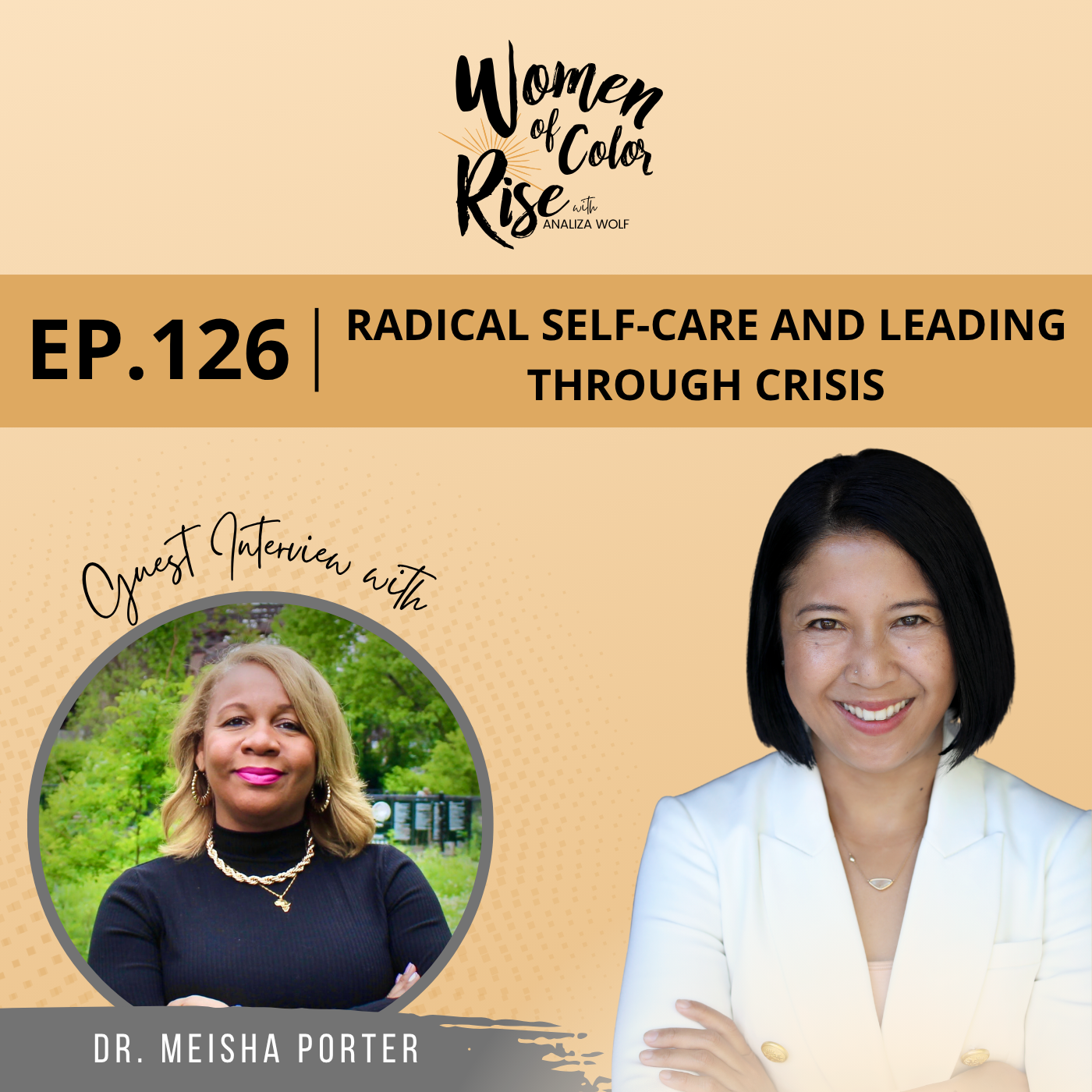
Welcome everyone. I am thrilled to be with Dr. Meisha Porter. She is currently a senior visiting fellow at the Center for Education Innovation, where she leads the development and growth of CEI Bronx. It's a hub for innovative equity driven learning, a lifelong Bronx educator and leader. She previously served as the inaugural president and CEO of the Bronx Community Foundation, and as Chancellor of the New York City Department of Education, the very first black woman to hold that role.
Meisha is deeply rooted in the Bronx, and she continues to champion transformative education and community empowerment through her leadership and service. Isha, thank you so much for being here.
Meisha:: It's a privilege. Thank you so much for having me,
Analiza:: Meisha. I always ask this question, which is how do you identify and how has that driven your career?
Meisha:: Yeah, so I mean, I identify as a black woman. and I feel like that's impacted my career. I think women generally, like we are nurturers, right? And I think black women in particular carry a heavy sense of responsibility. About not only nurturing the children, we birth, um, the children in our families, but really carry a heavy burden, a historical burden, frankly, of nurturing community.
And so that for me is how it's shown up in my career. And then in the multiple roles that I've held across the city, that kind of black woman community, nurturer, including when I was Chancellor and probably more than because of the time during which I was Chancellor, I felt a big sense of responsibility.
For showing up for all of the roles and people I represented. I was a student in New York City Public Schools. I was the parent of a New York City public school student. I was a teacher in New York City public schools, right? Like I was a principal. And I felt a huge responsibility to show up for all of those people and even for myself in all of those roles I served.
And I think the biggest compliment that I receive today, even. When I ran into people on the street, just two days ago, a woman came up to me and was like, I just wanna thank you. It meant so much to us when you sat in that seat and my identity as a black woman is so critical to that. and so many black women come up to me and say that to me.
And I'll say one more thing. When I was Chancellor, when I would visit schools, black women would like it. I'm a hugger, and so I hug strangers too. I'm like, I'm a hug. Gimme, I hugged three people before you. Now I gotta hug you too.and so I would hug a black woman in a school and they would just lean in and hold me a little tighter and say, we're praying for you.
We're thinking about you, and we love you. And that, that for me was like, it was a part of my leadership journey. Like my identity is such a part of my leadership journey.
Analiza:: Meisha. There obviously is so much grit and love and care in both your mission of nurturing and nurturing, my goodness. I mean the largest school district in the country as well as nurturing yourself.
You mentioned that. So I wanna go to this idea of myths because I wrote a book about Myths as Women of Color. Obviously we're not a monolith. But there are things we grow up with that serve us. And then there also myths that, gosh darn, when we look back, Ooh, that wasn't quite right.
So I'm curious if you consider myths that you grew up with, that you reflect on and maybe weren't quite spot on. Do any come to mind for you?
Meisha:: I think the myth that you can have it all and do it all, Like I, when I walked away from New York City public schools, I was. Physically, emotionally exhausted.
And I gave, and my career in New York City, frankly, I remember when I, people are like in New York City, right? Like the superintendency is a bit different. It's, you are more like an area superintendent. The Chancellor is the superintendent. And so when I was a principal, like there was no beginning or ending like, I'm responsible for these babies.
These are my babies. And so when I shifted from principal to superintendent, it was like, whew. It was like a bit of a load had been lifted. Even though I was responsible for a district, I was responsible really for cultivating the relationship amongst principals so that we built a district together and didn't operate as individual schools.
And so this myth that you can have it all, do it all, absent rest, absent self care, absent pauses, is a myth. It drains you. It makes you sick. It does not allow you to replenish your soul in the things that you need for yourself. and I'm talking about selfishness, right? Like, I tell people all the time, I'm coaching, I coach, I mentor, I, I tell anybody I'm coaching, I'm mentoring.
I want you to do something selfishly for you. Between now and the next time we talk. And I don't mean like, oh, we're gonna have family dinner. No, I mean, Analisa, you, Meisha me. Not for your husband, your wife, your children, your mother, your job, your something that is, I don't care if it's, I got $20 left to my name and I'm gonna go get a pedicure.
That's what I'm gonna do. I'm gonna go get a pedicure. I was in the pharmacy about a month ago. This young woman was picking up her prescriptions for her and her children, and she had like 10 things to pick up. And like I watched her sort through them, right? Because she couldn't afford to pay for all of them.
And so I said to the lady, I was like, how much is it? How much is it? And she's like, I gotta figure it out. I was like, just tell me how many it was. $50. Like for me, that was insignificant for her. She had to make a decision. So I was like, I'm gonna pay for it. So, the young lady passed me $20.
I was like, I don't want that. You cannot, I'm not gonna take your money. I was like, I want you, your repayment to me is for you to take this $20 I and do something selfishly dumb. It might be your last, I know it was for prescriptions, but you can't be all and everything to everyone without taking collective pauses to pour in and be to yourself what you need to be.
I don't care how rich you are. I don't care how poor you are if you don't take a pause. To like to engage in self-care. Audrey Lord talks about radical self-care as a radical act of resistance. It's real because you can't, there is anybody who thinks I can do it all, I can have it all, I, you know, and it, and don't realize it costs you something.
That to me is the biggest myth out there that like it, everything is yours to have. It is. With self-care, with pauses, with thinking about what it means to have it all and what you're sacrificing to have it all.
Analiza:: Meisha, I want to go into the specifics here.
Meisha:: Mm-hmm.
Analiza:: You have had this very, very big, big job, very public, big job.
So I wanna ask you, what's that? You mentioned there is a cost, and I want you to go there because it's helpful for us to see that if you're human, you're also human. So talk about that.
Meisha:: No, the cost was my marriage and thankfully we survived. The cost was my family and not being present for my family because like I had the job.
And, I shout out to Chancellor Banks, Chancellor Ivy Remos, Chancellor Samuels, Chancellor Carranza before me, Chancellor Farina, but I had the job at the hardest time possible, COVID. Mayoral transition, like some, there were shifts that needed to happen. We need to bring students back to in-person learning, and it required all of me, which meant my family got.
None of me, not in the way they are used to me showing up. And I tell people that when I was Chancellor, it was probably the hardest time in my marriage. Not 'cause my husband wasn't there for me, he was there for me. He was supportive of me. He was actually the one, he was like, Meisha, you gotta do this.
And I'm like, but. And he's like, no, I remember when I was going to meet with the mayor about the job, he was like, this is gonna happen for you. And I was like, I don't know. They just talked to me. He was like, this is gonna happen and you have to do it. And so it wasn't a lack of support, but it was a lack of, it was like a time when we weren't connected in the way that we are.
And I tell people, now that I've had that done, that I learned from it. This is probably the greatest time in my marriage since we started, because we are empty nesting and learning and loving how to love each other in this new story of us. But the hardest, it was so hard on my marriage, because I'm still a wife first and a mother first before Chancellor.
And during that time I was Chancellor first,
Analiza:: Meisha. Can you walk us practically through this big job leading through COVID marital transition on top of the normal crisis? Oh, being a Chancellor, how does one, could you have actually been a mom first, a wife first? Could that even have been possible? Are you saying its chapter is Analiza, this chapter was Chancellor first.
Then later you can look at that. Or is it possible that we can actually lead with our identity as mom, as a wife, and then job?
Meisha:: I think I led with my identity, but I think I put. the ways I showed up as mom and wife. I would also like to give honor and thanks to my family for supporting me, but I think I shifted my priority and I felt like, it might have been me, it might not have been, but I felt like I had to be Chancellor first.
Mm-hmm. In that moment for where we were. We needed to get kids back in school. We needed to open buildings. My mantra was open for in person learning, open for powerful summit opportunities, and open, you know, get our middle schoolers back in, in person because we didn't have middle schoolers back yet.
Right. Like, so it was open. And you know, I. had more time, had we gotten out of the pandemic while I was still Chancellor then I think, but I think the conditions of the moment, I don't think that cha like the job is a big job, right? And so I'm sure Chancellor Samuels, who still likes getting his sea legs under him.
I'm sure he feels some of that. But I think the urgency of the time in the moment required me at that time. the. Responsibility placed on me, required me to be Chancellor first and to be mother first for all of the million plus New York City students to be, you know, leader first to the teachers and leaders who needed a decision maker.
It required me to bring those parts of me into that role.
Analiza:: It's helpful to be honest, right? Yeah. To say actually it's a myth that We can have it all. That is not true. There are chapters, there are at this kind, big, big crisis that requires us to make a choice. And so thank you. Thank you. As a parent of New York City public school kids, Isha for your leadership.
That was hard enough as I was leading my own Yeah. Small charter school network, so I can't imagine the pressure you were under. So I'm very, very grateful to you.
MEISHA: Thank you.
Analiza:: And the sacrifices that you've made. So I wanna talk about this new season, and you've said it, you know, I learned a lot.
And your marriage has not, this is like better than ever.
Meisha:: Yes.
Analiza:: And you're really connected and you're empty nesters. So I wanna talk about, as a leader, how does one, when you're not leading through COVID and trying to open, how can you lead with being a. Partner mother first, like what does that practically mean?
Because I, people often say it and you're just like, I see you grinding. Like, are you actually prioritizing? So could you bring us to
Meisha:: Yeah, no, yeah. People say that to me all the time. They're like, I thought you were slowing down. It feels, for me, to slow down. Like I feel like I'm slowing down. I'm not.
I'm not on 24 hours a day, right? Like, I'm not watching, I'm not responsible for the crisis that shows up on the news, right? Like, I get to pause when I need to pause. I get to go on vacation. When I wanna go on vacation, right? Like, I don't have the same, I run a school and a school system for me is 24 7 work, right?
That you have a responsibility to the people. The role I'm in now, working in the nonprofit space. I always joke with my nonprofit peers now, like, y'all don't know what urgent is, right? Like today, we really need to get out this policy report in the next six months. Six months to produce a policy report child that's like six years in educated time.
And so I feel like I, and then I were doing this work around helping to build a strong teacher pipeline for Bronx schools in particular. And I joke when I talk about it, 'cause I say, when I was a principal, I either saw the teacher pipeline issue by Monday or by September 7th. Now I get to really be thoughtful and intentional about what it means to solve the teacher pipeline.
Because I'm not staffing a school on Monday. I'm thinking about staffing a school in 27, 28, 29 and beyond. And so I get to be more thoughtful. I get to pause for real active reflection, and I get to think strategy with a team because it is urgent. This space is different from urgent. and I don't wanna diminish the work that nonprofit leaders are doing.
There are people who are doing different kinds of work they are solving for food insecurity, right? And so that's different. That's different. It's different from what I'm doing now. And I wanna shout out all the amazing nonprofit leaders doing great work in this city, solving daily problems, you know, but that's not what I'm doing.
I am now in a seat where I get to think about. Long-term strategy to solve institutional problems, and I think that's what gives me space for pause.
Analiza:: Meisha, I wanna talk about your trajectory because you talked about being principal, superintendent, Chancellor, and then now in this very strategic big picture role.
And so I'm curious as someone who, as a woman of color learning from you and saying, Ooh, I want that kind of impact, both. The, I mean the big roles as well as the impact on the communities and in this case, like the city. So can you talk about, of all the different leadership moves and mindsets and training that when you think about your arsenal of skills, could you share maybe one or two that have really helped you to climb to this role of impact?
Meisha:: Yeah, I think, one thing I know about me is I'm a connector, right? Mm-hmm. Like I see people and I'm like, oh. You should be talking to this person, right? I'm a connector who sees like the pathway to build for folks to build things together. I have recognized that as my superpower.
I don't think I realized it was my superpower for so long, right? Whether it's somebody wanting to start a new school or. Find a new job opportunity or build a thing, I'm like, oh, I just, grant met somebody who does similar work. You should absolutely be connected. I can't believe you don't know each other.
I'm always surprised at who doesn't know who. 'cause I'm like, you don't know each other. You guys are doing such similar work that's so aligned. So I'm an amazing connector. The other thing that people value about me is that I am authentic. There's not, there are no versions of Meisha, like I, there's only one version of Meisha.
She says bad words. She works really hard. She loves really hard. She shows up for people. There's not, there aren't multiple versions of me. I love my birthday. It's my favorite day in the whole white world. I think it should be everybody's. I want to be celebrated on those days, whether it's at work or at home.
I expect somebody to like Meisha's birthday. The whole world should be happy. and so I think people just really appreciate my authenticity. You're not gonna, you're not gonna see me. On this stage at a conference doing a keynote, and I'm gonna be like, oh, not now Analisa. I'm gonna be like, oh my God, Analisa, it's so good to see you.
I can't believe we haven't got a chance to hug in person. That's who I am. and so I think that's something people appreciate about me is like this, authentic, the, the way I show up as my authentic self gives them permission to say, how do I do that? And the way that I show up as my authentic self helps people to see.
You don't have to create a caricature of who you wanna be to be that person.
Analiza:: I love that. Both connector and authentic leader through and through Meisha. Can you talk about how you were able, as a very public figure, to not only do all of the leadership and all of the crisis management, but also. I imagine being scrutinized for every move, every bad word.
Yeah. I don't have a potty mouth towel. And so how did you, with your authenticity, navigate what you see as what you get, but also people are judging?
Meisha:: First, I don't read the comments.
Analiza:: Hmm.
Meisha:: I never read the comments. It's not worth my energy. I have enough people in the world to love me, to not worry about the people who comment.
Right. I don't read the comments. So people wanna like it. Say nasty things to me in a comment, I'm never gonna know. I don't care. It's not that important to me. The people who genuinely pour into me and believe in my good work say that to me so I don't read the comments. the other thing for me is I also respect and value other people's opinions and like, there's no way to make everyone happy.
even I believed very strongly like. I said to Mayor De Blassio, I would only take the job if we were working to reopen schools. That's why I took the job. 'cause I felt like I could do that and it needed to happen. And so I remember my parents in the Bronx, which is where I'm from, where I live, where I spent most of my career.
I get a lot of love and support here. Parents in the Bronx were like. Mm. We are not going back to school. Y'all crazy? Mm-hmm. And I remember I had a conversation with the mayor and he said, jokingly, those are your people. They don't support you. I was like, no, they don't. It's not that they don't support me, they don't trust us.
I was like, you want parents in the Bronx to believe that we can? Create these ventilation systems that are gonna filter the air and keep their children safe. When the milk was spoiled last week, the bathroom on the first floor, you know, hasn't worked in two years. And so why would they trust and believe that we can reopen schools with the right ventilation if we can't even fix a bathroom?
And I think I told you I majored in employment in high school. I could probably fix the bathroom. and so I don't, I don't devalue disagreement. I value disagreement and recognize that I have to, in every decision I make, I have to consider both the intended and unintended consequences. And as a leader, you gotta live with that, and you gotta face that, and you have to answer for that.
I, I will tell you, I was watching the news this morning. I am so frustrated. Forget a party, right? Like my party affiliations are probably clear to most people, but. I'm tired of folks who we have elected in government saying it's the left or the right. We are blaming Kamala Harris and Joe Biden, and we are blaming the Democrats and we are blaming the Republicans.
People aren't eating, regular Americans aren't getting paychecks. That's the responsibility of the government. It. I didn't, we don't, we elect parties, yes. But we elect a full government that no matter who sits at the seat, we expect them to solve the problems that we have faced. and I feel responsible for the people who agree with me as much as I feel responsible for.
And four, the people who disagree with me. And I feel like, you know, when I was Chancellor. There were teachers who didn't wanna go back to in-person, and we had to consider what that meant. And I had to deal with the kind of backlash that came from teachers who felt like I betrayed them by requiring a vaccine mandate.
And I reckon with that, but I believed it was the right thing to do, and I still believe it was the right thing to do.
Analiza:: Meisha, I wanna go into that point because often as someone who's a recovering people pleaser. It is a leader, right? We're trying to lead, and I know good leaders are loved by everyone.
Otherwise, you're not a good leader, right? You have to make some hard calls. And I'm curious about this idea of not caring. You said this earlier, I wrote it down. I, I don't care. Like the comments, they're gonna be haters in there. I am. I have love from my community, from my family, and so to this point about.
People who really don't like your decision and also personally have gripes with you. How do you let both consider but also let that go? what does that look like?
Meisha:: Looks like my mama, my mom. I'll tell you, this is true, right? Like, so let's keep it real. So when I was, when I became Chancellor, my mom is like, so how do you feel?
I was like, it's gonna be great. I'm excited. I was like, everybody loves me. She's like, everybody doesn't love you, girl. Everybody doesn't even like you. And I will say I'm probably a recovering people pleaser too. from those roles we, I learned, right? Like, yeah, everybody, you might be excited about this, but everybody isn't excited about it.
And like that sat with me because I really have gotten a lot of love and appreciation most of my career, frankly. Like the things that I'm aware of. Like I told you, I don't read the comments. I really don't. I might have skimmed a couple and that helped me never to go back to 'em. But my mom was like, yeah, that was like just talking to me.
And I was like, oh, she's right. Like, I'm not gonna make everyone happy. I remember a council member here in the Bronx. said to me, you got rid of, you wanted to get rid of specialized high schools and get them talented. And I was like, ah, that's not what I wanted to do. What I wanted to do was equal a playing field for all kids, but Right.
Like people also interpret. A decision you make as one sided or one way. And so, you know, my mom and just her sage old, regular advice of like recognizing that, everyone's not gonna like you, everybody's not gonna love you, and it's okay. But I think the bigger question is. I like and love Meisha more than anybody else ever will, and I think that's the most important person to like and love me.
And as long as I know that like I'm moving with clear intentions, I'm moving with integrity, I'm moving with the best interests of the folks that I'm responsible for serving in mind. And I might get it wrong for some people, but if for the masses I'm getting it right then that means a lot to me.
Analiza:: Meisha, it was a magic that you just shared. And your mama, I actually am thinking about my daughter as well. I gotta straight up say people don't like you and people won't like you no matter what you do. And that's, we gotta move on. Yeah. And that like the most important person is you. I love that.
So, so, so much, Meisha. Thank you. Meisha. Let's move to lightning round questions.
Meisha:: Okay.
Analiza:: Chocolate or vanilla?
Meisha:: Chocolate.
Analiza:: Cooking or takeout
Meisha:: Cooking.
Analiza:: Climb a mountain or jump from a plane?
Meisha:: Can I not do either? I'll climb a mountain if I have to do one, but I'm not jumping out of a plane.
Analiza:: Have you ever worn socks with sandals?
Meisha:: Uh, with Birkin socks?
Analiza:: How would you rate your karaoke skills on a scale of one to 10? 10 being Mariah Carey.
Meisha:: Okay. I'm gonna say 10, but not Mariah Carey. I'm gonna say 10 Beyonce performers. I'm not a singer, I'm a performer and I got sets. If you ever wanna see Proud Mary Tina Turner. I got a set. Don't play with me in karaoke.
Analiza:: What's a recent book you read or just a good book you read?
Meisha:: I am actually, I'm actually rereading 1984. I'm reading George Jackson, SOAD brother of SOAD. So I've been in this space of, I feel like, our political climate is, is in the place of 30, 50, a hundred years ago. And so it's pushed me to read books from those times to see what are the common themes that are being threaded across our society.
So that's what I'm reading.
Analiza:: What's the favorite way to practice self-care?
Meisha:: Massage spa, spa spa. La la, la, la.
Analiza:: What's a good professional development you've done?
Meisha:: Ah, for me or with, for others, for me, I'm excited. Well, I'm very excited that I'm a Phar fellow and I've heard nothing but amazing things about that, so I'm getting ready to head off for that.
So I'm eagerly excited and about anticipating what that experience is gonna be like. So
Analiza:: I'm a Phar fellow, so I'm so happy about that.
Meisha:: Yay.
Analiza:: Welcome. Welcome. And then what advice would you give your younger self?
Meisha:: Ah. My younger self, I would say to her, just remain confident. Like, you like it, it will, it's gonna pay off for you.
Continue to love yourself the way you always do. I was like a baby child and so I was spoiled and. Brat probably. And like my whole family always just kind of wrapped themselves around me. And so I kind of came up in that and always felt really good about myself because of that. Mm-hmm.
And so sometimes people will be like, you need to chill. And I'm like, no, that love made me, gave me the confidence to lead in the ways that I've led in this world. And so that confidence is gonna pay off for your little girl.
Analiza:: Hmm. And then where can we find you? LinkedIn, anywhere else?
Meisha:: LinkedIn, Instagram, Facebook with all the other old people.
Analiza:: Oh, Meisha. All the
Meisha:: places. Then
Analiza:: final ask, recommendation, parting thoughts to share.
Meisha:: Say, say that again.
Analiza:: Any final ask, recommendations or parting thoughts to share?
Meisha:: My, my final ask is that people engage in self-care, like find some time to do the thing I ask everyone to do between when, whenever you see this, and the next time, if you run into me on the street or run into Analiza on the street, tell us something that you did to just center and take care of yourself.
Analiza:: Love it. Meisha, thank you so much for this conversation.
Meisha:: Thank you. I'm so
Analiza:: Appreciative.
Meisha:: Excellent. Thank you. This has been great and fun.
Analiza:: Thank you so much for carving out time to hear today's podcast. 3 things before you go. First, if you found it helpful, please leave a five star review. Second, you can get a free chapter of my book, The Myth of Success: A Woman of Color's Guide to Leadership at analizawolf.com/freechapter. And lastly, if you're interested in executive coaching, please reach out to me at analiza@analizawolf.com. Thank you so very much