Analiza:: Welcome to the Women of Color Rise podcast. I'm Analiza Quiroz Wolf, proud Filipino-American executive leadership coach and former CEO of a nonprofit and Captain in the U.S. Air Force. I'm also the author of The Myth of Success: A Woman of Color's Guide to Leadership. It's based on the lessons learned by many women of color leaders, including those on this podcast. We talk with successful CEOs and C-suite women leaders of color and learn about their leadership journeys. I'm on a mission to support having more diverse leaders at the table. If you're a woman or a woman of color who wants to sit at that table, you're in the right place. Now let's get into today's show.
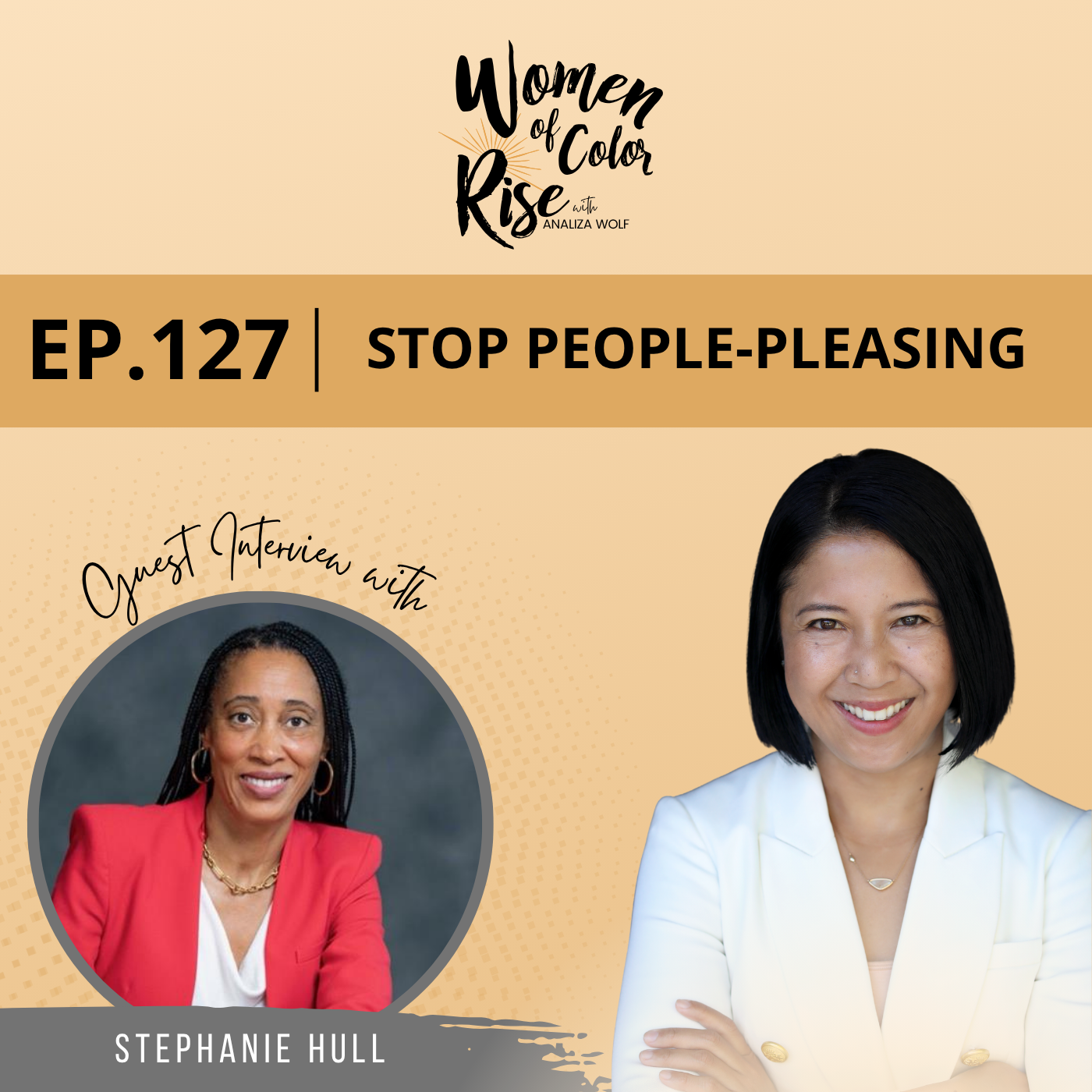
Hi everyone. I am with Stephanie Hull today. Thank you, Stephanie, for joining. Stephanie is the president and CEO of Girls, Inc. It's an organization that inspires all girls to be strong, smart, and bold through direct service and advocacy. Prior to joining Girls Inc. Stephanie was the Executive Vice President and Chief Operating Officer of the Woodrow Wilson National Fellowship Foundation.
She's also been previously head of the Brearley School. It's a private school here in New York City, and she's had various leadership positions at Mount Holyoke and Dartmouth. Stephanie, I'm so excited for this conversation. Thanks for joining.
Stephanie:: Thanks for having me, Analiza. I was looking forward to this all day.
Analiza:: Stephanie, let's start with the question I always ask, which is, how do you identify and how has that shaped your career path?
Stephanie:: I identify as female and black, and I think,for obvious reasons. Those are two things that have been challenging for a lot of people in the past. I, I think for me, what really shaped my career path and my path through the, my path through life generally is more.
It's more that I was a very shy kid. I was, as a young girl, I was really, really very shy. I wasn't, it wasn't that I lacked self-confidence, it was that I just really didn't interact with other people all that easily. And I think that had a lot to do with opportunity. I think that that's one of the things that stands in the way, especially for girls and especially for people.
Of minority status, that it's easy enough to overlook girls and people of color in this world, and if you are, you know, if you're standing back and standing aside, I think that makes it more challenging. So for me, I think it was that there was an expectation that I would underperform, that I, I wouldn't necessarily.
Amount to much so to speak, because people didn't have a chance to know me. I wasn't outgoing. I was, you know, sort of quiet and off to myself. But in terms of life, I had a lot of great opportunities. My parents are both very well employed, very well educated, so those things were not a disadvantage for me.
It was really that, that it took me a while to kind of find my voice and find my space.
Analiza:: Stephanie, you have had big roles, and I know you really care about women and the community of women, so I want to talk about this. This is like a very vulnerable share of being shy. Because often as a CEO, there's a white male, right?
That's what they look like. And then there's a persona that comes behind it. And so can you share with us how you evolve from. I was shy. And are you still shy? How does that still show up like or did you overcome it? Was women part of this? A community? Women? Mm-hmm.
Stephanie:: I am. I wouldn't say that I'm still shy. I think I'm still fundamentally quiet, which is funny given the job that I do. But I also am easily provoked by. Things like injustice. I am. I am easily moved to do something when I feel that there's something that needs to be done that I can do, especially if I think it's something that I'm really uniquely positioned to do.
It's hard for me to stand by and think, well, somebody else will take care of that. So. I am somebody who jumps in when I have something to say. It's not necessarily about me. The thing that I have to say is, I'm not a big self advocate, but I am a huge advocate for other people, and particularly for girls and women.
As it turns out, it wasn't. I wasn't always this way. I don't know how I evolved to be this person, really. I'm sure that it was the communities that I was part of. I'm sure that it was the way I was raised and the people I was around, I not, you know, not un. Important was that I went to Wellesley College and I'm, I think Wellesley has a lot to do with it, with just being sort of a feminist at your core.
You know, believing that women are here to do something and that it is your job to do things that you are capable of doing and, and positioned to do. So that's probably why I found my voice and spoke up and I've evolved to be a person who is out in front and doing things as opposed to waiting and hoping.
Something gets done. One of my least favorite things for people to say is somebody should do something about that. That's something that drives me crazy.
Analiza:: I hear it. I hear it. Stephanie, I want to talk about the passion, not only to do something, especially when you see inequity or injustice, but also that you really have.
Been an advocate for girls and women. And you went to Wellesley, obviously you're the leader of Girls Inc. Also, amazing schools like Burley. Can you talk about that passion? Were you always an advocate for girls and women, or did that come because of some experience? Talk about that.
Stephanie:: I think I've probably, when I look back, and this is one of those things, when you look back on your career, you kind of map the things about you to the thing you are now. So I don't know if it was always true that I thought about girls particularly, or about marginalized people, particularly.
I think what turns out to be true is. Whatever strength I used to advocate for other people, so I was a person who would stand up for somebody who was being bullied. It may turn out that more of those people being bullied were girls or girls of color or people who were being disadvantaged.
Maybe the people around me, maybe more of them were people who were girls and women and people of color. I, I'd like to think I would stand up for anybody. I mean, right now people are talking a lot about boys being disadvantaged and struggling, and I do think a lot about that, but it's clear to me that girls still think a little bit more than we wish they would about what other people think about them.
That is a thing that bothers me, on behalf of girls. I wish they didn't compare their professional preparation and their skills unfavorably when they run into young men. I wish that too many people didn't think that women were fundamentally different from men in a way that makes them less than.
I do think that there are differences between people. I don't know that they all play out along the lines of gender. I think people's experiences make them different. People's skills and personalities make them different, but too often we end up saying. To girls that they can't do things and that they should be okay with that.
and the way that that kind of translates for girls, that does, you can tell, in my life, that's something I feel like I can do something about. I've seen what it is, what a huge difference it makes when you just give girls a different message when you just tell them, actually, no, I, I think you're amazing just like you are.
However you are right now, you can do better. You can also have bad days, you know? But right now, right now is good enough. Right now who you are is good enough, is great actually. And, and that, that does, that's probably something that before I even remembered, it made a difference for me. I think people were supportive of me.
I had great teachers, and I had great adults around me. I had great opportunities. I was allowed to try things that were crazy. When I failed people said, well, that's okay. I think that's such a simple formula on some level. To create that kind of success mindset and to create that kind of abundance in young people.
Analiza:: So beautiful. You're amazing. You can try anything and fail and you're gonna have a supportive community around you. Mm-hmm. Can you talk about this concept of girls, you led with it? Girls think a lot about what other people think. Mm-hmm. And I'm curious, as someone who's studied in it and been in these environments, led in these environments, why do we care so much compared to others in general about what other people think?
Stephanie:: Well, what I understand about it professionally is that there's some biology involved, that there's, it's evolutionary that we depend on each other as people, and some people are wired to be part of society really strongly. And I do think it tends to be true. These are all generalizations and there will be boys like this and there will be girls who are not like this.
But more often than not, girls care about that connection in a way that will result in having them dim their light, if that'll help. Make a stronger connection or not say a thing that they know to be true, if that'll help them make a stronger connection. So it's, it's the biology of wanting to be connected, that that is at the beginning of it.
But then I think society plays on that and says, well, I have a group of children, boys and girls. I need them to be quiet. I can get the girls to be quiet first biologically, so I will do that. I will tell them people won't like you if you're not quiet. That's half the kids quiet. And then I can work on the people that I don't expect to be quiet because we don't tend to expect boys to, to be as concerned.
About fitting in. We expect them, on the other hand, to be less concerned and to be more out there, which is a, you know, again, it's a burden on them. If we could just see people, if we could just see people's strengths, I think it would do a lot for all young people, but especially I think for girls, because that burden of being told you sit down first is deep in our society.
It's deep in our society that the way we control it. Any kind of, you know, outward behavior is to say, maybe that's not ladylike, or, you know, maybe that's gonna make you look too bossy. And those things, those messages are everywhere. They're on social media, they're on all the TV shows.
They're everywhere. And you just drink fed in when you're a young woman, a young girl. And ultimately you have to fight hard to come out and say, well, you know, right now I think I've got something important to say or do, and I don't, I don't really care. Don't care what you think I look like while I'm doing the thing that I believe to be right.
That's really hard to break free from. It takes people a long time in a career to, you know, come out from under that. And so what we're doing at Girls Inc, for example, is making sure that girls have a mentor and have a peer environment that is supportive. Of the chances they want to take there.
It's not that they don't care what other people think it is, that when they know that they are acting in strong character and acting according to the community's values, that's all they're supposed to worry about. They don't have to worry if the thing that they decide to do doesn't turn out exactly the way they wanted it to do.
They do have to worry about being kind, and I think that that's what it is. That's not an unfair ask to say, I think you'll succeed. Think about other people, but don't necessarily think about what they think of you. Just think, am I doing something I think is helpful? Am I doing something I think is kind?
Have I been thoughtful about the impact I'll have on others when I do this thing? That's the conversation to have in your head, not am I pretty, will this threaten somebody else? You know, in terms of their ego. Those are the things that are really hard to balance for young people.
Analiza:: Wow. It is interesting, This is my focus area, is focusing on women and trying to uproot a lot of these myths, Stephanie, and to have you actually talk about biology to say, yeah, there is real disconnect in our body when I don't, when have to let go that Stephanie thinks blank of me. I know this because she told me.
Right. Or I found out about this through a person who said that gossiped.
Analiza:: And to say. I do care about Stephanie and our community, and at the same time, I do believe it's aligned. And so, however you feel about me, I'm not gonna care as much about that right now, even though my body is just fighting it.
Stephanie:: Right. It's visceral. Yes. And I think that's also, it tends to be true that girls are more wired to. That kind of thing when they think they're helping somebody else than when they think they're just helping themselves. Yes. So all of that is happening, that I think that I just said that about myself too.
I will, I will fight much harder for somebody else than I'll fight for myself. That's, that is a thing that can be exploited positively, but it can also be exploited negatively. And when I talk to young girls or young women, often the thing that causes them the most stress is to feel like they're in competition with each other.
To feel like girls will not necessarily get a spot. The spots are not for you. There may be a couple of spots that are available, but you have to fight each other for that spot, you're not just sort of competing against your own best self or competing, you know, against the entire world.
It's as though we say, well, I'm gonna let one or two girls of color be part of this thing. Look around the room, you know, 10 of you aren't coming. So then it's hard for them to fight. It's, you know, it's hard for them to push because they feel like they're being pitted against each other. They're not being pitted against a problem
Analiza:: Really hard.
Can I ask you about that? Because I actually want to, is it true that there's a. There are only a few spots, right Stephanie? If you were me and there's only one spot, that's the reality bit. Mm-hmm. If we're gonna generalize the experience, we're gonna try to win. So I'm just asking as a, as I know you're talking about athletics and, and just like right there, there's that piece.
So one, is it true that there are limited spots and then two, therefore it makes sense to be competitive? Or is there another way to be.
Stephanie:: I actually think it's not true. I'm a person who believes in abundance. I think what is causing the appearance of limitation is that there aren't enough women doing all the different things women could potentially be doing.
If you could look across any profession and see several different kinds of people doing it. You could see yourself represented there. It still means you have to work hard. You may have to go to school, you may have to get certain grades, you may have to practice a thousand hours. All the things that people say, but it, but for example, I fly quite a bit for my job.
It is rare for me to get on a plane and have the pilot's voice be female. It is. That's still, if I were a child, I would say empirically, girls can't fly planes. Because the number of times in all the planes I've been on and I'm, you know, like I've got, I'm in the million miler club. I fly a lot one or two times that I can remember in recent memory, the pilot was a woman, and when I saw her walk on that plane with her four bars on her arm, I felt a little something at my age in this world because a woman had achieved status and was in charge of that entire plane.
Why is that shocking? With all the women in the world.
Flying a plane isn't physically more challenging than driving a car. So why is it that you would, you would be smart as a young person to conclude there are only a few spots for girls who want to fly planes. So that's what I mean. It's not even, it's not a sinister thing, it's just a quiet little message that says you name one time that you got on a plane and the pilot was a woman.
And you can, because if that ever happened to you, you marked it in your head and you put, you know, a big star next to it and said, oh, like that was the time that I flew on the plane with the women. And it's just a plane. It applies with a computer almost always. Right? But that's a thing that apparently we don't get to do.
And so that's what I mean about the scarcity isn't even, it's not even evil. It's just a subtle fact of life. I think you do see certain professions that, you know, when I was a kid, they weren't necessarily gendered. I mean, how many men are nurses compared to before? A lot more men are nurses.
So those, when those things happen, it's just, you can tell anybody anything you want, but you walk around in the world and you don't, you don't see the thing. So I do think. I, the math in your head is like, they're telling me I can be anything. It's not the same as, like to be an Olympic high jumper, you can't be that because you're just not good.
That's not the same thing. But everybody who goes to a public school should have an equal shot up to a point at a whole range of professions that it doesn't seem like we have an equal shot at It. Doesn't really seem like it. that's not kind of sifting out into equity or equality. That's, I guess that's what I'm talking about.
It's not that I think people are sinister and trying to hold people down. I do think though, that if you don't see yourself represented in certain places, it takes a really special person to say, I don't care. I'm gonna be the first woman to, you know, do this thing. I mean that, and people do. Girls do that all the time, but that's a different kid.
That is a bolder kid than a lot of kids. And I, I mean a lot of young people and they're incredibly bold and brave and fabulous. But it takes work to keep them thinking whatever it is you land on, I can, if I tell you how much work it takes and where you have to go and what you have to do, and you're willing to put in that work and do those things, then you'll be there.
And again, it's not, like I want to be. 10 feet taller than I am, or 3% stronger than I am. But some of these things just require a pathway and a focus and diligence. And more of them should be available to people.
Analiza:: I want to, I want to talk about this even for you. It, it is rare to see women of color as
In these big roles, and yet you have had and continue to have these big jobs. And so before we move to lightning round questions, I want to ask, what was the, you know, of, of course, many skills and many mindsets and many unveiling of these myths that really weren't true. What would you say is one thing, one mindset, one skill that has helped you get to where you are today?
Stephanie:: Honestly, I think some of it is, is the luck of being part of a family that had access to education for generations. Having a grandmother who went to college, that gives you an advantage in the world. I am, I'm so far from being first generation, it's not even funny and so I, I've often said to people.
Really, I should be judged for the things I didn't accomplish because the path was laid out for me. The public school I went to was great. The teachers were great. They loved me, I loved them. I used to cry on the last day of school because I loved school so much. So education was amply provided to me. I got into a great college.
I got into a great graduate school program. I could afford to go. I have a PhD in a field that I just wanted to have a PhD in. I don't necessarily use my PhD in specific, vocational ways, but I, that the blessing of education, the A, the access of education, the belief that now that I can read, there's nothing I can't do.
I mean, there'll be things I can't do. That long jumping thing is probably not gonna happen. But those, but those kinds, that's the blessing for me. the access in my mind that I may not be willing to work hard enough to learn to fly a plane, but I feel like I could. I feel like if people would, if they would sit down with me and teach me, I feel like I could do that.
And that, I think, to give to kids that thought in their head that you can decide against things, but things can't decide against you.
That's really important I think for young people. Yes, there's realism, there's, you know, like where you live and all these different things about, you definitely decide that.
But if you're lucky, something you love will align with where you're. Capabilities are, and that's, I think that's what we have to say to them. You know, not everything that's of interest has to be your job. It can be your hobby. Sometimes you won't necessarily be publicly good at a thing, but if you want to sing and you don't sing well, then sing.
Sing all you want. You're probably not getting a job singing, but you can still sing. It's, it's that mindset to say,
Analiza:: Do what you love.
Stephanie:: Don't put so many cant’s on things. Right.
Analiza:: So great. So great. All right. Let's do our lightning round questions. Okay. Here we go. Chocolate or vanilla.
Stephanie:: Mm-hmm. Vanilla.
Analiza:: Cooking or takeout?
Stephanie:: Cooking.
Analiza:: Climb a mountain or jump from a plane.
Stephanie:: Oof. This one's a hard one. Climb a mountain. I don't like heights.
Analiza:: Have you ever worn socks with sandals?
Stephanie:: No. Absolutely not.
Analiza:: How would you rate your karaoke skills on a scale of one to 10? 10 being Mariah Carey.
Stephanie:: I feel like I'm an 11.
Analiza:: What's a good book you've read or a recent book you've read?
Stephanie:: I haven't read it recently, but I love the book, the Wind and the Willows.
Analiza:: What's a favorite way to practice self-care?
Stephanie:: I like gardening.
Analiza:: What advice would you give your younger self?
Stephanie:: I would probably tell her that it would all work out.
Analiza:: And then where can we find you? Like LinkedIn, anywhere else?
Stephanie:: Girls inc.org. And I'm also on LinkedIn, but all of our socials are girls inc.org.
Analiza:: And then last question. Any parting thoughts to share?
Stephanie:: I want to say thank you for the time. It was fun to talk to you. And I think my parting thought would be if you have a young person in your life, really try to take the time, not only to mentor from that person, but to try to learn from them.
Try to ask questions and try to hear, because some of what I think, I know I. I didn't get that from my own experience. I got it by listening and learning from younger people. I think that's the beauty of the career that I've had with young people that I've gotten a chance to absorb and to be given what they know and not just to try to share.
What I think. I know.
Analiza:: So beautiful. Stephanie, thank you so much for this.
Stephanie:: Yeah, thank you. Great to talk to you.
Analiza:: Thank you so much for carving out time to hear today's podcast. 3 things before you go. First, if you found it helpful, please leave a five star review. Second, you can get a free chapter of my book, The Myth of Success: A Woman of Color's Guide to Leadership at analizawolf.com/freechapter. And lastly, if you're interested in executive coaching, please reach out to me at analiza@analizawolf.com. Thank you so very much