Analiza:: Welcome to the Women of Color Rise podcast. I'm Analiza Quiroz Wolf, proud Filipino-American executive leadership coach and former CEO of a nonprofit and Captain in the U.S. Air Force. I'm also the author of The Myth of Success: A Woman of Color's Guide to Leadership. It's based on the lessons learned by many women of color leaders, including those on this podcast. We talk with successful CEOs and C-suite women leaders of color and learn about their leadership journeys. I'm on a mission to support having more diverse leaders at the table. If you're a woman or a woman of color who wants to sit at that table, you're in the right place. Now let's get into today's show.
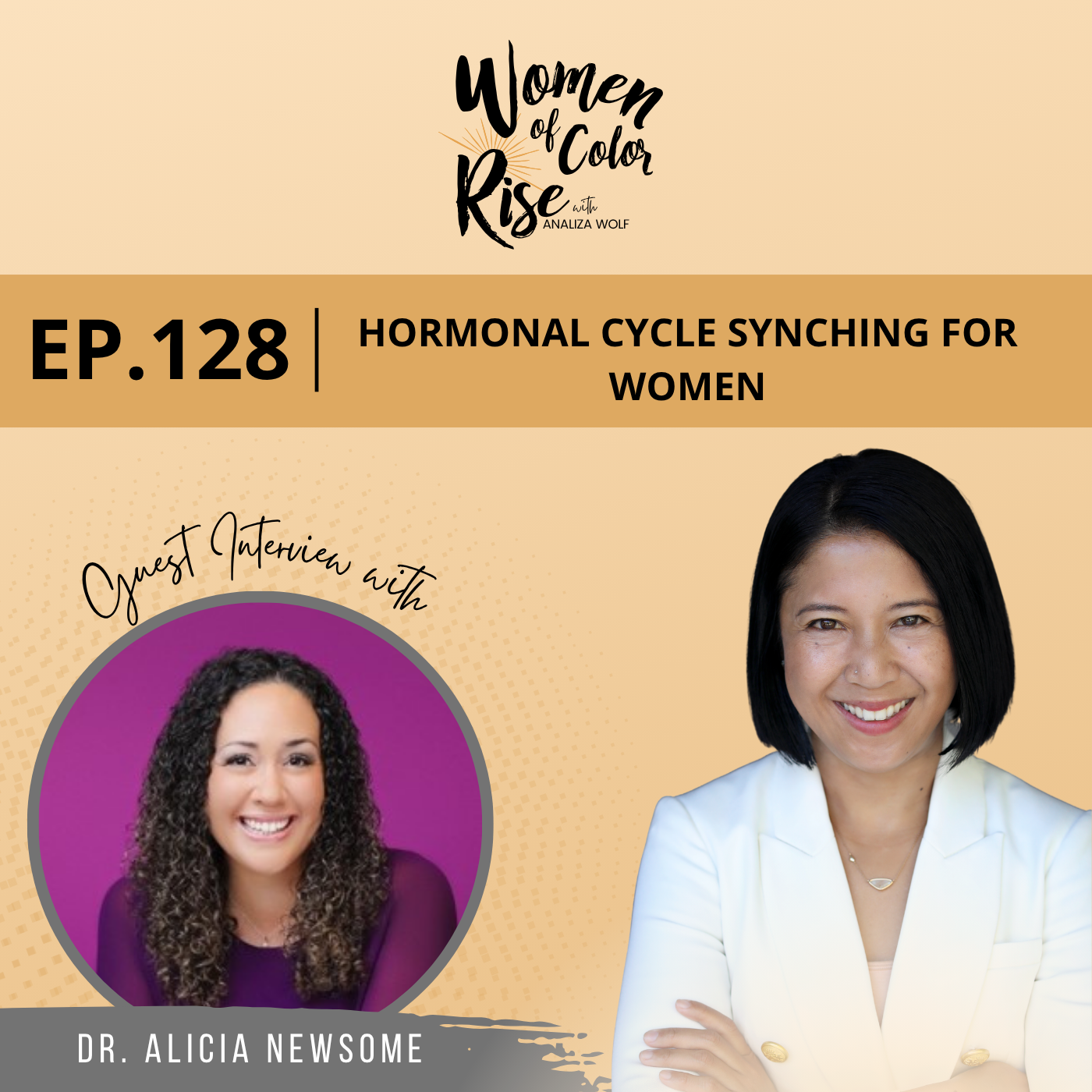
Hi, everyone. Welcome. I am with Alicia Newsome today. She's a doctor, author, speaker, helping women reclaim their lives by helping them understand and work with their body's hormones, digestion and metabolism. Also, Alicia is a presidential Lifetime Achievement awardee. So congratulations, Alicia. Thank you so much for joining. Thank you for having me here today. So Alicia, we always start with this question, which is, how do you identify and how has that shaped your career path?
Alicia::So I identify as my father's black, foundational black American, and then my mother is Hispanic, so that makes me a little mix,
Analiza::Yes, and how has that shaped you?
Alicia::For me, it shaped a big part of who I am. You know, growing up in the early 80s, I grew up at a time where, just, you know, a decade or so before interracial marriage was something that was illegal, you know, and even though my mom's Hispanic, you know, there weren't a lot of, like, mixed kids running around. You know, there weren't a lot of curly hair products sitting on the shelves. And for me, I grew up in a community where there were still like other children around me that were mixed primarily black community, but in seventh grade, I went to a school that was a county over and it was the second richest county in the United States, and the county I grew up in was the fifth poorest. And I feel like that shaped me just that one year of my life really impacted me, because I was so different during that time, the people that I went to school with did not look like me. I was picked on for, you know, my hair and, you know, my father being black and, like all these different things, and for a long time in my life, I carried that with me, you know, and always felt like I didn't fit, I didn't belong. When I went back to eighth grade and went to school around the kids that I grew up with, you know, I felt more accepted and for me, and I guess, the question I don't normally get asked, like, what do I identify as? And I don't normally, even, you know, say that, like I identify this way.
But I think I've always more so than the Hispanic side identified as a black woman to, I guess, more clearly answer your question, I'm not as much in touch with the Hispanic side of my family. And my mother always raised me in a way that was she told me, you know, you're a black woman, you know, my father's black. My father was in the household doing all of those things. I don't speak Spanish. I can't make tamales, you know, like all of those different types of things. But I think one thing that I carried with me for a long time is a feeling of not belonging, you know, and like I go into spaces where a lot of times people don't look like me.
So I think that shaped my future, and it shaped how I became someone that likes to over perform. And I think we do that a lot as women of color, where we live in this world, where we're minorities, and we tend to over achieve, you know, and we may have these kind of internal things that we carry with us, that we may feel like we're not enough, we don't belong, you know, all of those different types of things. So, Alisa, you became a doctor, yeah, focusing on hormones, digestion and metabolism. And so I want to take this beautiful thank you so much for my vulnerability. Story of how you know your identity and how that shaped you, and talk about that connection. I mean, from looking at the woman of color and how we tend to believe what we tend to believe about ourselves. How did you get to Okay, hormones? Yeah.
So it really started with my own journey of dealing with hormonal imbalances and not really finding answers, taking the traditional route, all of those different types of things. And I used to struggle with really bad, heavy, painful periods, and it was completely normalized. You know, even growing up in high school, it was like my mom gave me a book on PMS. You know, being moody, being tired, having cramps, tender breasts, was always something that was very normalized. And I used to have really sporadic periods. They'd come every 28 days, every 35 days, 32 days. And that kind of, to me, just felt normal.
But it wasn't until I hit this point where my exhaustion really started to take over, and it was after I had had my first two babies. They were both still in diapers, and I was going through a divorce, leaving a very volatile marriage, and I was exhausted all the time. I was in private practice. I was working, I was seeing patients all day, and then I go, you know, pick my kids up from daycare, and then feed them, get them in bed so mama could go to bed. And at that point in time, I ended up meeting a functional medicine doctor that really helped me understand what was going on with my body in a deeper way than what I had been doing. I was always a little natural, you know, like, I like a good detox, some supplements, all of those. But he did some advanced lab testing that really helped me understand what was going on with my adrenals and my stress hormones, and helped me resolve those issues.
And then later, I went and did deeper work to understand what was going on with my periods and all of those different types of things. So when I launched this practice that I have now, and you're, you know, in business, and all those things are like, what's your niche? Who do you want to help? And I wanted to help other women that were like me. And I picked hormones because that's where my expertise was, and I've had years of experience on the pharmaceutical side, and fibroids, endometriosis, women's health, cancer, all of those types of things. So it really made sense for me to go in that direction. But when I launched this practice, I did it through webinars. And then women would, you know, buy a consultation from me. And one question I would always ask them is, you know what prompted you to schedule this call with me? And women would say, Well, I wanted to work with a black doctor. I wanted someone that could really understand what I'm going through. And while that's always been deeply rooted in me to want to help people and women who look like me, who have had similar experiences as me, it really helped me see that in functional medicine, specifically, it is a type of medicine. It's a type of care that is highly marketed to white, middle class and upper class women. Women of Color are completely removed from the conversation, from continuing ed, from all of these things where it's just not a thing to serve our population of people.
Analiza:: Alicia, thank you for that. It's so beautiful to see how, through your pain, you have found purpose in helping people who like me, people who don't tend to see ourselves reflected. And I know that you did on Good Morning Arizona on cycle syncing for women. Yeah, it was about, you know, how do you think about your habits to support during different hormone phases? So I just love to hear more about that, because, yeah, don't hear that perspective cycle sinking. Can you share more?
Alicia::Yes, that was so exciting when I was on TV and talking about this topic, because it's something a lot of times we don't learn about growing up. Is our menstrual cycle. So to begin our menstrual cycle begins the day of first red blood, like bright red blood, okay, so not pink spotting, not brown, anything like that. Okay. And if it's brown, there might be some type of luteal phase defect, something going on with your cycle that we need to look at. So day one is red blood, and then you go through multiple phases.
A lot of times we think of our menstrual cycle as just the time that we're bleeding, but it's really the menstrual phase is the time that we're bleeding, and then we move into what's called a follicular phase, and that's where our body's getting ready and it's to produce the egg that will come during the next phase, ovulation, and then after that, we have what's called the luteal phase. So I'll go through each one and give some tips on what we can do, because we have all these different hormones that are going through our body and changing during those times that we can really lean into and use to our advantage, especially when things are in balance and doing what they need to do.
So during our menstrual cycle, that's the time when we're bleeding, all of our hormones are pretty low. Okay, it's a good time to rest. It's a good time to just honor what's happening. I like to really look at it like a release. Like, what do I need to release in my life? Those types of things.
When you move into your follicular phase, that is when estrogen starts to go up, and then also the right and left side of your brain, they are more connected during this time. So it's a great time for executive function. It's a great time for speaking engagements. It's a great time for getting projects done. The higher estrogen goes up, and then testosterone goes up. That's when you're getting really close to ovulation. And when you think about it in nature, you know, that's the time where your body's producing an egg, and you know, it's waiting, like it's waiting on sperm to come and fertilize it, right? So naturally, like our skin starts to glow, we feel more outgoing, you know, like, think about a mate, you know, mating and things like that. We're more we're, we feel a little sexier, right? We're, we're wanting to get out. So it's a good time to be social, do things with your friends, and plan things around that time.
And then you move into your last phase after you ovulate. Then you move into your luteal phase. And I like to break the luteal phase into two phases, really, because it's about 14 days. It's the longest one of the phases. It's the time from ovulation until the day before that bleed again, and that's when everything starts all over again. So right after ovulation, you're feeling a lot of the high from those good hormones, you know, so it's still a good time to be active and social and all of those things.
And then once you move into that last week, and this is where PMS, you know, gets normalized, like being moody and irritable and eating a lot and tired and all of those things, that's the way I used to be, like, exhausted. Actually, I used to really be so tired and depressed during this time of my cycle that I wouldn't like, really want to go inward and, you know, I didn't like myself, I didn't like my kids, I didn't like my work, my husband, anything. I would not feel like myself at all. I'd go into a very deep depression during that, that last week before my period came, and then my period came in, and I feel like my brain turned back on. But that wasn't normal, okay? What is normal is that progesterone is high, if, if things are working right, I was having a progesterone issue.
But if progesterone is nice and high, progesterone is like your body's natural volume. It's anti anxiety, it's calming, it's relaxing. So you will feel a little more relaxed during that time of the month. It's not the time that you may feel social. Progesterone causes you to go a little more inward, and it's a good time for reflection. And if you are experiencing any of that irritability or anything premenstrual, then it is a good time to look at your life and really examine, you know, the next things that you may or may not want to take into the following month, the next, you know, the next season. And use that as a tool, because it does, you know, without having that estrogen, which is neuroprotective, it does make us a little more susceptible to the things that do irritate us. We see that. And it's, I look at it as more of a gift of okay, is this something that I want to continue to say yes to in my life?
So our body really ebbs and flows throughout the month. And it's, you know, there's different exercises if you want me to do that and, yeah, okay, thank you. So that I was really more going through with, you know, social life and work and things like that. Now, when it comes to exercise, exercise with the going back to the bleed. You may, may or may not, some women feel like, you know, I want to go exercise, but it's good to take those first couple days, first two, three days of your cycle easy, and then once you're moving into that follicular phase and testosterone is rising, all of all of that is happening, it's good to do that's when you can do like your high intensity exercise. That's when you can do more weight lifting, all of those different types of things, especially once you get over into ovulation time. Okay, like weightlifting, all of that is good when you move into your luteal phase, that's where you want to do things that are more relaxing. So yoga, walking, pilates,all of those different types of things, swimming, that are less stressful on the body. So here's where stress comes into this entire picture because stress when you're stressed out physiologically. And that stress could come from exercise that's too intense. It could come from an argument that you had with a partner. It could come from work deadlines that are piling up. It could also come from toxins in your body. It could come from nutrient deficiencies, lack of sleep, gut issues, all of those are stressful on the body.
And what happens when your body's stress is that it produces a hormone called cortisol. It produces adrenaline, all of that, and cortisol is created to be there short term, and think about it as if there was a bear coming after you, and a bear is coming after you, you're either going to fight or flight. You know, you're going to fight it to get rid of it, or you're just going to run away and get back to safety. After that, your body goes into what's called parasympathetic activity, where it's Rest Digest. This is where your hormones are built. Okay? The reason why this is important is because when you think about a bear running after you, the last thing that your body would think is a good thing to do right now is make a baby, right? It's not going to do that. And I know some of the women listening may want to make babies.
Some may say, I don't want any, and some maybe I'm done with that phase of my life. But regardless you need you still need those hormones, and what your body will do is it will prioritize safety that stress hormone cortisol over progesterone. And progesterone is that main hormone in your luteal phase. So that's where all the PMS and different things will start popping up because you don't have enough progesterone. Also, if you're doing high intensity exercises during that time, things that are very stressful on the body, it can impact that hormone as well, too. So that's why we want to do exercises. We really want to be able to go with the flow of like where our hormones are in the month and what they're doing. So before that luteal phase, you don't, and you may even feel that when you go to the gym, like you're just like, but last week, I was like, in here lifting, and I was running, and I was feeling really good, and then now you're like, I don't even feel like it. That's really the design, you know, it's really for you to go for a gentle walk, do some yoga, do something that is more in line with where you are in this phase of your cycle. I love this so much.
Analiza:: Alicia, I'm wondering, for a person who is going all the time, and I know that you have the Presidential Lifetime Achievement Award, so what an amazing accolade. Congratulations. Thank you. You know, how does one get to Okay? See, I hear the wisdom from Alicia, and I know this incredible word, but how do you allow yourself to rest? Because there is a jump there that makes you bet on some progesterone. Are these things that you buy like you're just like, look, it's hard. Tick pill, no consultation with you. Not what I'm saying. Ladies, do not go get some progesterone. We want your body to produce its own. Yeah. I mean, just talk. Talk about that. Because I do want to do these things, but it's not the way that I normally operate. How might I get help? They should, of course, do a consultation with you, just and of course, I'm not a doctor. This is a doctor here with Dr Alicia. But how might you put this into practice, even with this wisdom, you know, and the information that you get even from a consultation, how does one practice?
Alicia::It's interesting. You brought up rest because I have a book coming out called worthy of rest. And you know, a lot of times they say when we write books, we write them for ourselves. So it's been a lived experience for me, especially as a woman of color who never gave myself permission to rest and never felt like even others were giving me permission to rest. So it's worthy of rest for the woman who's tired of being the strong one. And we live in a culture that worships exhaustion. You know, we get that pat on the back.
You know, even when you bring up a Lifetime Achievement Award, it's an honor to have received that also, you know, it's an accolade, right? It's, I actually got an award for continuing to give and give and give of my time and myself, right? And we live in this, this world that's just the way it is, like, the more we give, the more we do, the more we go, we get rewarded for that, right? We show up. We're tired. We're juggling so many different things, and sometimes you'll even get pointed out at a meeting like but look, she had all this going on, and she still met the deadline, and she still showed up, and she still helped and did all of those things. But in that conversation, a lot of times, what I have had to learn is that I can't leave myself out in helping others.
When I say yes to things, there are dozens of other things that I'm saying no to, and I can't be one of those. Sometimes there's things that, you know, we've got to handle, but we have to include ourselves in the conversations. For me, a lot of times, you know, I'm asked to do something in the past, and it's, it's like, an automatic Yes, like, okay, yes, can you do this? You know, you see that I'm doing a good job at work, and they're, you know, people are quick to say, well, Alicia, can handle that. Can you, can you do this too? Yes, okay, I can do that. And not pausing long enough to really say, Can I do that? Do I have the capacity to do that? Is this something that I should really own? You know, this even shows up in friendships and relationships, you know, sometimes where, you know, people may call for advice, family may call for money. You know, different things like that. And we also have to allow adults to be adults like some people I know, for me and other women of color a lot of times, especially when you know, we've quote, unquote, made it out right, and we're the ones that may have gone to school or built businesses or done different things.
There's people around us that look up to us. There's family members, siblings that may not be in the same position as us, and they want our help, right? And we want to help, right? We love them. They're our family, but sometimes we enable them by providing help, and also sometimes we're just still just pouring from this cup that's very empty as well. So it's just very important to put things in perspective. And one of the things that I really recommend is that we pause, if it's just for a moment, to. Check in with ourselves before we say yes to things.And I recommend when women first begin doing this to give themselves 24 hours, like when someone says, Can you do this project? Can you volunteer next Sunday? Say, let me check my calendar. I'll get back to you tomorrow, even if like you, you want to say Yes, right? Or it might be a no, give yourself that space to be able to really look at, you know, do you have the capacity to do that? Do you have the mental energy to get it done? You know? Do you have the physical energy to do these things, like, where is your capacity in in what will you have to give up if you say yes, and then as you get more accustomed to listening and checking in about how you really feel about something, you know you'll eventually learn like in that moment, you can say yes, but you can give yourself like the a window no one has the right to our calendars and our time, and to just say, Okay, I'll get back to you tomorrow on that. Yeah, I love that, because it's actually interrupting a natural tendency of ours to say, of course, Alicia, yes, whatever you need. And pause and say, Hold on, yeah. Let me give it even a moment.
Analiza:: I love this so much. Alicia, are you ready for lightning round questions?
Alicia:: Yeah, let's do it
Analiza:: Chocolate or vanilla.
Alicia:: Ooh, chocolate with almonds.
Analiza:: Cooking or takeout?
Alicia:: Cooking.
Analiza::Climb a mountain or jump from a plane?
Alicia::Oh, climb a mountain.
Analiza::Have you ever worn socks with sandals?
Alicia:: No.
Analiza:: How would you rate your karaoke skills, scale one to 10,
Alicia::Like a four.
Analiza::What's a good book you've read recently?
Alicia::Ooh, a good book that I've read recently? Well, I'm like, knee deep in my own book worthy of my breast but I recently revisited atomic habits, which is one of my favorite books.
Analiza::What's your favorite way to practice self care?
Alicia::Oh, it' s such a good question self care is, and I'm down like I don't want to go down my rabbit hole.Self Care is anything that really allows you to turn your mind off and, you know, give yourself permission to do nothing. One of my favorite things to do is color, and it really just allows me to, like, completely relax and unwind.
Analiza::What's a good professional development you have done?
Alicia:: So many years ago, and it's very different now, but I've done a lot of work through landmarks worldwide.
Analiza::What's your definition of a Boss Mama?
Alicia:: Oh, a boss mama.Well, a boss mama, she's got some kids, or she's got a life that is that she's handling, and she's including herself in that, you know, so she's she's actually having a say in what she's saying yes to and what she's saying no to, while building a life that she absolutely loves.
Analiza::What advice would you give your younger self?
Alicia::You are enough.
Analiza::And where can we find you? LinkedIn, your website. Would love to hear about all those.
Alicia::Yes. So you can find me.You can Google me. Dr Alicia Newsom, my website will come up. It's Dr Alicia Newsome. My LinkedIn, Instagram, YouTube, everything is my name, dr, Alicia Newsome.
Analiza::And then last question, could you share a parting recommendation with us?
Alicia:: Well, I think that as women of color, I want to remind everyone that's listening that, you know, where we may not always fit in different spaces. You know, we may not feel like we belong, that God has given you a purpose and a plan. Everyone is uniquely designed, you know. And Comparison is the thief of joy, you know. So a lot of times in this world, where there's so much, so much happening in different rooms, and people are saying, get in the room or social media, there's all the glitz and glam when we compare ourselves to that, we really take away from who we are and who we were created to be. So when we stay in our lane, there's no traffic, and we're really able to walk out our purpose.
Analiza::Beautiful. Alicia, thank you so much. I love this. Yeah, thank you. Thank you for having me here today.
Thank you so much for carving out time to hear today's podcast. 3 things before you go. First, if you found it helpful, please leave a five star review. Second, you can get a free chapter of my book, The Myth of Success: A Woman of Color's Guide to Leadership at analizawolf.com/freechapter. And lastly, if you're interested in executive coaching, please reach out to me at analiza@analizawolf.com. Thank you so very much