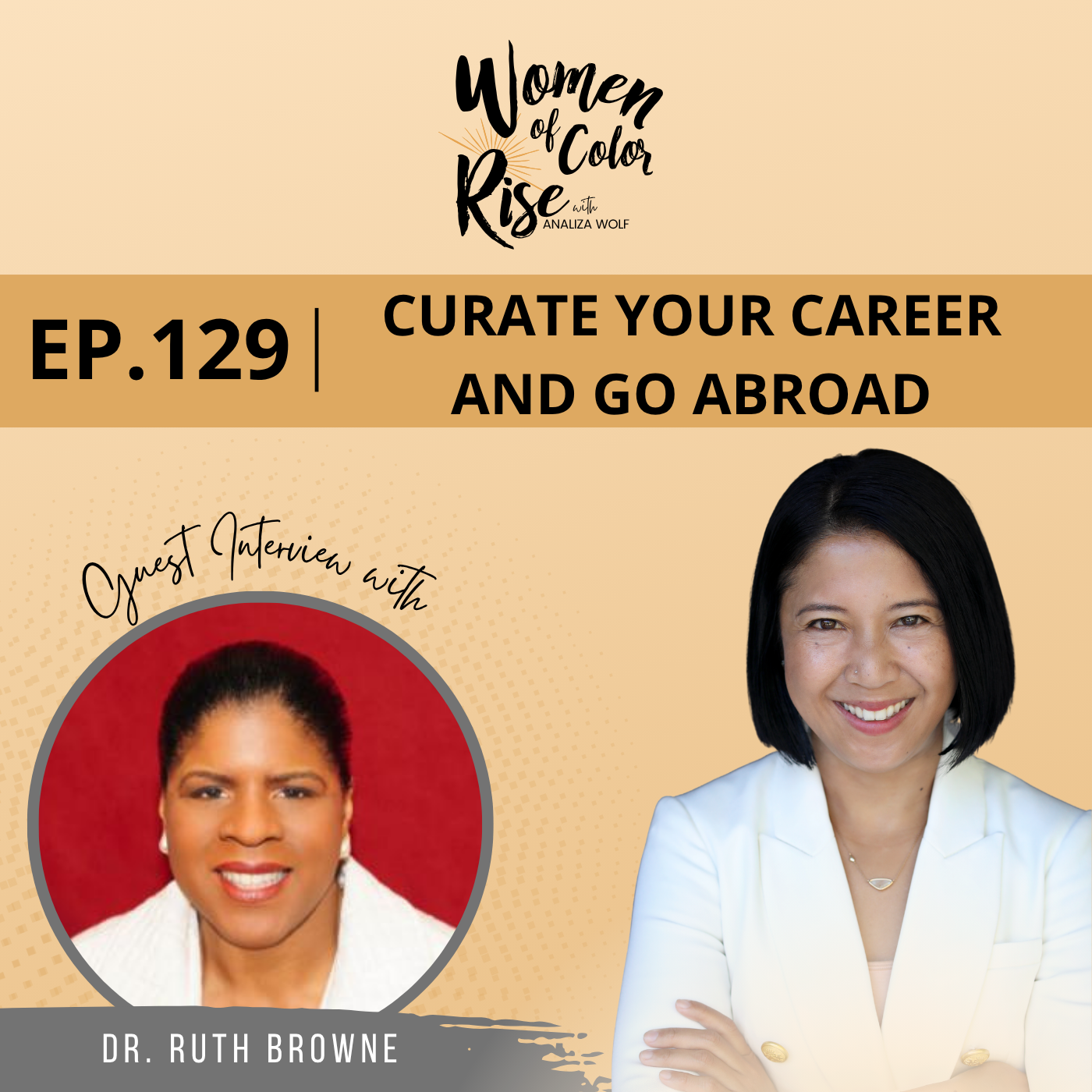
Analiza:: Welcome to the Women of Color Rise podcast. I'm Analiza Quiroz Wolf, proud Filipino-American executive leadership coach and former CEO of a nonprofit and Captain in the U.S. Air Force. I'm also the author of The Myth of Success: A Woman of Color's Guide to Leadership. It's based on the lessons learned by many women of color leaders, including those on this podcast. We talk with successful CEOs and C-suite women leaders of color and learn about their leadership journeys. I'm on a mission to support having more diverse leaders at the table. If you're a woman or a woman of color who wants to sit at that table, you're in the right place. Now let's get into today's show.
Hi, everyone. I am overjoyed to be with Dr. Ruth Brown today. Dr. Ruth Brand is the immediate past president and CEO of Ronald McDonald House, New York. She is also on many boards and has a lot of board experience. Her background is actually from Princeton University of Michigan, Harvard. She's also a three-time Fulbright scholar and has been recognized by Mastercard Harvard for innovative leadership. Ruth, thank you so much for being here.
Ruth:: Thank you for inviting me, Annalisa. I'm really happy to be here.
Analiza:: So, Ruth, I want to start with this question, which is, how do you identify, and how has that shaped your career?
Ruth:: Absolutely, I identify as an African American woman with Caribbean roots. I grew up in this country, the United States of America. I'm a New Yorker through and through, although I was born in Cincinnati, Ohio. And the reason I identify that way is because I truly believe that the shared experiences of people who come from that identity have shaped my career, and you know, and I'll and I'll tell you a little bit about how. So one of the things that I'm really, I'm really stressing these days is the notion of how you bring your authentic self to your leadership, and I bring my authentic self because I have no problem sharing the experiences of people who identify like I do, and I truly believe that because of the shared experiences, which include joy as well as struggle, that we have a lot to share about who's at the table and who's not at the table, and when we're included, and when we're not included, and why that makes a difference. And so my career has been shaped by the pursuit of equity in everything that I do, and whether it's been educational pursuits or whether it's been in terms of my professional career where I'm paid, or my work that I do-that is civic and community and social sector work-where I'm not paid, and and those voices are important in shaping solutions on either side.
Analiza:: Ruth, it is very powerful to hear how you have been driven by authentic leadership and has been a source of strength. And I'm curious because, as CEO and with your many, you know, your experience having led at these senior positions, how like what are experiences that you think, if I were to, if you're getting to know a staff or you're getting to know your board, like when you think about your identity, you know, is there a story that comes to mind that helps to have people understand your background and know your your experience? So, what would you do? Could you share a story with us? Like, what was it like for you growing up, or any of those types of stories you'd want to share with others?
Ruth:: Well, sure. I mean, I think I was shaped early by folks who were very active in terms of community support, institution building, as well as community development, and that really inspired me to choose the area, the pathway that I wanted to choose. But one of the things that happened to me very early was the opportunity to go abroad, and that really was a life changing experience for me because when you only see your own neighborhood, you only see your own environment, and you don't get to experience at least viewing, right? Even if you're not a participant observer, but at least viewing how other people live in other contexts, you just have a narrow view of the world. And what I got to do was go abroad to the Caribbean, where I actually have roots and studied as an undergraduate, as a foreign study student, where the issues of the day were very palpable for the students who were my peers. So they were being taught by the people who were shaping the government. Policy who were leaving the classroom and then going to the Senate, or you know, they were actively involved in the solution building in their own communities and were studying all of the you know political science scholars that I had you know read about, but actively putting that into practice, and so that was very influential in how I sort of began to curate my own career. And I think the other thing that was important was I was always one of very few in an academic environment, and when I say one of very few, I mean one of very few people of color, one of very few black students, one of very few. And so, when I went to University West Indies for two semesters, two separate times, I was immediately struck by the diversity in the faculty and the diversity in the student body, but I was not one of very few. Even as an African American, I was not one of very few, and so that was very important because it was a different experience for me in the academic environment, and I loved it. Yeah. So that notion of who is included, who's there, who's present, who shapes solutions-all of that was shaped early by both the influences of parents and grandparents who are active in civil rights Struggles and and and community building, but also in that experience early on at 18 to get to go to university the West Indies.
Analiza:: It's it's interesting, Ruth, that your parents, your ancestors, grandparents, and then as well as your peers, your students at both your undergrad and the West Indies, all of those help to make this idea that it matters who's at the table, it matters who's represented, like it it shapes that right, and it's it's it's beautiful. And I know Ruth that you continue to prioritize having new perspectives, especially going abroad, you're a three-time Fulbright scholar, and I'd love for you to share about those experiences. Where did you go? What inspired you to go there? Because it continues to be something you live today.
Ruth:: Okay, I will take you through each three, each of the three quickly. My first experience as a Fulbrighter was in 2007, and I got to go to Jerusalem. I went to teach a course in community health empowerment at Hadassah on the Hadassah campus at Hebrew University, and what was interesting about it was that I was teaching international public health students. So those students were from all over the world. In fact, I think there might have been one or two actually native Israeli students in the class. It was such a diverse mix of people and perspectives from the student perspective, and then also getting to know just the many interests of the faculty there. But that was really a great experience. Now, I can tell you that I can always say I'm glad that I had the experience to go to Jerusalem in retrospect, but the time that I was there was very very intense, and I had never felt that kind of intensity in any place I'd been the way I felt it in Jerusalem. So that was the first experience. The second experience, and and I gotta tell you, these kids were leaps, and I won't even say kids. These students were leaps and bounds ahead of the graduate students that I was teaching, not in terms of talent, but in terms of their worldview and experience. And so it brought together a really interesting and wonderful diversity of thought. The second experience I had was really amazing. It was a new program in the Fulbright program called the Fulbright Nexus Regional Scholars. It was initiated in the Obama administration, and it was 20 students, I believe. It's 26 scholars. These were not students. These were professionals who were working in many sectors, all united around climate change, and working on individual projects in the Western Hemisphere. So each scholar went to a different country, and then we also worked on a project together. And then we also had a project that we worked on in groups. It was wonderful because it taught you. First of all, that was way before COVID in 2011, and really showed how you could collaborate without being in the same room. And then, secondly, it was my project was really working with students at University of the West Indies who were coming from high school and who were going to be based on the campus for six weeks in the summer, and they were going to work assigned to not not for profit or non governmental organizations, where they were working on climate change projects. Really, really interesting opportunity. Again, the opportunity to do international collaboration, the opportunity to look beyond your regular environment, and cross-cultural learning was really influential in how my career was built out and curated.And then the last opportunity was this recent opportunity I had this year. I retired from 10 years as the CEO of Ronald McDonald House New York, wonderful organization, great mission, one of the largest international child-serving organizations in the world. I retired from that organization and went straight into a short-term Fulbright professional for professionals within the Fulbright program. And my project was I was based at Nelson Mandela Children's Hospital and its university, developing recommendations for a pediatric referral pipeline for Nelson Mandela Children's Hospital is a highly specialized hospital in Johannesburg, serving the region. And what I was looking at is what happens. Why are there kids at the community level who never get that specialized care who need
Analiza:: Why are there kids at the community level who never get that specialized care who need
And then what happens to kids who do get it who return to the community? It's like they're lost to follow-up. And so the idea was: what kinds of recommendations could you make to begin to plug that leak?
Ruth:: It was-it was great in terms of collaboration with the faculty at Vits, the incredible number of international agencies working in South Africa who provided advice, and also just the opportunity to visit even other hospitals that were feeders for Nelson Mandela Children's Hospitals. One of the biggest hospitals in the world, probably third largest in the world, is a hospital called Bara. I can't say the full name, but it's probably third to hospitals in China and India in terms of size.
Analiza:: Yeah.
Ruth:: And they're also a feeder for Nelson Mandela Children's Hospital. So this notion of you know a collection of experiences has really influenced how. The other thing I would say, Analiza, is when you hear me talk about those kinds of experiences, most of which I did while working, right? And my jobs were not weighty, right? You don't have a lot of time, but for me, it's always been important to carve out opportunities where I get to grow, not just do. The other thing I am incredibly committed to, and I would advise anybody to be the same, is I never want to be out of the workforce. I always have to be doing something that helps me curate my career, and those things don't have to be paid. They can be scholarships, they can be collaborations, projects, charitable work, sitting on boards, etc. But even when I was in school, I was involved in things that allowed me to collect those experiences that influenced how I curated my career.
Analiza:: Okay, Ruth, your diversity of experiences started very young, even as a student.
Ruth:: I get bored easily.
Analiza:: Well, it's when I listen to you, the idea that we curate a career often it's network. Often it's you know build a skill, get a degree, cross train, right? But you're actually busting that. Now I see it's a bit of a box to say, look, there's so much more. I mean, the fact that you were working and doing these projects. I remember when I first met you. And you told me that, and I said, "You're, you've got big jobs. How did you do it? And you said, "Well, now I'm realizing it's actually a very strategic move to done not as okay. I'm going to volunteer on the side, but actually as part of your growth, and it sounds like success to be where you've been, so I'd love to talk about this idea of curation because you said you made a list, and I was like, "Those are you're dropping a lot of gems here, charitable work, paid scholarship, Fulbrights, like how? Yeah, like that's it's it's it's expansive. So I'd love it if you don't mind, Ruth, to just drop down a little bit more in detail. You know, here's how I think about it. Here's when I thought about it in my career. It doesn't have to be so deliberate and strategic, but you've modeled it for us here. So anyway, but it is.
Ruth:: First of all,thank you for the question. It is deliberate and strategic.
Analiza:: Okay. Okay.
Ruth:: And I say that because I have always wanted to be well credentialed, but the credentialing has a purpose. I don't want to be left out, and so I'm going to put myself at the table. And if a credential is going to get me there, I'm going to get the credential. And so, but I'm not chasing titles. I'm chasing impact. And in order to have impact, you have to have broad knowledge, a broad base of support. You have to be broadly influential, and you also have to have people who you can reach out to externally from whatever circumstance you're in, who will give you objective and often hard advice. I'm a solution builder. I'm a community builder. I'm an institution builder. I know how hard it is to build infrastructure, but I'm not chasing infrastructure. I'm chasing impact. And so these kinds of experiences are where the real learning occurs. That you don't necessarily get from your project that you do in your graduate class, right? You don't necessarily get from what you do on the job, right? You have to bring things to your experience that are going to go beyond what is the status quo? At least that's what I've always wanted to do, and so this notion of curation is very much intentional, because I'm not chasing a title.
I'm not. I never wanted to be a CEO. That was never a goal. But what I will say, to be quite you know frank and candid, is that I also don't want to be told what to do. So, so, so it's very important to be self-aware, right? And and and don't get me wrong. There are people who are excellent number twos to a CEO and number threes and fours and fives, right? And they want to be in those roles, and they're exceptionally good at execution, and they are probably the most valued people in an organization. A good leader is someone who creates opportunities for them to excel.
Analiza:: Nice. That's so great.
Ruth:: Yep. I'm very clear. I don't want to be told what to do. Oh, I have to be the number
Analiza:: Yes. That's so good. It's so good to have that knowledge. You're paying me, yes, right.
Ruth:: Yes, and in and I've always worked in the social sector, so you know, number one is sort of you know a little delusional because every not good not for profit CEO reports to a board.
Analiza:: That's right.
Ruth:: Your job as a CEO is not to not take direction, but not to be told what to do. It's to advise, partner with.
Analiza:: Yes.
Ruth:: With a really good board.
Analiza:: Yes, that's right.
Ruth:: Right, because what we're jointly chasing is impact.
Analiza:: Yes, exactly, exactly. That's the whole point, Ruth. I want to ask you because you've shown your share often. I ask about power moves and mindsets and leadership practices. I'm hearing from you about career curation of career that it's not just you're not trying to chase a title. We're chasing impact that includes both those development experiences, especially the ones that help you look outside, right? Not just ourselves, but even outside borders, to your network, to feedback, yes, and those that self awareness of knowing who you are, and that I've got to be number one, and I will help others develop into knowing who they are, so that they can be in their own position. Allows all of us to thrive for impact. So I love all of that. Is there anything, Ruth, you would say that you would add to that or double down on in terms of you know you've risen to these top positions and you're going to continue? I imagine there is anything that I haven't shared here or you want to double down on that you want to add to you know has really helped me, you know, get to the CEO title, even though that wasn't what you were aspiring to do. Anything else you would add?
Ruth::
I think what you know I started off with authenticity, right? And that has to be intentional too.
Analiza:: Yes, right.
Ruth:: Yes, but you know you learn from the power of, and in my case, so much of what I do has to be in authentic partnerships. You know what you do alone is never going to amount to what you could be doing with others.
Analiza:: Right.
Ruth:: And so I learn from the power of authentic partnerships. I listen first. Right. I try to find common ground and build trust through action.
Analiza:: Right, trust is not some elusive concept.
Ruth:: Right, most meaningful accomplishments come from collective leadership.
Analiza:: Yeah.
Ruth:: You can be a number one, you could be a great leader, but if you don't have a collective, you're accomplishing much less than what you could be doing together, so I think that's really important in terms of just having a power mindset.
Analiza:: It's beautiful. I love that. It is to be yourself and to be yourself with others and to have real relationships through showing the right to to collectively drive impact action. I see a lot of themes here, Ruth. I see a lot of themes here. You're not a talker. You're like, let's make it happen. Let's talk strategically, but let's move to action.
Ruth:: So you know, one of the things I'm glad you said that I'm not a talker. I really like to move things to action because I don't. I don't want my time. I don't have a lot of time.
Analiza:: Yes.
Ruth:: Right. Whether it's because I'm so busy doing all these things, or because life is so challenging, or because there's so much to do, so I don't want my time wasted.
Analiza:: Yep.
Ruth:: And so action is where you get to impact. Yeah. Right. Yeah. And one of the things you know, I had the privilege of leading an incredibly Palpable not for profit. When you work with sick kids and they're stressed out parents, it's very palpable. You know, I know that my pursuit has always been social justice, and in social justice, you could wait 10 years to see a very incremental impact. You could wait. You could wait decades to see incremental impact, but you keep pushing, right? Sometimes people who are in education, you know, have very palpable milestones because they see the impact, or the influence, or the progress of their students in this role I had at Ronald McDonald House. What was palpable to me was how much my day made a difference in the lives of these kids and their families. Very palpable, right? But it's very heavy, very heavy because you know the majority of kids make it, but some don't,right? And so I, like I said, I don't want my time wasted, and what I learned and what I have truly believed is that compassion-you know-people are very compassionate and sympathetic about the plight of these young people and their families, but that's not enough. Compassion is an action, and that's why, under my leadership at Miles McDonald House. I was very committed to going beyond providing a hospitality model for these kids, where you're providing accommodation and food, et cetera, and really looking at what are those social determinants of health that are impacting their lives, and what's going to make a difference in how we provide services to them. That's going to help them on their health and healing journey, regardless of the outcome, right? And so, compassion to me is an action.
Analiza:: I love that.
Ruth:: Right? It's not about oh my gosh, these four kids. You know, I feel so sorry for them. It's not that. What can we do? What action are we going to take to make this journey better, regardless of the outcome? And not only that, it's these kids we see who are providing accommodation for. What about those who still have cancer and other serious childhood illnesses that they don't even get to? What can we do as an organization that is going to provide even more impact than the 95 rooms we can offer to people who need a home away from home while their child's getting treatment? Right. So that's what I mean about chasing impact. It is so much more than what's in front of you. It's thinking about what's ahead and how you're going to make sure you're structured in a way that you can do even more.
Analiza:: Fantastic, Ruth. We are now at lightning crown round questions. Are you ready?
Ruth:: Oh boy! Yeah.
Analiza:: Chocolate or vanilla?
Ruth:: Vanilla.
Analiza:: Cooking or takeout?
Ruth:: Takeout.
Analiza:: Climb a mountain or jump from a plane?
Ruth:: Climb a mountain.
Analiza:: Have you ever worn socks with sandals?
Ruth:: Only in my house.
Analiza:: How would you rate your karaoke skills on a scale of 1 to 10, 10 being Mariah Carey?
Ruth:: One.
Analiza::
What's a good book you've read or a recent book you've read?
Ruth:: I actually have not read a book in a long time. I have had some very serious eye challenges, so I've had books read to me. Okay. And the most recent book I had read to me was a heavy book. It was cast. Yeah. It took a long time for me to finish that book, and so having chapters read, and so over time I have, you know, listened to chapters of the cast. It's really an incredibly moving book.
Analiza:: What's your favorite way to practice self care?
Ruth:: Ah, my favorite question in the world. So I love to dance. If I don't care if I'm in the mirror, if it's dark, if anyone's watching or not, I am always with a smile on my face when I'm dancing. I can dance with people, without people, and I am always trying to find a dance class if I have time. And my goal in life is to learn how to moonwalk.
Analiza:: Oh.
Ruth:: And I'm really bad at it, but I'm going to master it. I love it.
Analiza:: I love it, Ruth. What advice would you give your younger self?
Ruth:: Wow, you know, I would definitely give my younger self the permission to be as authentic all the time, as you can be. I don't think that I am. It's never really been a goal to fit in, but you're taught that you need to if you want to get to places in your career and make an impact. But quite frankly, I would say that one of your best leadership currencies is your authenticity, and I think I would give myself even more permission to be even more authentic.
Analiza:: Yeah,so good.
Ruth:: We're not taught as women of color, as people of color, to bring our authentic selves to work. That's for sure. But I truly believe that my gifts, and I have a lot to give, is my authenticity.
Analiza:: Beautiful. And then, where can we find you, Ruth? Like LinkedIn? Anywhere else?
Ruth:: Yeah, you can find me on LinkedIn. I recently-I am really retired. I have started a consulting practice. I don't plan to do a lot, but I do plan to do some impactful consulting work. My I can be found at my email address, which is ruthbrownscd@gmail.com.
Analiza:: And last question: Do you have a final ask or any parting thoughts to share?
Ruth:: I do. I think that you know one of the things that we don't really talk about is denial. You know, we are always having to perform in a certain way as people of color, women of color, in the environments we are often one of very few in, and sometimes even we deny that it's a barrier, right? And I think that one of the things we need to do is to really take stock of the fact that the barriers are real, that the racism and discrimination is real, that the sexism is real, that those are interconnected, and that we are not imagining it, right? Because one. Once you give yourself permission to say, "Yeah, this is real, you don't necessarily always have the skills and the tools and the resources to act on it. But if you deny that it exists and question what you sense intuitively from the shared experiences where we started, you are doing yourself and everybody else who has those shared experiences a disservice. Yeah, we we when I was at Arthur Ashe Institute for Urban Health as the CEO before I came to Ronald McDonald House, I had the privilege of developing programs for young people interested in health careers, and they came from high schools to a public institution, SUNY Downstate Medical Center, where it had four health professional schools, and we provided them with that access. These were kids of color, mostly from high schools, local Brooklyn high schools, and one of the things that we were committed to was helping them navigate all of those things. We didn't start off by saying you just buckle down and study and keep pushing and whatever. That is denial, and not helpful. We said here are some of the things you might experience. This is what it looks like. Don't doubt that it exists, and here's how you navigate it: tools, resources, reality checks, right? Which to me are how you make people successful by not living in denial, but living in the reality of it exists. This is how you navigate.
Analiza:: Yeah, and that you're not alone.
Ruth:: And you're not alone.
Analiza:: So powerful! I wish that I had heard that when I was in my early years. But I'm so glad, Ruth. Grateful to you for sharing your many, many, many gems of experiences, and also being available to for us to yeah to see this is it's possible to to be authentic and also be impactful and also be yeah feel a sense of like we're we're not alone and we're in this together. So so much gratitude to you, Ruth. Thank you so very much.
Ruth:: Oh, you're very welcome, and thank you for this podcast that you're doing, I'm sure it will help lots of people.
Analiza:: Thank you so much for carving out time to hear today's podcast. 3 things before you go. First, if you found it helpful, please leave a five star review. Second, you can get a free chapter of my book, The Myth of Success: A Woman of Color's Guide to Leadership at analizawolf.com/freechapter. And lastly, if you're interested in executive coaching, please reach out to me at analiza@analizawolf.com. Thank you so very much